Ma Rainey's Black Bottom (2020)

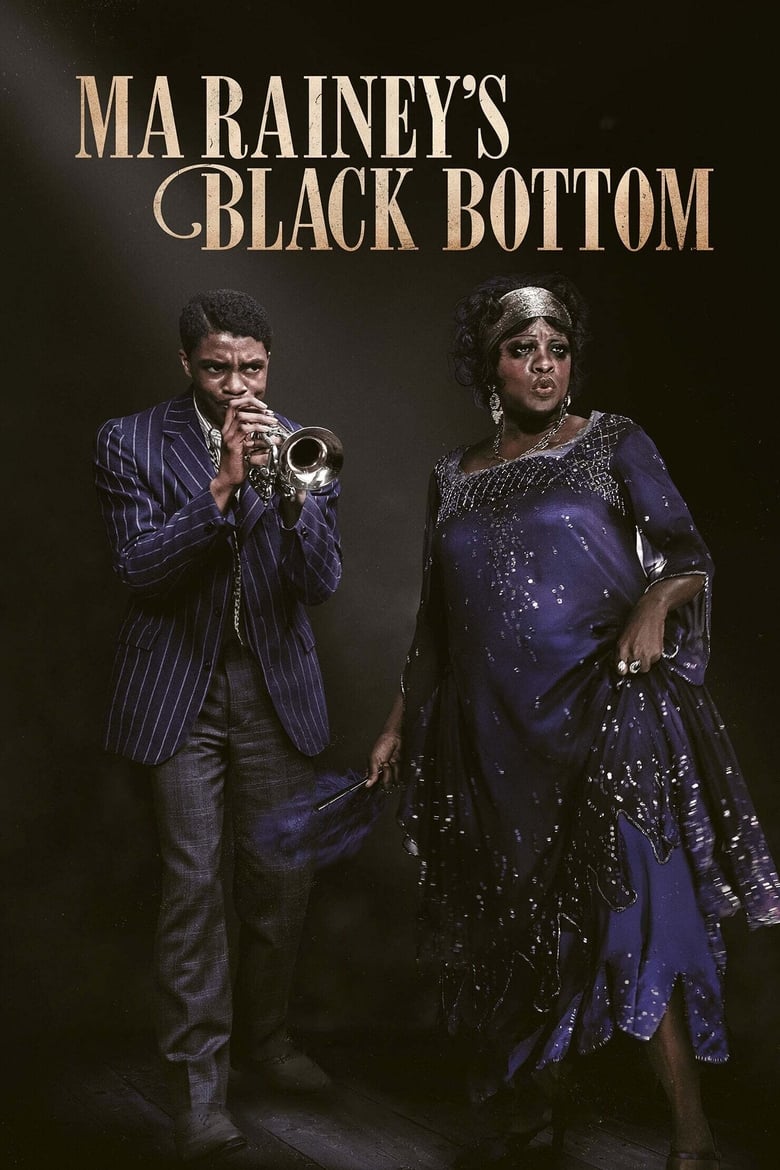
August Wilson wrote Ma Rainey's Black Bottom for the stage in 1982, and it became one of the defining works of his celebrated Pittsburgh Cycle, a series of ten plays charting the experience of Black Americans across the twentieth century. This particular entry, though, is set not in Pittsburgh but in Chicago, in 1927, when the recording industry was still finding its feet and blues music was being packaged and sold to white-owned labels by artists who had precious little say in the commercial machinery around them. The real Gertrude "Ma" Rainey was a foundational figure in American music history, one of the first women to record the blues professionally, and the tension between her artistic authority and the cold indifference of the men who profited from her is very much the engine of the piece. It arrived on Netflix in late 2020, produced through Escape Artists and Mundy Lane Entertainment, at a moment when the film industry was searching for ways to release prestige work during a year of closed cinemas. The conditions were unusual, but the material was not: this was serious, award-season drama adapted from serious theatrical source material.
The adaptation was handled by Ruben Santiago-Hudson, himself a celebrated stage actor and playwright with deep roots in Wilson's world, having won a Tony Award for his performance in Wilson's Seven Guitars back in 1996. That connection to the material matters. George C. Wolfe directed, bringing with him a career built almost entirely in theatre, including years leading the Public Theater in New York, and that theatrical sensibility sits at the heart of every creative decision here. Wolfe works with a cast that reads like a masterclass roll-call: Viola Davis as Ma Rainey herself, Chadwick Boseman as the ambitious and volatile trumpeter Levee, and Colman Domingo, Glynn Turman and Michael Potts as the other band members. Boseman, of course, had already become a cultural touchstone by this point, not least through his work in Black Panther (2018), but his performance here, shot in what turned out to be the final year of his life, is a different register entirely: rawer, more urgent, more exposed. It received a posthumous Academy Award nomination for Best Actor.
Cinematographer Tobias A. Schliessler shoots the film in close, warm, sometimes suffocating frames. The palette is all amber and shadow, the kind of visual texture that suggests heat trapped in a room with no windows, and there is something studied about the way the camera moves between faces rather than spaces, keeping you inside the pressure rather than allowing the eye to escape. The recording studio and the rehearsal room below it become almost theatrical sets in themselves, deliberately confined. Composer Branford Marsalis, the jazz saxophonist and bandleader, provides a score that does something genuinely interesting: rather than underlining the drama with conventional orchestration, it breathes around the edges of the action, keeping the blues idiom present without tipping into pastiche. Editor Andrew Mondshein, who has a long history of working on prestige American drama, faces the particular challenge of finding cinematic rhythm in material that is built to resist it, favouring slow accumulation over cuts. I also reviewed Candyman (2021), another film wrestling with the history of race in America, and if that comparison interests you, see also my thoughts on Black Panther, which approached similar cultural territory from a very different angle.
The acting is the whole reason to see Ma Rainey's Black Bottom, and it is more than reason enough.
This is a film you can tell was adapted from a play almost from the first scene: very talky, very confined, built around long stretches of dialogue rather than incident. It unfolds mostly in and around a cramped recording studio, where a Black band waits, rehearses and argues while the heat and the tensions slowly rise, talking about music, money, faith and the daily indignities of their lives.
The performances are what hold you. Colman Domingo is the standout for me, but Viola Davis is tremendous as Ma Rainey herself, and Chadwick Boseman is electric, coiled and charismatic and simmering with fury. There is something in the way it traps a group of people in one room and lets the pressure build through talk alone that put me, oddly, in mind of 12 Angry Men. A different world and a different subject entirely, but that same sense of a single space heating up until something has to give.
It is not flawless. The pacing is strange, lurching between long, becalmed passages and sudden bursts of intensity, and it does occasionally feel more like filmed theatre than cinema. But it builds to a finale that lands hard, a gut-punch I will not spoil, and the sheer quality of the playing carries you past the rougher patches. Three and a half stars, a stagey but gripping piece anchored by some of the finest acting you will see from a cast this strong.
Ma Rainey's Black Bottom is, in the end, a film that wears its theatrical origins openly and without apology. Whether that is a virtue or a limitation rather depends on what you bring to it. What is not in question is the quality of the company assembled to make it, or the weight of the history it is drawing on. Wilson's play has been performed around the world for four decades now, and there is a reason it endures: it locates something in the specific, particular experience of Black musicians in the Jim Crow era that still resonates far beyond its historical setting. Wolfe's film version may not fully solve the problem of translating that stage energy onto the screen, but it preserves something essential. The blues, as the tagline has it, would leave an empty world behind it, and this film, for all its unevenness, feels that weight. It asks you to sit in the room and listen. Most of the time, that is quite enough.
Rating: ★★★½ | Year: 2020 | Watched: 2026-10-03
Trailer
▶ Watch the official trailer for Ma Rainey's Black Bottom (2020) on YouTube
Where to watch
Watch in the UK
Stream: Netflix · Netflix Standard with Ads
Physical: Amazon UK · Zavvi
Watch in the US
Stream: Netflix · Netflix Standard with Ads
Physical: Amazon US
Affiliate disclosure: Movies With Macca may earn a small commission on purchases or subscriptions started via these links. It costs you nothing extra.