Cavalcade (1933)

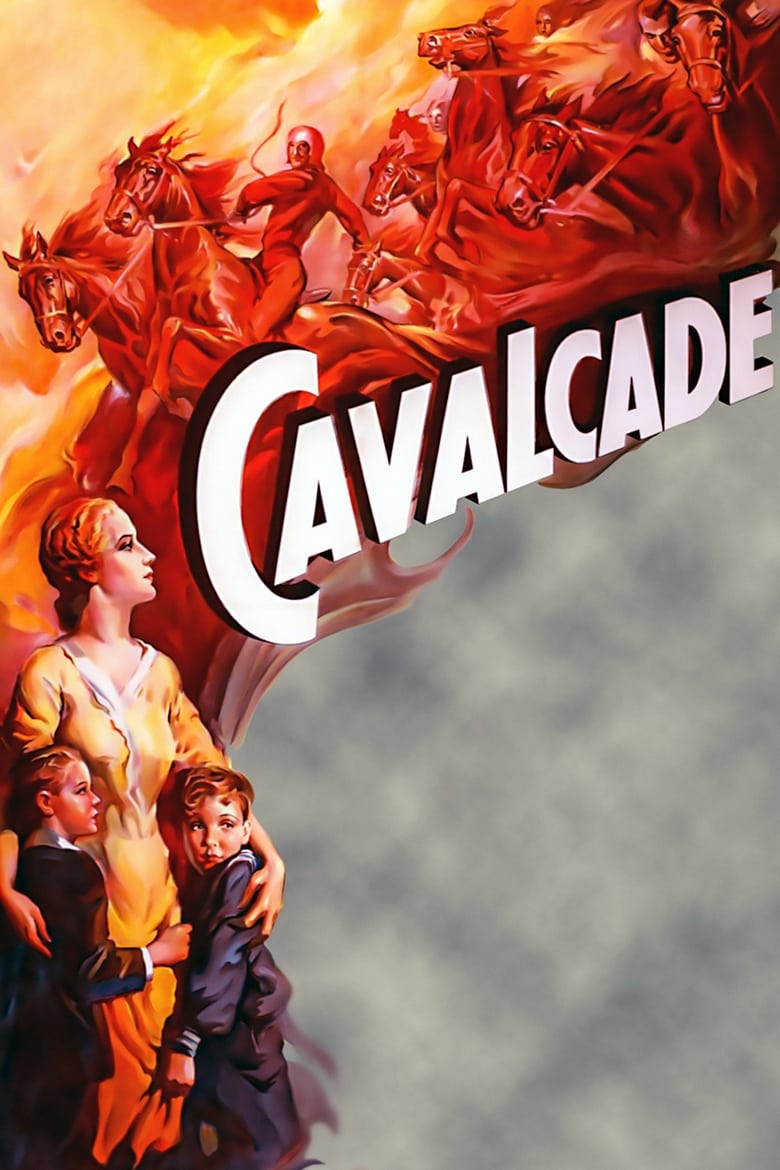
There is a particular kind of prestige film that arrives laden with cultural expectation, sweeps the major awards, and then spends the following decades quietly puzzling anyone who actually sits down to watch it. Cavalcade, released by Fox Film Corporation in 1933 and winner of the Academy Award for Best Picture at that year's ceremony, is perhaps the most striking example of that phenomenon in the Oscar's entire history. Based on Noël Coward's enormously popular 1931 stage production, which ran at the Theatre Royal, Drury Lane to enormous public and critical acclaim, the film traces the life of a prosperous London family, the Marryots, across more than three decades of British history. Boer War. Queen Victoria's death. The Titanic. The trenches of the Great War. It is, by any measure, a serious-minded and ambitious piece of work, and its ambition was rewarded handsomely at the time.
Frank Lloyd, the Canadian-born director who had already won a Best Director Oscar for The Divine Lady in 1929, was chosen to translate Coward's sprawling pageant from stage to screen, with the screenplay adapted by Reginald Berkeley working from Coward's original text. Lloyd was a reliable Hollywood craftsman of the period, polished but unremarkable, more likely to deliver a competent and well-organised production than to impose a strong visual personality on the material. That reputation for steady professionalism perhaps made him an obvious choice for something this grand in scope. The supporting cast around leads Diana Wynyard and Clive Brook includes Una O'Connor, Herbert Mundin and Beryl Mercer, all of them bringing strong stage backgrounds to what was still, in 1933, a relatively young sound era. Wynyard, playing Jane Marryot across the full thirty-odd-year span of the story, received an Academy Award nomination for her performance, which gives you a sense of how the film was received at the time, even if that reception looks considerably more complicated from this distance. For a companion piece from the same year, King Kong offers a rather vivid illustration of just how wide the tonal range of 1933 Hollywood actually was.
Cinematographer Ernest Palmer, who had a long and busy career at Fox throughout the early sound period, shoots the film with the kind of broad, well-lit compositions that suited a production of this scale. The big crowd sequences, reconstructions of public grief and national celebration, are handled with genuine logistical ambition, and there are moments where the sheer number of bodies on screen gives the film a weight that its quieter scenes sometimes lack. The score, credited to Arthur Lange and J.S. Zamecnik, draws heavily on period songs and patriotic material, leaning into the nostalgic register that Coward's original play wore so openly on its sleeve. Margaret Clancey edited the film, and the cutting in the larger set pieces has a processional quality that suits the subject, though whether that stateliness serves the drama or simply slows it down is precisely the sort of question that critics have been arguing about ever since. I also covered Man of Aran, made just a year later, which offers an interesting contrast in how early thirties filmmakers approached the question of scale and human drama. And for those interested in how the war film evolved from this period onward, my thoughts on Paths of Glory might make for useful reading alongside this one.
There is nothing exactly wrong with Cavalcade. The problem is simpler, and harder to forgive, than that: it is crushingly boring. Which is a shame, because the premise is wonderful.
It follows one well-to-do London family across more than three decades, from the eve of the twentieth century onward, using them as a lens on the great events of the age: the Boer War, the death of Queen Victoria, the sinking of the Titanic, the Great War. On paper, that sweep of history should be enormously involving.
In practice, it left me cold. It is slow, oddly inert for a film covering such momentous ground, and the acting rarely rises above the stiff and stagey. Great things happen on screen and somehow none of them land with any weight, as though the film is marching dutifully through a historical checklist rather than making you feel any of it. It is also long, far too long for what it actually delivers, which only makes the slowness harder to sit with.
It has also nudged me towards a growing suspicion: these earliest Best Picture winners do not seem to be all that good. I had much the same trouble with Wings, the very first of them, another handsomely mounted and historically significant film that I found a slog to actually sit through. Important, clearly. Enjoyable, not so much. Two stars for Cavalcade, a grand idea and a prestigious trophy wrapped around a film I found a chore from fairly early on.
Cavalcade sits in a strange position in film history: genuinely significant as a cultural document of how Britain chose to remember itself at a particular moment of anxiety and nostalgia, and far less easy to defend as a piece of living cinema. The film's Oscar win has, over the decades, become something of a shorthand in conversations about the Academy's habit of rewarding size and sentiment over vitality. Whether that judgement is entirely fair, or whether the film rewards more patience than most modern viewers are likely to offer it, is a question worth sitting with. What is not in much doubt is that Cavalcade takes one of the richest possible canvases and marches across it at a very determined, very stately pace. Some films age like wine. Some age like the bunting from a street party, still technically there, faded almost beyond recognition.
Rating: ★★ | Year: 1933 | Watched: 2026-10-09
Trailer
▶ Watch the official trailer for Cavalcade (1933) on YouTube
Where to watch
Watch in the UK
Rent: Amazon Video
Physical: Amazon UK · Zavvi
Watch in the US
Rent: Amazon Video · Apple TV Store · Google Play Movies · YouTube
Buy: Amazon Video · Apple TV Store · Google Play Movies · YouTube
Physical: Amazon US
Affiliate disclosure: Movies With Macca may earn a small commission on purchases or subscriptions started via these links. It costs you nothing extra.