Broken Blossoms (1919)

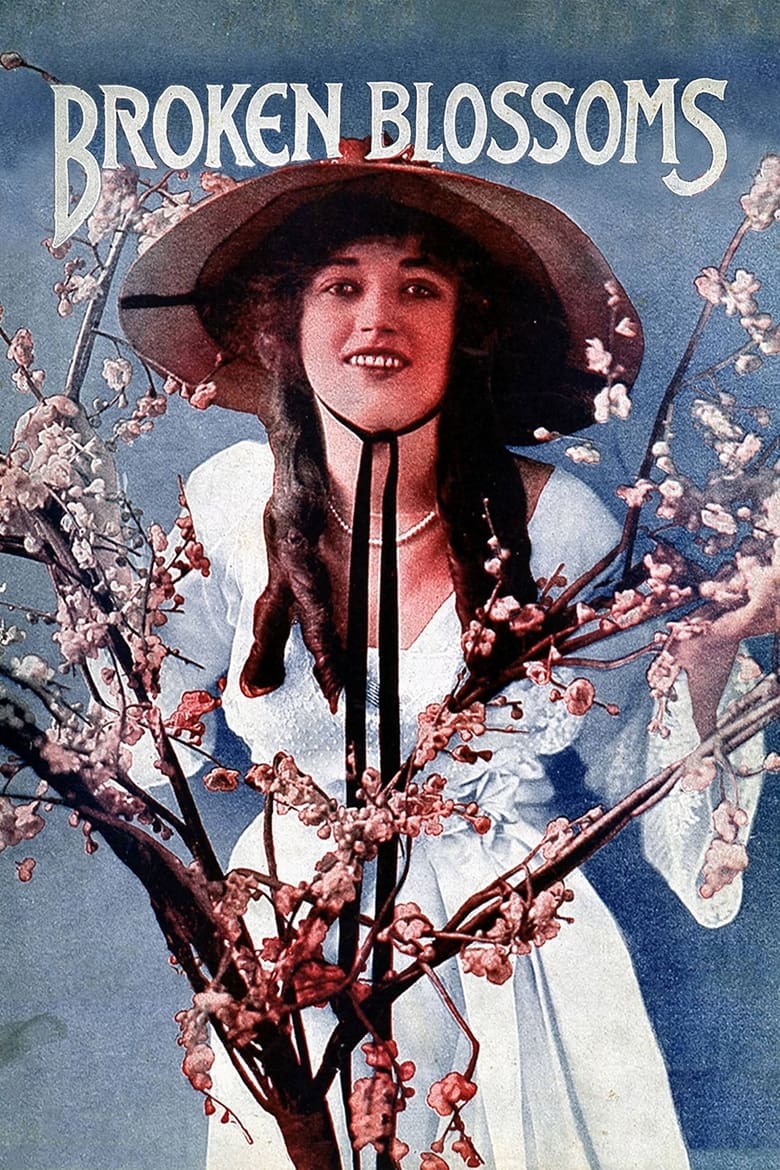
D.W. Griffith made Broken Blossoms in 1919, the same year he co-founded United Artists alongside Charles Chaplin, Mary Pickford, and Douglas Fairbanks. It arrived at a peculiar moment: Griffith was both at the height of his cultural influence and already beginning to feel the first tremors of a reputation that would prove increasingly complicated. The film is set in the Limehouse district of East London, a neighbourhood that loomed large in the popular imagination of the era as a place of fog, vice, and what the period called the "Yellow Peril." A young woman, brutalised by her prizefighter father, finds a measure of kindness from a young Chinese immigrant, and the story unfolds from there in ways the period called tragic romance. Griffith drew on Thomas Burke's 1916 short story collection Limehouse Nights for the source material, adapting and scripting it himself, and produced the film through his own company, D.W. Griffith Productions. The budget was relatively modest compared to his more spectacular productions, and the film was shot almost entirely on constructed studio sets, giving Limehouse a hermetically sealed, theatrical quality rather than anything resembling documentary realism.
The three central performances sit at the core of everything the film attempts. Lillian Gish, already the defining face of Griffith's cinema by this point, plays the young woman at the centre of the story. Gish had an extraordinary physical sensitivity as a performer, an ability to convey fragility and inner life through the most economical of gestures, and her work here is frequently cited as among her finest. Richard Barthelmess takes the role of the Chinese immigrant, and Donald Crisp plays the brutal father with the kind of broad, theatrical menace the era encouraged. Arthur Howard and Edward Peil Sr. appear in supporting roles. The casting of Barthelmess, a white American actor, in the lead Chinese role is the most immediately visible of the film's substantial problems, and it is not something that can be filed away as an incidental period detail.
Cinematographer Billy Bitzer had been Griffith's primary collaborator for years by the time Broken Blossoms was shot, and the visual language they developed together is very much on display. Bitzer used soft-focus techniques and selective lighting to create a gauzy, almost painterly look for many of the interior scenes, particularly those in the immigrant's small room. The images have a deliberate quality of sentiment built into their texture, pools of warm lamplight against murky shadow, faces emerging from darkness in a way that is clearly meant to carry emotional weight. The editing, handled by James Smith, keeps the film moving at a relatively spare pace, leaning into the melodramatic rhythms of the material rather than working against them. The score, as with many silent film presentations, varies depending on the version seen, and no single composer's work can be definitively attached to the film as a whole. For a point of comparison with the era's visual ambitions, see also Dante's Inferno (1911), which gives a sense of how far early cinema had developed in the years leading up to Griffith's work here. I also reviewed City Lights (1931), which offers a useful contrast in how silent-era filmmaking could handle a story of class, suffering, and unexpected tenderness with rather more grace, and my thoughts on Letter from an Unknown Woman (1948) touch on a film equally interested in doomed, lopsided romantic feeling, though from a very different angle.
I am sorry, but Broken Blossoms is simply a bad film, reverence or no reverence.
It is a silent picture, and a badly dated one, its melodrama pitched so high and so broad that it is hard to take seriously today. Even setting aside everything else, it would be a creaky, difficult sit. But it is everything else that sinks it entirely.
The film is, to put it plainly, racist. Its Chinese lead is played by a white actor in heavy makeup, a piece of yellowface stereotyping that was questionable even in 1919 and is indefensible now, and the whole conception of the character trades in tired Orientalist cliché. And then there is the central relationship, between a grown man and an abused young girl, which the film frames as tender romance and which sits deeply, deeply wrong. Neither of these is a small quibble you can wave away as a product of its time; they are baked into the very heart of the thing.
I understand the reverence D.W. Griffith commands as a pioneer of the medium, and I am not out to relitigate the whole of film history here. But reverence should not be a free pass, and taken on its own terms, as a film to actually sit and watch, this one does almost nothing for me and a fair amount that actively repels me. One and a half stars. I get why it is studied, but for my money this is one that deserves to be left in the bin.
Broken Blossoms occupies an awkward position in any honest account of cinema history: a film that is studied because of who made it and when, but that asks its audience to look past a great deal that is not simply dated but actively harmful in its conception. Griffith's technical achievements are real, and his influence on the grammar of filmmaking is not in dispute. But influence is not the same as quality, and a pioneering technique deployed in the service of yellowface casting and a romanticised portrait of a child's abuse is not redeemed by the craft surrounding it. Some films reward the effort of historical contextualisation; this one, on close inspection, rather confirms the suspicion that context only gets you so far.
Rating: ★½ | Year: 1919 | Watched: 2026-10-24
Trailer
▶ Watch the official trailer for Broken Blossoms (1919) on YouTube
Where to watch
Watch in the UK
Physical: Amazon UK · Zavvi
Watch in the US
Stream: fuboTV · MGM+ Amazon Channel · Philo · MGM Plus Roku Premium Channel
Rent: Amazon Video · FlixFling
Buy: Amazon Video · FlixFling
Physical: Amazon US
Affiliate disclosure: Movies With Macca may earn a small commission on purchases or subscriptions started via these links. It costs you nothing extra.