Top Hat (1935)

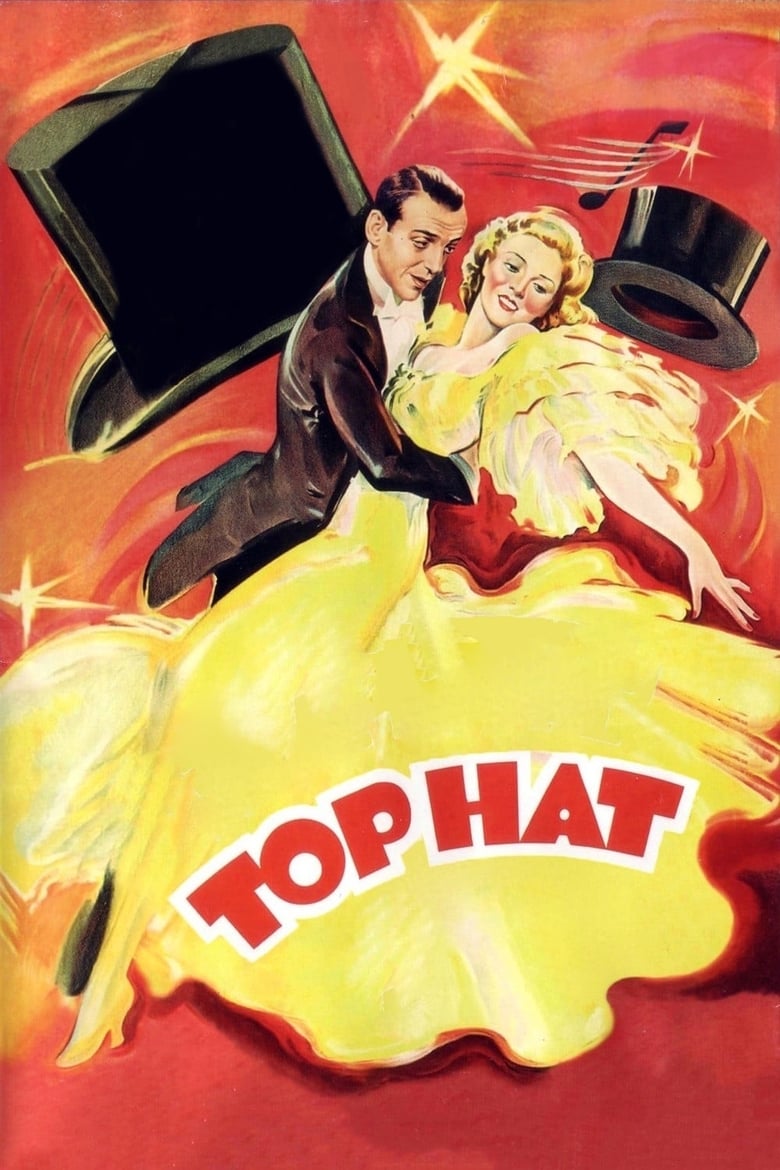
By 1935, Fred Astaire and Ginger Rogers were already a phenomenon. Their partnership had clicked into place two years earlier with Flying Down to Rio (1933), and by the time RKO Radio Pictures put them in front of the cameras for Top Hat, the studio knew exactly what it had. This was the fourth of their ten collaborations together, and the most commercially successful of all of them, breaking box office records on both sides of the Atlantic and earning four Academy Award nominations, including Best Picture. For a film built on the lightest of premises, that is a remarkable footprint.
The script, by Allan Scott and Dwight Taylor, draws on Taylor's own stage play The Gay Divorcee (not to be confused with the 1934 Astaire-Rogers film of a similar name, which Scott had also worked on). The setup is classic farce: American showman Jerry Travers, working in London for producer Horace Hardwick, disturbs the sleep of the woman in the room below by practising his tap routines in the small hours. What follows is a tangle of mistaken identity, romantic pursuit, and the kind of comedy of errors that the genre would go on to repeat, in various forms, for decades. Mark Sandrich directed, and Top Hat was the third of five Astaire-Rogers pictures he would helm for RKO. He had a natural instinct for pacing light material and, crucially, for letting the dance numbers breathe rather than cutting around them. The supporting cast is well chosen: Edward Everett Horton, one of the great comic character actors of the period, plays Hardwick with his trademark flustered-gentleman routine, while Erik Rhodes and Eric Blore round out the ensemble with the kind of broad, good-natured mugging that suits the material perfectly.
The look of the film is the work of cinematographer David Abel, whose lighting of the big musical sequences gives everything a polished, slightly unreal sheen, all white sets and gleaming floors, as if the film is set not quite in London or Venice but in some idealised, Art Deco version of both. That quality is very deliberate. The production design leans into artifice rather than away from it, and Abel's photography plays along, keeping the frame clean and luminous. The score and songs are by Irving Berlin, who wrote the whole thing, including "Cheek to Cheek", "Top Hat, White Tie and Tails", and "Isn't This a Lovely Day". Berlin had already been one of the dominant forces in American popular music for two decades by this point, and his work here is polished but never mechanical, each number shaped to the specific emotional beat of the scene it sits in. Editor William Hamilton's handling of the dance sequences is worth noting: the cutting is restrained, designed to show the full bodies of the performers rather than to impose rhythm artificially, which is the right call and one that lets you actually see what Astaire and Rogers are doing.
For a companion piece from the same period, see also Modern Times, Chaplin's own contribution to mid-thirties popular cinema, and I also covered City Lights, which shows how differently the era could play comedy and romance when the mood took it. Both sit in interesting contrast to the particular flavour of escapism Top Hat is selling.
Only recently I sat down to Bringing Up Baby and called it, tentatively, one of the first major romantic comedies. Then I watched Top Hat, which predates it by three years, and found myself revising the thought: perhaps this is the one that got there first. Whatever the truth of that, it is unmistakably an early blueprint for the whole genre, the daft misunderstandings, the sparring that softens into swooning, all of it present and correct.
The setup is pure, featherlight farce. Fred Astaire's Jerry wakes Ginger Rogers's Dale, who has the misfortune to live in the room below his, by practising his tap routines at an ungodly hour, which is, let me say, deeply relatable upstairs-neighbour behaviour. He promptly falls for her and sets about the wooing, only for a case of mistaken identity to muddy everything, as Dale comes to believe Jerry is in fact the husband of her close friend. It is slight and silly, and it knows it.
What you are here for, of course, is the dancing, and Astaire and Rogers are a joy together. The famous "Cheek to Cheek" number is the highlight, elegant and effortless in that way only the two of them could manage. I will say it does not, for me, hold a candle to the dance sequences in something like The Red Shoes, which operate on a different plane altogether, but that is a lofty bar, and it would be churlish to hold it too hard against a film this light on its feet.
More than anything, it is flamboyant, a glossy, glamorous, top-hat-and-tails confection that wants only to charm you, and largely does. Three and a half stars. A thoroughly good time and a key piece of the romantic-comedy puzzle, light as a feather and twice as graceful, even if its dancefloor magic has been bettered since.
Top Hat remains one of those films that is easier to understand as a cultural object than to fully account for in purely critical terms. It is not trying to do anything except make you happy for ninety-nine minutes, and there is a case that doing that well is harder than it looks. As a snapshot of Hollywood at a particular moment, all optimism and orchestration in the middle of the Depression, it is genuinely revealing. As a film, it is exactly what it says on the tin: white tie, top hat, and not a hair out of place.
Rating: ★★★½ | Year: 1935 | Watched: 2026-11-04
Trailer
▶ Watch the official trailer for Top Hat (1935) on YouTube
Where to watch
Watch in the UK
Buy: Apple TV Store · Amazon Video · Sky Store
Physical: Amazon UK · Zavvi
Watch in the US
Rent: Amazon Video · Apple TV Store · Google Play Movies · YouTube
Buy: Amazon Video · Apple TV Store · Google Play Movies · YouTube
Physical: Amazon US
Affiliate disclosure: Movies With Macca may earn a small commission on purchases or subscriptions started via these links. It costs you nothing extra.