
My Man Godfrey (1936)

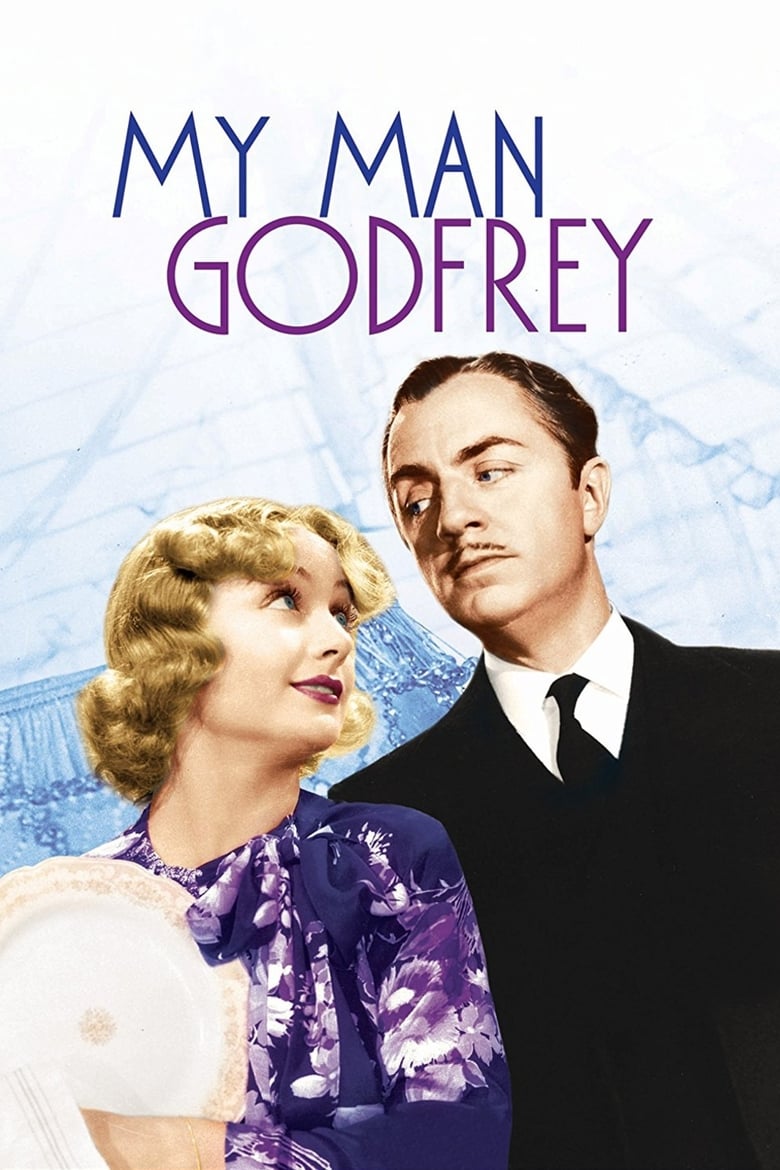
By 1936, Hollywood had refined the screwball comedy into something close to its own genre, a peculiar fusion of physical farce, rapid-fire wit, and class anxiety that felt perfectly suited to Depression-era audiences who were, by and large, in no mood to be sympathetic towards the idle rich. My Man Godfrey arrives squarely at the peak of that cycle, and it does so with considerable confidence. The premise, drawn from Eric Hatch's 1935 novel and adapted for the screen by Hatch alongside Morrie Ryskind, takes the contrast between the very wealthy and the very destitute and plays it for laughs while keeping one eye, just about, on something more pointed. It is the kind of film that uses a silver tray as a prop and a soapbox at the same time.
Gregory La Cava was already a seasoned hand by this point, having worked in animation before moving into features, and he had developed a reputation for encouraging improvisation on set, a fairly unusual working method for studio Hollywood. There is a looseness to the comedy here that feels very much like his influence, a sense that the performers are given just enough slack to find their own rhythms. Universal Pictures produced the film, and while it was not a lavish production by the standards of the day, it punched well above its weight at the box office and became one of the studio's major successes of the period. Notably, the film made history at the Academy Awards: it received nominations across all four acting categories, a first for any film, recognising the sheer quality of the ensemble work on display. It remains the only film to achieve that distinction without receiving a nomination for Best Picture, which tells you something about the Academy's complicated relationship with comedy, then as now.
The cast is the film's obvious and immediate asset. William Powell plays Godfrey with a particular brand of dry, unflappable composure that suits the material perfectly. He had spent years playing slick, knowing characters, most famously as Nick Charles in The Thin Man two years earlier, and he brings that same quality of amused detachment to a role that demands a man remain serene in the middle of complete domestic chaos. Opposite him, Carole Lombard is a force of screwball nature as Irene Bullock, all wide-eyed sincerity and chaotic energy, and the fact that Powell and Lombard had been briefly married in real life lends their scenes a sparring intimacy that no casting director could have manufactured. Alice Brady as the scatty Angelica Bullock and Eugene Pallette as the perpetually exasperated patriarch Alexander contribute layers of broad, reliable comic support, while Gail Patrick offers a nicely calibrated contrast as Cornelia, playing her with a cooler, more calculating edge that the film needs as a counterweight to Lombard's warmth.
Cinematographer Ted Tetzlaff shoots the film in crisp, functional black and white, making good use of the contrast between the Bullocks' over-furnished Fifth Avenue apartment and the sparse, improvised world of the shanty town by the East River. The two spaces are lit quite differently, the Bullock household almost too bright and busy, the riverside camp understated and clean by comparison, and that visual distinction quietly reinforces the script's class commentary without ever calling attention to itself. The editing, handled by Ted J. Kent and Russell F. Schoengarth, keeps the pace brisk without letting the rapid dialogue feel frantic. The score is not credited, but the film leans heavily on its performances rather than musical underscoring, which suits the tone well enough. For companion pieces from around the same period, see also my review of Bride of Frankenstein, another Universal production from the year before, and I also covered Rose Hobart, a rather stranger artefact from 1936 that makes an interesting contrast with the polished studio product on offer here.
You would not expect a screwball comedy from 1936 to remind you of Wes Anderson, and yet My Man Godfrey does, again and again.
It has that same fondness for eccentric, faintly ridiculous rich people all talking over one another, the same deadpan quirk, so much so that it kept putting me in mind of The Grand Budapest Hotel.
The setup is pure screwball: a scatty socialite named Irene, hunting for a "forgotten man" to win a society scavenger hunt, plucks a derelict off a rubbish dump and installs him as the family butler, whereupon he has to survive her gloriously unbearable clan.
Half the fun is simply listening to it. The dialogue is delightfully of its era, all that rapid, ornate, rambling patter these old films do so well, and it is a pleasure just to sit and take it in. The characters are vivid, if a shade melodramatic, the script is sharp and beautifully constructed, and there is a twist in the tale I did not see coming that lands wonderfully. It is funny, too, in that dry, class-skewering way the best screwball comedies always were.
What holds it back, for me, was the version I ended up watching. It had been colourised, and not in the lush, Technicolor way that can be rather lovely, but in a murky, flickering sort of wash, like everything was lit by a dying campfire, and it dulled a film that ought to sparkle.
On its own merits I suspect this is a four-star charmer, and the shabby colour job knocked half a star off it for me. Three and a half stars, a witty, eccentric delight of a comedy that I would dearly love to see again in crisp black and white.
My Man Godfrey sits comfortably in that category of films that are easier to admire than to argue with. Its pleasures are real, its craft is polished if unremarkable, and its satirical instincts, however lightly worn, have dated less badly than you might expect for a comedy nearly ninety years old. The class dynamics it pokes fun at are different in their particulars but recognisable enough in spirit, which is partly why screwball comedies from this period still travel. For those who want to explore more comedies that use dysfunction and domestic chaos as their engine, my thoughts on The Happiness of the Katakuris might offer an interesting, if considerably stranger, companion piece. My Man Godfrey is the sort of film that makes you wish you could watch it as it was meant to be seen: the right print, a good screen, no interference. Some films just deserve better than they sometimes get.
Rating: ★★★½ | Year: 1936 | Watched: 2026-09-23
Trailer
▶ Watch the official trailer for My Man Godfrey (1936) on YouTube
Where to watch
Watch in the UK
Stream: Amazon Prime Video · Shout! Factory Amazon Channel · FilmBox Live Amazon Channel · Amazon Prime Video with Ads
Rent: Amazon Video
Buy: Apple TV Store · Amazon Video · Google Play Movies · YouTube
Physical: Amazon UK · Zavvi
Watch in the US
Stream: Amazon Prime Video · Philo · Pure Flix · FlixFling
Rent: Amazon Video · Apple TV Store · Google Play Movies · YouTube
Buy: Amazon Video · Apple TV Store · Google Play Movies · YouTube
Physical: Amazon US
Affiliate disclosure: Movies With Macca may earn a small commission on purchases or subscriptions started via these links. It costs you nothing extra.



