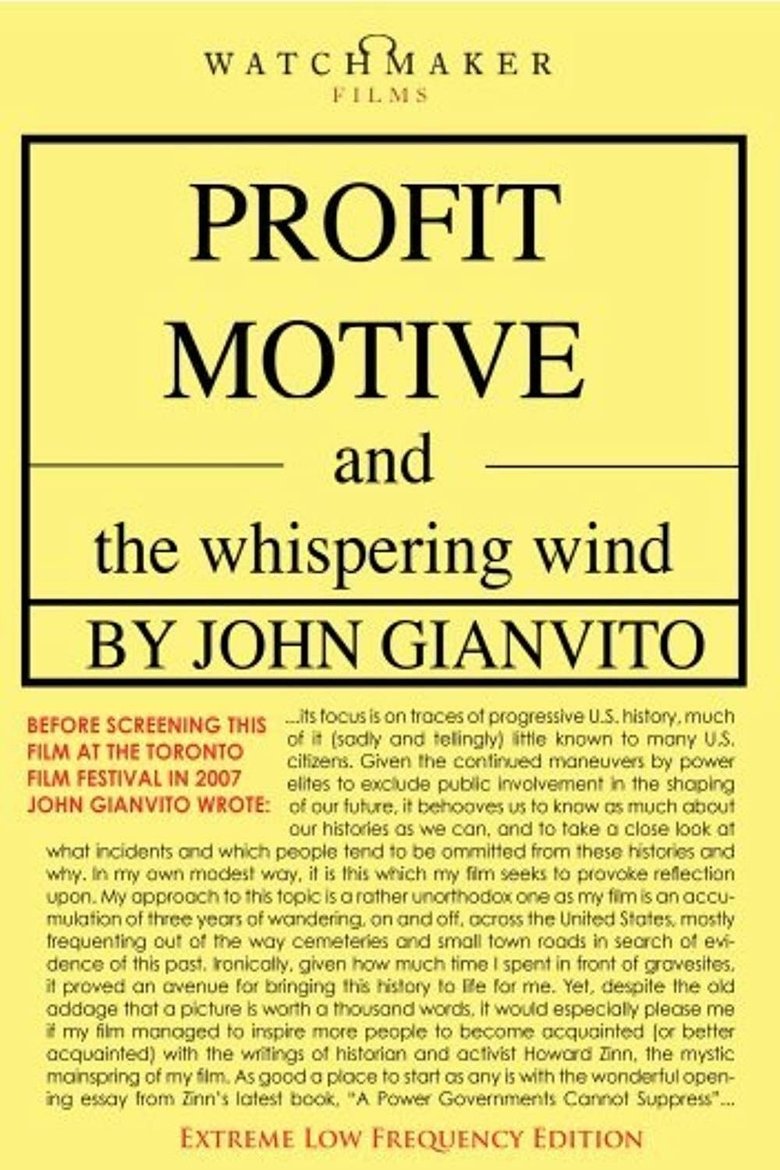
Profit Motive and the Whispering Wind (2007)

There is a particular tradition of American experimental documentary that treats the cinema screen less as a storytelling surface and more as a space for contemplation, a place where images accumulate meaning through patience rather than argument. Profit Motive and the Whispering Wind (2007) sits firmly in that tradition. The film is, at its core, a sustained visual meditation on the graves, monuments and plaques that mark the lives of the people who fought, often in obscurity and at great personal cost, for labour rights, racial equality and social justice across American history. The inspiration is explicit: John Gianvito has cited Howard Zinn's A People's History of the United States as the film's animating text, and the connection is appropriate. Zinn's project was to recover the history that official accounts tend to skip over, the strikers and abolitionists and suffragists who shaped the country without receiving much of the credit. Gianvito sets out to honour that same cast of characters, but through image and silence rather than through prose.
The film was made essentially as a one-man operation. Gianvito, a Boston-based filmmaker whose work has long occupied the fringes of American independent cinema, wrote, directed, shot and edited the film himself, which is both a statement of intent and a practical description of a very small production (no studio is credited, and the budget, whatever it was, is clearly minimal). Running at just 58 minutes, the film sits in an awkward zone between short film and feature, long enough to feel like a sustained experience but brief enough to resist the label of a conventional documentary. It screened at festivals rather than receiving any theatrical release of note, and it has remained largely a cult artefact, known mainly to those who follow experimental and essay film. For a point of comparison on how the essay film form can operate with more conventional documentary ambition, it is worth glancing at Koyaanisqatsi, which shares the wordless, image-led approach but operates on an entirely different scale and with very different resources. A closer cousin in spirit, if not in subject, might be A Visit to the Louvre, Jean-Marie Straub and Danièle Huillet's similarly austere exercise in looking at things quietly and letting the viewer do the interpretive work.
Because Gianvito served as his own cinematographer, the visual texture of the film reflects a single sensibility, and the images he captures are consistent in their qualities: close and patient framings of carved stone, weathered text, moss and rust, cut against wide shots of grass bending in wind, branches moving, light changing on an open field. The look is unadorned and deliberately unhurried, closer to the pace of a walk through a cemetery than to conventional documentary rhythm. The score, composed by Roberto Cassan, is sparse and ambient, sitting below the surface of the image rather than directing the viewer's emotional response. It functions less as a soundtrack in the conventional sense and more as an atmospheric texture, the musical equivalent of the whispering wind the title promises. There is no narration, no talking head, no archival footage. What you have, for nearly an hour, is the accumulation of stone and wind and silence. Whether that accumulation adds up to something meaningful or simply adds up to a long sit is the central question the film poses to its audience, and it is the question Macca turns his attention to below.
I will say this for Profit Motive and the Whispering Wind: I understood exactly what it was going for.
John Gianvito's 2007 film is a near-silent, wordless procession of images, gravestones, plaques, monuments and memorials to the people and movements of America's radical, progressive history, the abolitionists and unionists and campaigners the official story tends to hurry past, intercut with quiet shots of wind moving through grass and trees. Inspired by Howard Zinn's A People's History of the United States, it is, in effect, a visual roll-call of the forgotten fighters for a fairer country.
As an idea, there is something quietly moving in that, and I have real sympathy for what it sets out to honour. The trouble, as ever with this sort of thing, is the experience of actually watching it. For the best part of an hour it is essentially a slideshow of headstones, with no narration, no argument, no through-line beyond the accumulation itself, and however noble the intention, that makes for a long, static and frankly wearying sit. It asks you to bring all the context and all the feeling yourself, and to supply your own patience by the bucketload.
So I come down where I keep coming down with these austere, experimental pieces: sympathetic to the thought behind it, worn out by the reality of it. There is a real, stirring subject buried in here, and a more conventional documentary might have done it proud; as it stands, this is more a gesture than a film. Two stars, and a heartfelt tribute I found far worthier in theory than in practice, which I am realising is a verdict I reach for rather often with films of this stripe.
Profit Motive and the Whispering Wind is the kind of film that provokes an honest conversation about what we actually want documentary cinema to do. The subject it gestures toward, the long and frequently suppressed history of American radicalism, is genuinely rich, and the instinct to honour that history through image rather than polemic is not without its own logic. But intention and experience are different things, and the gap between them is where a lot of experimental cinema either earns its austerity or fails to justify it. If you find yourself drawn to films that test that boundary, Zorns Lemma is perhaps the more demanding end of the spectrum, while Higher Learning represents what it looks like when political subject matter is filtered through something with a good deal more narrative propulsion. Profit Motive asks you to meet it on its own terms. Whether those terms feel like rigour or like reticence rather depends on what you bring to the churchyard.
Rating: ★★ | Year: 2007 | Watched: 2026-08-26
Where to watch
Watch in the UK
Stream: DocAlliance Films
Physical: Amazon UK · Zavvi
Watch in the US
Stream: DocAlliance Films
Rent: DocAlliance Films
Physical: Amazon US
Affiliate disclosure: Movies With Macca may earn a small commission on purchases or subscriptions started via these links. It costs you nothing extra.