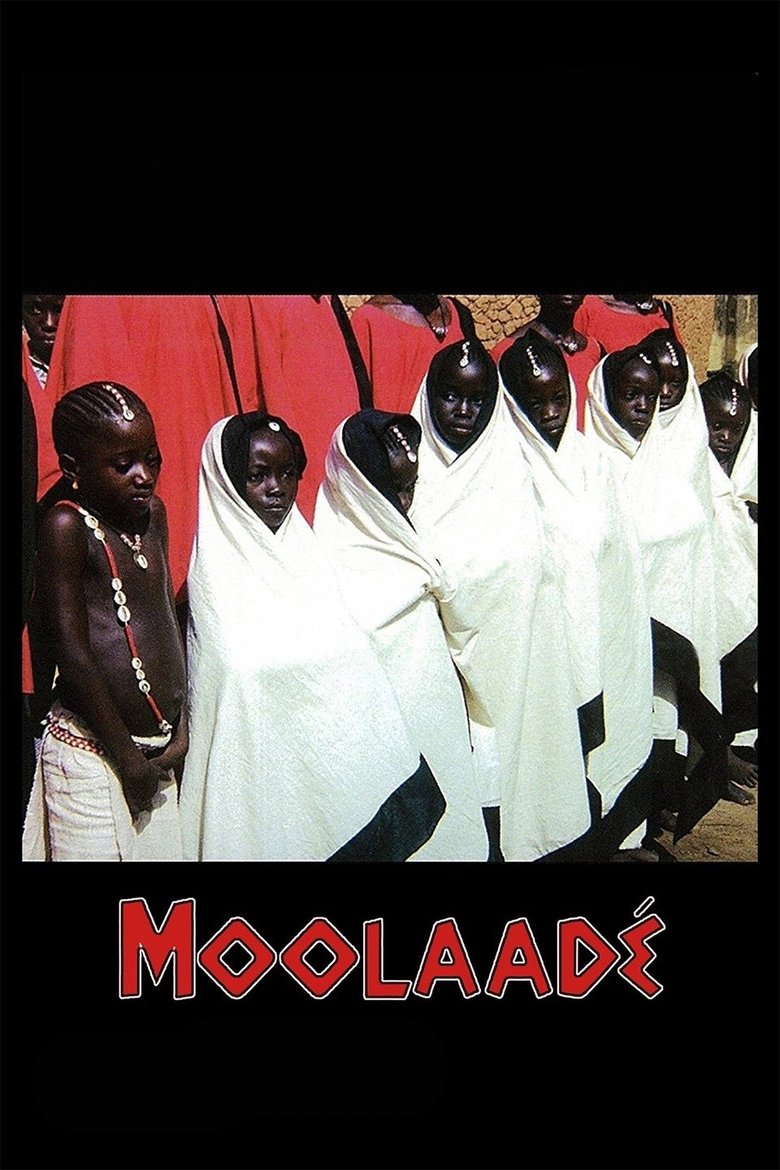
Moolaadé (2004)

Share
Moolaadé (2004)

Ousmane Sembène spent roughly five decades building a body of work that is, by any reasonable measure, the foundation on which African cinema stands. Born in Senegal in 1923, he came to filmmaking relatively late, having already established himself as a novelist, and he brought to the screen a novelist's instinct for social anatomy: the way power concentrates, the way silence is enforced, the way ordinary people absorb or resist the structures that press down on them. His 1966 debut Black Girl remains a landmark of world cinema, and the films that followed, from Xala to Faat Kiné, kept returning to West African life with a directness that mainstream international cinema rarely matched. Moolaadé, released in 2004 when Sembène was in his eighties, was his final feature, completed two years before his death in 2007. The fact that he chose, as a last film, to make something this unambiguous about female genital mutilation says a good deal about the man and his priorities.

The film was a genuinely pan-African production, with funding and support drawn from Burkina Faso, Cameroon, France, Morocco, Senegal and Tunisia, a coalition of backers assembled through institutions including the Fonds Sud Cinéma and the Centre Cinématographique Marocain. It was shot on location in Burkina Faso, in a village whose physical geography, the compound walls, the gathering spaces, the single television aerial that becomes a recurring image, does real work in establishing how enclosed and watched the world of the film is. Sembène wrote the screenplay himself, as he almost always did, and the story is his own: a woman in a rural village grants sanctuary ("moolaadé") to a group of girls fleeing the ritual excision ceremony, and the act of protection sets her against the men and elder women who see tradition as something that cannot be challenged from within. The film won the Un Certain Regard prize at Cannes in 2004, which was both a deserved recognition and a reminder of how rarely African cinema gets that kind of platform.

The lead performance comes from Fatoumata Coulibaly, who carries the weight of the film with a physicality that is controlled and expressive in equal measure. Around her, Maimouna Hélène Diarra, Salimata Traoré, Dominique Zeïda and Rasmané Ouédraogo fill out a cast that largely avoids the kind of broad characterisation that polemical filmmaking can tip into. The roles are written and played with enough texture that even those positioned on the opposing side of the argument feel like people rather than positions. That matters for a film working this close to advocacy. Sembène's great skill, consistent across his career and visible too in the kind of African storytelling you can trace through films like Yeelen, was in keeping his moral argument and his human drama in the same frame without letting one swallow the other.

Cinematographer Dominique Gentil shoots the village in warm, even light, with a preference for wide and mid-range framings that place characters within their environment rather than isolating them from it. The visual approach is observational, unhurried, close in spirit to the rhythms of the community being depicted. Editor Abdellatif Raïss cuts at a pace that matches Sembène's own tempo: deliberate, with room for scenes to breathe and for the social dynamics of each encounter to become legible before the film moves on. Boncana Maïga's score draws on West African musical textures and sits lightly under the action, present without insisting on itself, punctuating rather than underlining the drama's emotional turns. Together the craft elements give the film a polished but unremarkable surface quality that keeps attention on the story and its people, which is clearly where Sembène wanted it.

Ousmane Sembène is often called the father of African cinema, and Moolaadé, made in 2004, turned out to be his final film, a fitting last word from a director who spent his whole career turning his lens on injustice.

Nearly forty years after his landmark debut Black Girl, an eye-opener I rated highly, he signs off with something every bit as brave: a drama that confronts the practice of female genital mutilation head-on, and the terror it inflicts on young girls in rural West African villages. It is a subject I have now come to in a handful of films and documentaries, and it loses none of its power to appal.

The film comes at it thoughtfully. It begins by laying the practice out from several angles, the weight of tradition, the pressure on families, the quiet complicity that keeps it going, before narrowing to its heart: a woman who takes a group of frightened girls under her protection, invoking "moolaadé", a form of sacred sanctuary the village cannot easily override. Her defiance, and the mounting cost of it to her and those around her, becomes the engine of the story, and Sembène is clear-eyed about just how dangerous that kind of courage is.

As a piece of film-making it is modest. It is plainly low-budget, and it carries the slightly rough, unhurried texture of a good deal of African cinema of its era, but it is well made and well acted, and it never lets its message flatten it into a lecture. If it stops short of greatness for me, that is more a matter of scale and polish than of intent or impact; this is a decent, dignified, quietly furious film about something that still matters enormously. Three stars, and a brave, worthwhile final statement from a giant of the form.

Moolaadé sits in an honourable tradition of African filmmaking that uses the particular to open outward, that takes one village, one woman, one act of defiance, and finds in it something that speaks well beyond its specific geography or moment. For viewers coming to Sembène fresh, this is a reasonable place to start, though it rewards more if you arrive with some sense of his wider project; Dahomey offers an interesting companion piece in terms of the ongoing conversation about African culture and who gets to define its terms, and those interested in the broader history of political filmmaking on the continent might also find something in Wallay. For a filmmaker's farewell, it is a considered, committed, characteristically unbowed piece of work. The father of African cinema left the room making the kind of noise he always made.


Rating: ★★★ | Year: 2004 | Watched: 2026-08-27

View on Letterboxd →


Trailer

▶ Watch the official trailer for Moolaadé (2004) on YouTube

Film images and data courtesy of TMDB. This product uses the TMDB API but is not endorsed or certified by TMDB.