
Melody of Change (2019)
★★ — Melody of Change (2019)

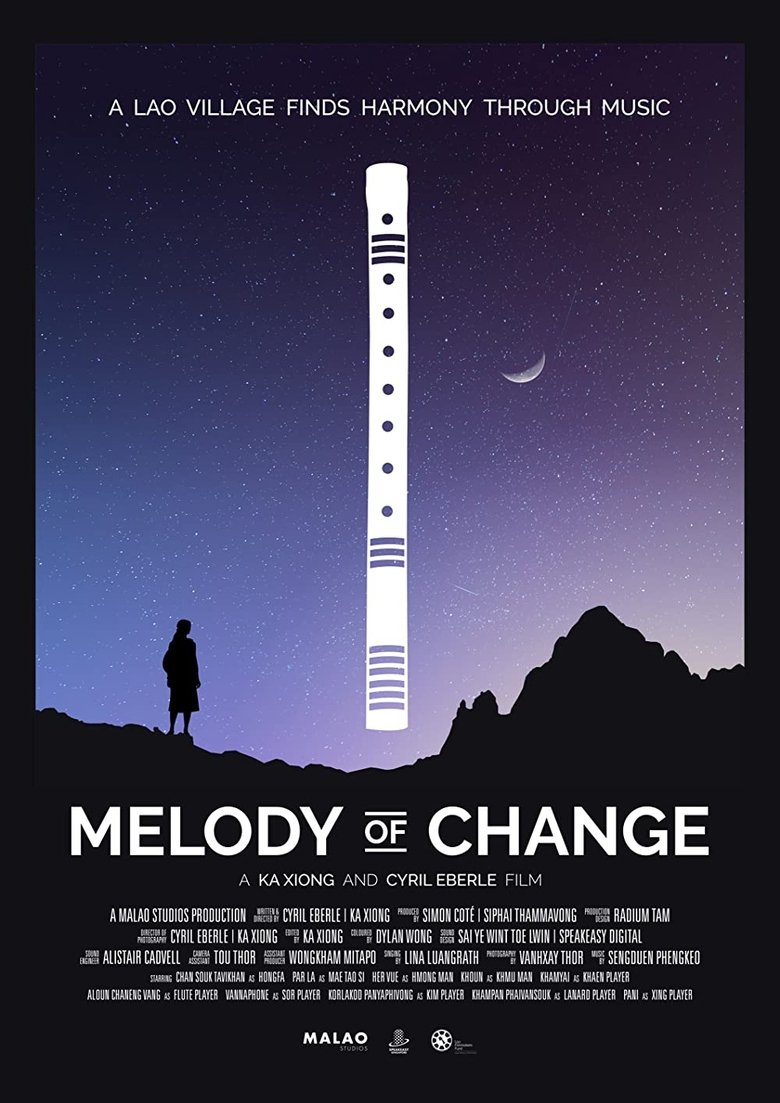
Melody of Change is a short drama from 2019, running to just nineteen minutes and produced by Malao Studios under the co-direction of Ka Xiong and Cyril Eberle. The film is set in a Khmu and Hmong village in Northern Laos, where a young woman named Hongfa arrives and finds herself caught between two distinct cultural worlds. Her efforts to draw the two communities together through their respective musical traditions form the spine of what the film is trying to say. As a piece of work, it sits in interesting company: short-form drama from Southeast Asia occupies a genuinely underserved corner of world cinema, and anything that makes a sincere effort to document living traditional music cultures is worth acknowledging. Laos, as a filmmaking nation, rarely makes it onto the international radar, which gives even a modest production like this a certain curiosity value.
Ka Xiong and Cyril Eberle represent a cross-cultural collaboration behind the camera, which feels fitting given the film's own preoccupations with bridging communities. Neither director carries a substantial international profile, and very little production detail beyond the Malao Studios credit has made it into the public record. The cast, the writer, the cinematographer, the editor and the composer all remain uncredited in publicly available sources, which is not unusual for micro-budget short film production in this region. What can be said is that the film was clearly made with access to the genuine landscapes and, crucially, the genuine musical traditions of Northern Laos. The Khmu and Hmong communities each carry distinct musical heritages, and a film that wanted to use those as raw material had something real to work with. Whether the production fully exploits that material is, of course, the question.
On a purely visual level, the film leans heavily on the natural environment of Northern Laos: lush, densely green, bathed in warm natural light. Without a named cinematographer on record, it is impossible to credit a specific eye, but the framing of landscapes and the handling of available light give the images a clean, unhurried quality. The picture is crisp rather than stylised, closer to observational documentary aesthetics than to any conspicuously authored visual approach. The score, or more accurately the diegetic music, is the real centrepiece: the traditional instruments and vocal styles of the Khmu and Hmong communities are given room to breathe, and the film seems most at ease when it is simply letting those sounds exist on screen. For a companion piece on the kind of film that places music at the absolute centre of its identity, my thoughts on Jazz on a Summer's Day cover similar ground, and I also wrote about Distant Voices, Still Lives, another drama in which music and cultural memory are inseparable from the fabric of everyday life. Both make for an interesting frame of reference here. For something more recent from my 2010s coverage, see also Jiro Dreams of Sushi, which similarly trains its attention on a specific cultural practice with a great deal of affection and rather less narrative urgency.
This short film came my way as part of my A-Z World Movie Tour, with Laos ticking off the letter L. It's actually the first Letterboxd review of it, which tells you something about how far under the radar it sits. The film follows Hongfa, a central figure who acts as a kind of bridge between two communities, each with their own distinct traditional music styles. That premise, on paper, has real potential. A human connector between cultures, expressed through sound and landscape? That could be something genuinely moving.
And to be fair, some of it is. The scenery is absolutely stunning. Laos clearly has a landscape that the camera loves, all lush greens and warm light, and whoever was behind the lens knew exactly how to frame it. The picture quality is crisp and clean, which makes the whole thing a pleasure to look at. The music itself, being very much the focus here, is genuinely nice. There's something peaceful and authentic about hearing these traditional styles play out, and if you're coming to this purely as a musical document, you'll probably leave satisfied.
But here's the problem: I'm not sure a short film about music and community can coast on vibes alone. There's no real story here. Hongfa is positioned as this important connective figure, but we barely get to know him. What does this role mean to him? What's the tension, the history, the stakes between these two communities? Those questions hover at the edges of the film without ever being answered, or even properly asked. It's like being handed a beautiful picture frame with nothing inside it.
It reminds me a little of certain music documentaries that are so in love with their subject that they forget to actually tell you about it. Compare that to something like Style Wars (1983), which is also fundamentally about an art form and the communities built around it, but digs into the people and the conflict and the passion behind it all. That film has texture. Melody of Change is almost wilfully surface-level.
I don't want to be too harsh, because it's clearly made with care and genuine affection for Laotian culture. It's not bad. Nobody is going to switch it off in frustration. But there's a difference between a film that's inoffensive and a film that's satisfying, and this one sits firmly in the former camp. You come away thinking "that was pleasant" rather than "that meant something."
For a short film, depth is arguably even more important than in a feature. You've got limited time, so every scene has to carry weight. Here, scene after scene is music and landscapes, music and landscapes, with just enough human presence to remind you there's supposed to be a story underneath. That structure might work as a promotional piece, or as a cultural record of sorts. As a film you're meant to engage with emotionally? It doesn't quite get there.
Two stars. Beautiful to look at, lovely to listen to, and frustratingly thin on everything else.
That tension between a film as cultural document and a film as story is one I keep returning to, and Melody of Change crystallises it neatly if not entirely comfortably. For me, the most honest way to put it is this: there is a genuinely worthwhile short film buried somewhere inside this one, probably twenty seconds longer and considerably more willing to sit with its characters rather than its vistas. The care is evident, the setting is extraordinary, and the music is the real thing. I just wish the film trusted its own material enough to push past the surface. Sometimes the most beautiful frames are the ones that need a little more inside them.
Rating: ★★ | Year: 2019 | Watched: 2025-07-03
Related on Movies With Macca
More from the 2010s: Wonder (2017) · Beautiful Boy (2018) · The Witch (2015) · What We Do in the Shadows (2014)
More drama: Viy (1967) · Wonder (2017) · A Better Tomorrow (1986) · Beautiful Boy (2018)
More music: Style Wars (1983) · 8 Mile (2002) · Chicken for Linda! (2023) · Tender Mercies (1983)



