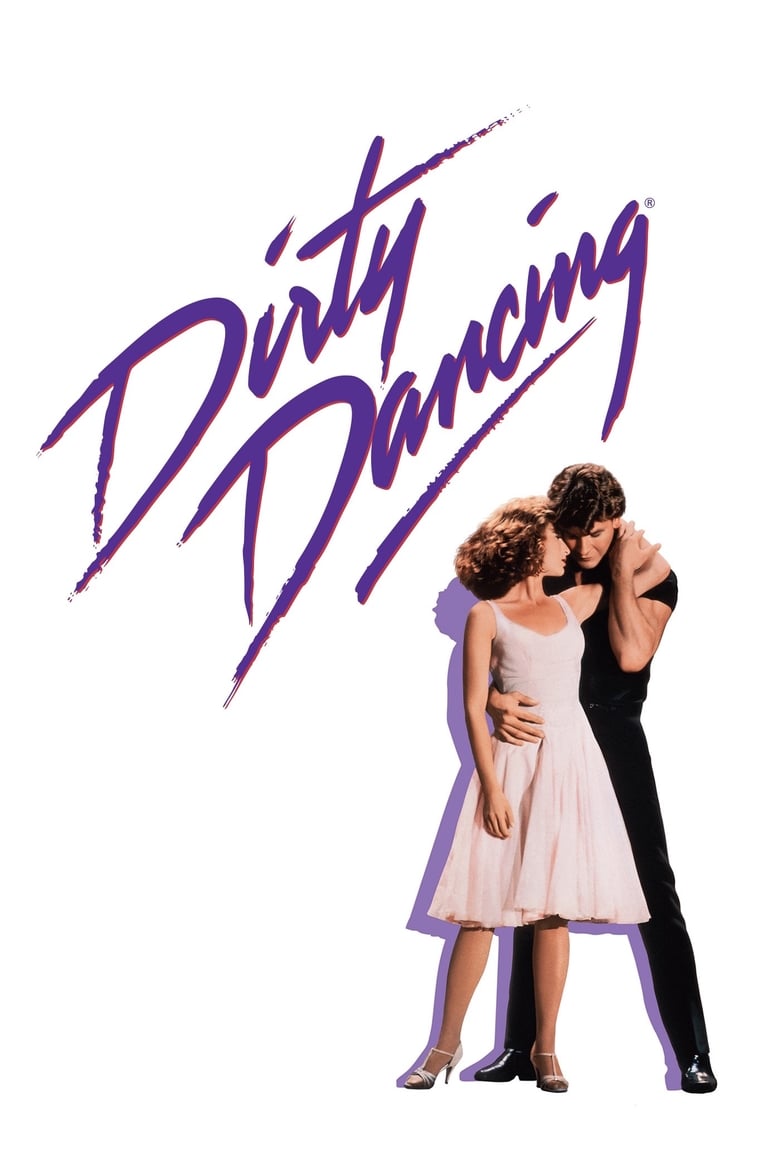
Dirty Dancing (1987)
There is something genuinely curious about the cultural longevity of Dirty Dancing. Released in the summer of 1987 by the now-defunct Vestron Pictures, it was made for a modest budget, shot quickly, and set in a world, the Catskills resort circuit of the early 1960s, that was already fading from relevance by the time the film was in production. And yet it became one of the defining romantic films of its decade, the kind of picture that entire generations seem to have watched on a loop on VHS, and whose soundtrack still gets pub jukeboxes moving at closing time. That gap between modest origins and outsized cultural impact is, in itself, worth pausing on before a single frame has played.
The film comes from writer Eleanor Bergstein, who drew heavily on her own experiences growing up and dancing in the Catskills, giving the script a specificity of milieu that lifts it above a generic summer romance. The social texture, the class divisions between the resort's wealthy guests and its working staff, the particular flavour of early-sixties America on the cusp of change, feels lived-in rather than assembled from a Hollywood period kit. Director Emile Ardolino, whose background was in documentary and arts television (he had won an Oscar for his 1983 dance documentary He Makes Me Feel Like Dancin'), brought a genuine feel for performance and movement to the material. It shows, most of all, in the way the dance sequences are filmed and assembled. The film was produced through a partnership between Great American Films and Vestron, the latter a company better known at the time for home video distribution than for theatrical production, which perhaps explains why Dirty Dancing always had the feel of a film that found its true audience on the small screen. Films from that same year doing rather different things with American culture, like Hollywood Shuffle, offer a useful reminder of just how varied 1987's output was, even within relatively low-budget American independents.
Cinematographer Jeffrey Jur gives the film a warm, honeyed look, the kind of images that make even a functional resort hotel feel like a place where something electric might happen: late evening light through trees, bodies close together in low-lit staff quarters, the Blue Ridge Mountains providing a lush but unfussy backdrop. It is polished but unremarkable in the wider shots, and then suddenly alive whenever the frame fills with movement. Composer John Morris provides an orchestral underscore that keeps things anchored emotionally, while the pop and soul tracks sourced for the soundtrack, including Franke Previte's "(I've Had) The Time of My Life", do the heavy lifting in terms of atmosphere and era. Peter C. Frank's editing is perhaps most notable in the dance sequences, where cuts are tight enough to sustain energy without obscuring what the performers' bodies are actually doing, a balance that is harder to strike than it looks.
The principal cast centres on Jennifer Grey as Frances "Baby" Houseman, the sheltered, idealistic teenager whose unexpected summer among the resort's dance staff sets the story in motion. Grey had shown considerable range the year prior in Ferris Bueller's Day Off, and here she is asked to carry a character arc that requires her to shift from bookish observer to someone genuinely transformed by movement and feeling. Opposite her is Patrick Swayze as Johnny Castle, the dance instructor at the heart of both the romance and the film's class dynamics. Jerry Orbach brings welcome texture as Baby's father, a man whose decency and blind spots are both entirely believable, while Cynthia Rhodes and Jack Weston fill out the resort world with reasonable efficiency. The kind of romantic coming-of-age energy the film trades in has echoes in later pictures, and anyone who has spent time with The Perks of Being a Wallflower will recognise something of the same emotional register, that particular ache of a young person finding out who they are through someone else's world.
Every so often a single performer is so magnetic that they drag an entire film up several rungs by sheer force of presence, and Dirty Dancing is one of the purest examples I can think of.
Strip Patrick Swayze out of Emile Ardolino's 1987 hit and you are left with a fairly ropey little picture; drop him in as Johnny Castle, the working-class dance instructor with the cheekbones and the coiled swagger, and the whole thing suddenly sings. It is the same effortless charisma that would later make him the best thing in Point Break; the camera simply adores him, and so, helplessly, do you.
The story itself could hardly be more familiar. A sheltered rich girl, Jennifer Grey's Baby, spends a summer among the dancers and dreamers on the wrong side of the tracks, falls for one of them, and finds herself transformed. It is Romeo and Juliet with better hips, the same class-crossed romance that Titanic would later dress up in far grander clothes, a formula so well-worn you could set your watch by it. And outside of Swayze, the acting is, frankly, poor across the board, stiff and broad and every so often actively distracting, the sort of thing that would sink a more weakly anchored film.
What saves it, alongside its leading man, is everything that actually moves. The choreography is superb, the dance sequences full of heat and real snap, and the soundtrack is a knockout, wall to wall with songs that lodged themselves in the culture and never left. That combination, one magnetic star, a great soundtrack and choreography with serious bite, is the whole reason a fundamentally formulaic, patchily acted film became the enduring cult favourite it is. Cast anyone but Swayze in that role and we would not still be talking about it forty years on.
Three stars, and living proof of what one irresistible star can do for an otherwise ordinary film.
Dirty Dancing is, in the end, a film that rewards thinking about in terms of what actually makes popular cinema stick. It is not a sophisticated piece of work, and it was never trying to be, but it understood a handful of things very well: movement, music, and the particular pull of a performer who makes the screen feel different when they are on it. That combination travelled further than anyone at Vestron could reasonably have predicted in 1987. Much like the way Quadrophenia anchors its generational feeling in performance and music rather than narrative complexity, or the way Point Break runs almost entirely on the charisma of the people at its centre, Dirty Dancing is a reminder that formula, executed with the right ingredients, can outlast almost any amount of craft. The formula hasn't aged especially well. The ingredients, in certain lights, still have life in them.
Rating: ★★★ | Year: 1987 | Watched: 2026-08-15
Trailer
▶ Watch the official trailer for Dirty Dancing (1987) on YouTube

Where to watch
Watch in the UK
Stream: Disney Plus · ITVX Premium
Rent: Apple TV Store · Rakuten TV · Amazon Video · Google Play Movies
Buy: Apple TV Store · Rakuten TV · Amazon Video · Google Play Movies
Physical: Amazon UK · Zavvi
Watch in the US
Stream: Hulu · YouTube TV · Sling TV Orange and Blue · Lionsgate+ Amazon Channels
Rent: Amazon Video · Apple TV Store · Google Play Movies · YouTube
Buy: Amazon Video · Apple TV Store · Google Play Movies · YouTube
Physical: Amazon US
Affiliate disclosure: Movies With Macca may earn a small commission on purchases or subscriptions started via these links. It costs you nothing extra.