
Apocalypse Now (1979)

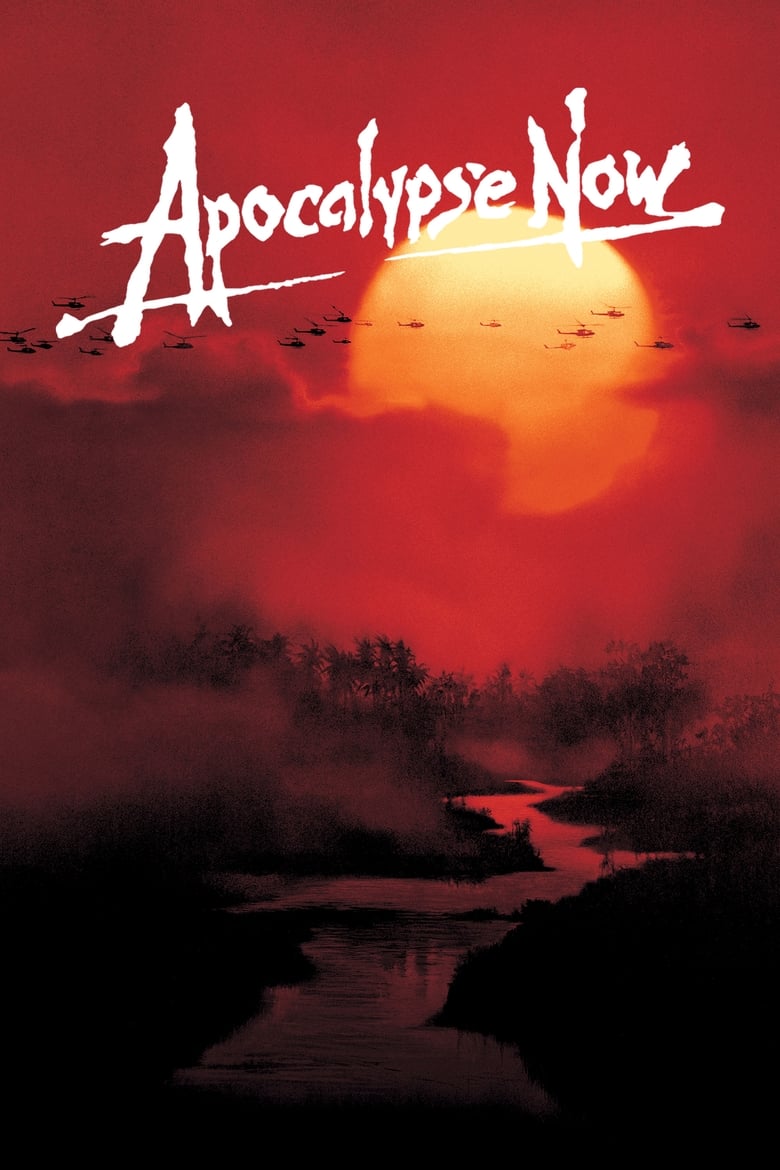
Few films arrive carrying quite as much mythology as Apocalypse Now. Released in 1979 after a production so chaotic and catastrophic it became its own legend, Francis Ford Coppola's Vietnam war epic is one of those films that exists in two places at once: on the screen, and in the cultural conversation that has surrounded it for nearly half a century. Typhoons, a star's heart attack, a ballooning budget, Marlon Brando turning up overweight and unprepared, and Coppola himself on the verge of a breakdown in the Philippine jungle. The making of the film was, in many respects, as hallucinatory as the film itself. Eleanor Coppola documented it all, and Fax Bahr and George Hickenlooper later assembled that footage into Hearts of Darkness: A Filmmaker's Apocalypse (1991), one of the most extraordinary making-of documents ever committed to film. That backstory is not just gossip. It feeds directly into how the film feels: unwieldy, excessive, occasionally visionary, and produced at a cost, financial and human, that few studios would sanction today.
The screenplay was written by John Milius and Coppola, loosely transposing Joseph Conrad's novella Heart of Darkness from the Belgian Congo to the Mekong Delta. Milius had been developing the project for years before Coppola took the reins at American Zoetrope, the independent outfit he had founded after his early studio work. Coppola came into the film fresh from the twin commercial and critical triumphs of The Godfather and The Godfather Part II, which meant that when the production fell apart around him, the fall was very public indeed. Martin Sheen leads the film as Captain Willard, a soldier assigned to a classified mission to find and terminate Colonel Kurtz, a decorated Green Beret who has established his own command deep in the Cambodian jungle. Alongside Sheen, the boat crew includes Frederic Forrest, Albert Hall, and a then-fourteen-year-old Laurence Fishburne, who reportedly lied about his age to get the role. At the far end of the river, of course, is Marlon Brando, who had already worked with Coppola on the first Godfather film and whose presence here carries its own considerable weight. (For more on that earlier collaboration, see also my thoughts on On the Waterfront, where Brando's particular brand of internal, barely-contained performance is very much in evidence in a different context.)
The craft on the film is extraordinary by any measure. Vittorio Storaro, the Italian cinematographer who won the Academy Award for his work here, shoots the jungle in images that feel both beautiful and corrupted: orange napalm light bleeding into river mist, faces half-swallowed by shadow, helicopter silhouettes moving across a burning horizon. The photography is rich and painterly in a way that makes the violence feel both gorgeous and repellent, which is precisely the point. The score, composed by Carmine Coppola and Francis Ford Coppola themselves, leans heavily on treated sound and synthesiser textures, more atmosphere than melody, a low hum of dread that sits under the film rather than commenting on it from above. The Doors' "The End" opens and closes proceedings in a choice that locks the film into a specific moment in American cultural history. The editing, shared between Lisa Fruchtman and Gerald B. Greenberg, has the unenviable job of imposing some kind of shape on footage that was notoriously difficult to assemble, and the cuts between the boat's slow passage and the escalating surrealism of what it encounters have a rhythm that is genuinely disorienting in the best possible sense. For a companion piece on a film that similarly uses landscape and physical endurance as psychological portrait, see also The Lighthouse.
I know Apocalypse Now is held up as one of the greatest films ever made, and there is a great deal here to admire, but I could never quite get it over the line in my head from a very good film to a great one. It sat, for me, stubbornly in the former camp. So much of it works, and yet something kept me at arm's length from the masterpiece everyone else seems to see.
The setup is simple enough: Martin Sheen's soldier is sent upriver to find and eliminate Colonel Walter Kurtz, a decorated officer who has gone rogue deep in the jungle. But the film is far less about that mission than about the journey to reach it. For a good two hours we are travelling, drifting through the madness and horror of the Vietnam war on the way to Kurtz. And much of that passage is extraordinary: there are astonishing set pieces, some spectacular explosions, and a hard, unflinching grittiness to the violence that is tragic and thought-provoking in equal measure.
The problem, for me, comes when we finally arrive. Marlon Brando's Kurtz has been built up across the entire film, and Brando is extraordinary, mesmerising in a way that perhaps only he could be, but the destination could not quite live up to the journey. After everything it took to get there, I found the camp itself strangely anticlimactic, more muted and abstract than the fever I had been promised. The build is so strong that the payoff was always going to struggle, and for me it did.
It is also too long. Even this cut feels as though you could lift a good hour out of it and lose nothing essential, so the knowledge that a version exists with another ninety minutes bolted on rather boggles the mind. That bloat is a large part of what holds it, for me, just shy of greatness. Three and a half stars. A remarkable, gruelling and often staggering film that never quite tipped from very good into great for me, and one I suspect would have floored me at two-thirds the length.
Apocalypse Now remains one of those films that critics and audiences seem to need a position on, a film that demands to be argued about rather than simply watched. It sits alongside Coppola's other major work (I covered The Godfather Part III separately, a film with its own complicated relationship to expectation and legacy) as evidence of a filmmaker who worked on a scale, and at a personal cost, that now feels almost historical. Whether or not the film earns its reputation is, genuinely, a matter of where you land on the question of ambition versus execution, and that is precisely the tension worth sitting with. Some films become great by achieving everything they attempt. Others become great by attempting more than anyone could reasonably pull off. The river, as ever, keeps moving.
Rating: ★★★½ | Year: 1979 | Watched: 2026-10-23
Trailer
▶ Watch the official trailer for Apocalypse Now (1979) on YouTube
Where to watch
Watch in the UK
Stream: Studiocanal Presents Amazon Channel
Rent: Apple TV Store · Rakuten TV · Amazon Video · Sky Store
Buy: Apple TV Store · Rakuten TV · Amazon Video
Physical: Amazon UK · Zavvi
Watch in the US
Stream: Paramount+ Amazon Channel · Lionsgate+ Amazon Channel · Howdy Amazon Channel
Rent: Amazon Video · Apple TV Store · Google Play Movies · YouTube
Buy: Amazon Video · Apple TV Store · Google Play Movies · YouTube
Physical: Amazon US
Affiliate disclosure: Movies With Macca may earn a small commission on purchases or subscriptions started via these links. It costs you nothing extra.


