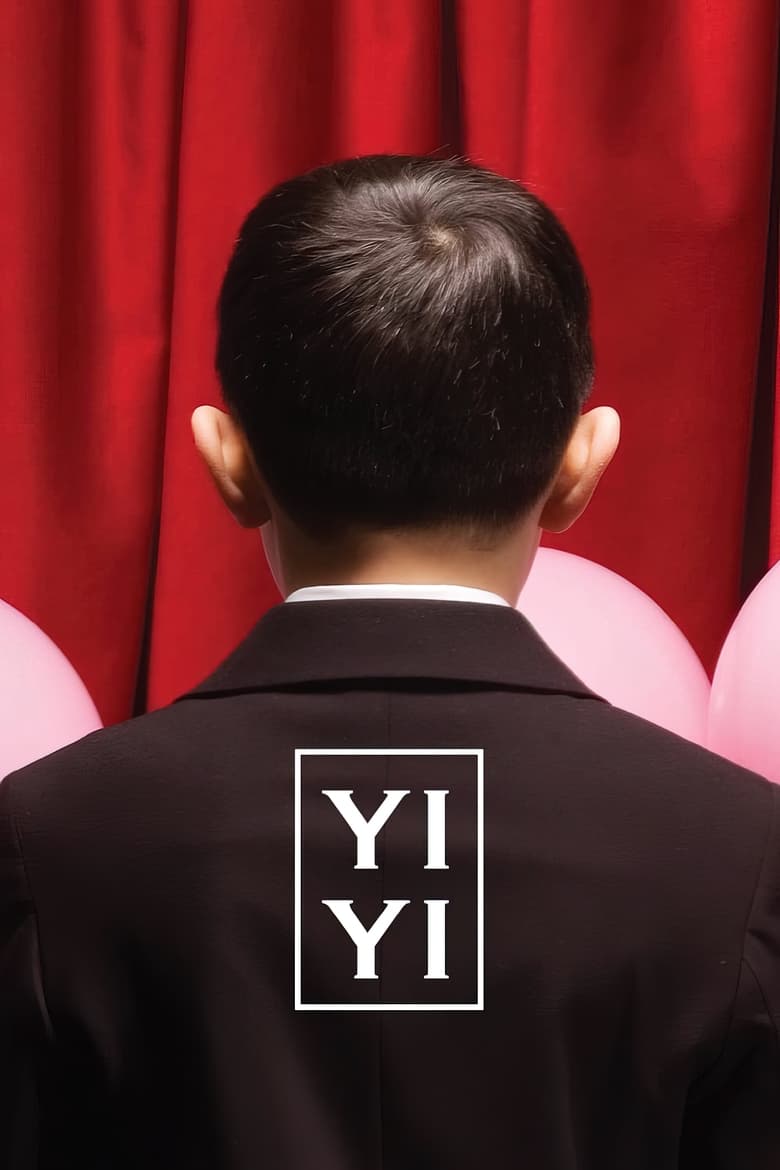
Yi Yi (2000)

There's a scene in Yi Yi where a man performs a simple card trick, and in the space of a few silent gestures, you feel the weight of everything he's never been able to say out loud. No dramatic music swell, no close-up designed to cue the tears. Just a moment, held still, and then gone. That's Edward Yang's film in miniature: quiet, generous, and almost unbearably true to life.
Yang, who died in 2007, made what I'd comfortably call one of the great family portraits ever put on screen. It follows a Taiwanese family across several generations and points of view, catching each of them at a particular crossroads: grief, romantic longing, professional doubt, the creeping suspicion that your life has somehow taken a wrong turn without you noticing. None of it is sensationalised. None of it is moralised over. Yang simply watches, and trusts you to feel what he's showing you.
The comparison that kept coming to me was Ozu's Tokyo Story, which is obviously not an accident. But where Ozu keeps a respectful emotional distance, Yang gets closer, and I think the result is something even more affecting. There's a warmth here that doesn't tip into sentimentality, and a sadness that never once feels manipulative. It's a difficult balance to strike, and Yang makes it look effortless.
A lot of the credit goes to the performances. Issei Ogata plays Ota, a Japanese businessman who wanders through the film like a gentle, slightly comic sage, and he's extraordinary. The card trick scene I mentioned is his, and it captures something a lot of films spend their entire runtime chasing: a lifetime of unvoiced feeling compressed into a handful of gestures. He's one of those supporting characters you keep thinking about long after the credits roll.
Yang's visual approach suits the material perfectly. The cinematography frames Taipei's streets and domestic interiors with a luminous, unhurried clarity. Nothing is over-lit or over-composed. Ordinary rooms look like ordinary rooms, which sounds like faint praise but is actually quite hard to pull off without losing all visual interest. The recurring piano motif does similar work on the soundtrack, appearing and disappearing like a half-remembered feeling.
Where the film doesn't quite land for me is the pacing, and I'll be honest about that. The deliberate rhythm is part of the point, I know, but there are stretches where it tips from contemplative into genuinely glacial. The young son's storyline, which is thematically rich and visually inventive, never quite gets the narrative space it deserves, and you occasionally feel the slight asymmetry of a film that's more interested in some threads than others. I'm not sure those are flaws so much as choices, though. Real life leaves plenty unresolved, and there's something fitting about a film that mirrors that honestly rather than papering over the gaps.
If you've ever been moved by a film that prioritises observation over plot mechanics, something like Fish Tank in its commitment to watching people rather than pushing them around a narrative, you'll find a lot to hold onto here. Yi Yi operates on a similar frequency, even if the cultural context and the scale are entirely different.
Four stars. It doesn't shout. It breathes. And in that breathing, it catches something about memory, time, and the quiet ache of being alive that most films don't come anywhere near. Give it the patience it asks for and it'll repay you handsomely.
Rating: ★★★★ | Year: 2000 | Watched: 2026-06-07
Where to watch
Watch in the UK
Rent: Apple TV Store · Amazon Video
Buy: Apple TV Store · Amazon Video
Physical: Amazon UK · Zavvi
Watch in the US
Rent: Amazon Video · Apple TV Store · Google Play Movies · YouTube
Buy: Amazon Video · Apple TV Store · Google Play Movies · YouTube
Physical: Amazon US
Affiliate disclosure: Movies With Macca may earn a small commission on purchases or subscriptions started via these links. It costs you nothing extra.