Winter Light (1963)

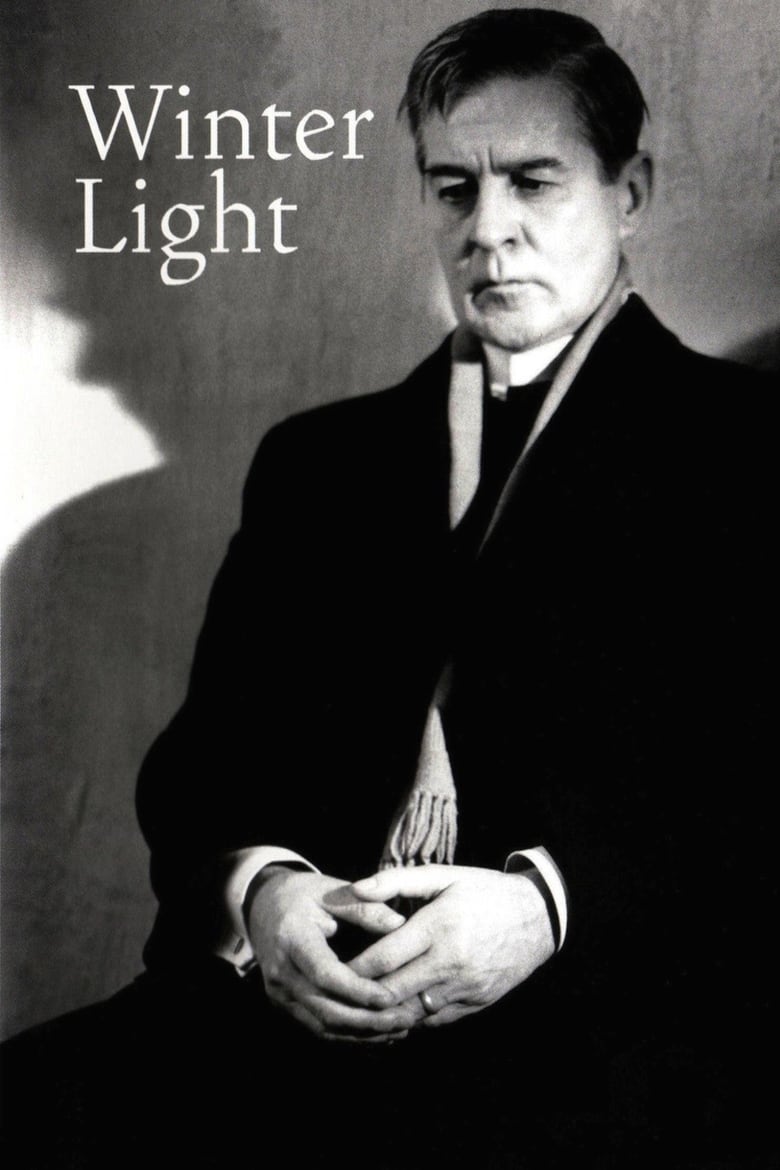
There's a moment early in Winter Light when Bergman simply lets his camera sit in a Swedish church and watch a Sunday service play out, nearly in full, in real time. No cuts to spare you, no intercutting to build tension, just the sermon, the sparse congregation, the cold light through the windows. It's a bold choice, and it tells you exactly what kind of film you're in for. Whether you take that as a promise or a warning probably determines everything about your experience of what follows.
I want to be honest about where I land: somewhere in the uncomfortable middle. This is clearly the work of a serious artist operating with total command of his medium. The black-and-white photography is genuinely beautiful in places, the performances are precise and restrained in ways that feel entirely deliberate, and Bergman's thematic focus, a pastor in full-blown spiritual crisis, wrestling with doubt and emotional paralysis in a bleak Swedish winter, is surgically sharp. As one entry in his so-called "silence of God" trilogy, it holds its place in the canon without question. I understand why it matters. I understand why some viewers find it profound.
But admiration isn't the same as enjoyment, and I kept finding myself at arm's length from the whole thing.
The central problem, for me, is Pastor Tomas himself. He's intentionally closed off, a man so thoroughly retreated into himself that watching him is less like following a character and more like observing a specimen. That's a valid artistic choice. But it asks an enormous amount of the audience in return, and what it asks for, chiefly patience and theological curiosity, it doesn't particularly reward. The dialogue is intellectually weighty, sure, but it's delivered with a flatness that sits somewhere between restrained and inert. There's a difference between a film that earns its stillness and one that simply imposes it, and I'm not convinced Winter Light always knows which side of that line it's on.
What makes this genuinely frustrating is that I've seen Bergman do extraordinary things with similarly difficult, withholding material. Persona crackles with psychological tension even in its most abstract stretches. There's always something to grip onto, some current running beneath the surface. Winter Light, by contrast, feels like it seals itself off. The pacing never shifts. The emotional temperature doesn't rise or fall. You watch a man who cannot connect with others, cannot connect with God, and the film mirrors his disconnection so faithfully that you can end up disconnected from the film itself.
I read other reviews before sitting down to write this, and there's clearly a community of viewers for whom this is a deeply moving, even essential experience. I don't want to dismiss that. But I also felt, honestly, excluded from whatever it is they're accessing. That's a strange and slightly deflating feeling when you've come to a film with genuine openness. Sometimes a film's reputation builds a door that just won't open for you, no matter how sincerely you knock.
The craft here is real. The thematic rigour is real. Its place in art-house history is secure and deserved. But there's a difference between a film you respect and a film that gives you something to hold onto, and Winter Light kept slipping out of my hands. If you're moving through Bergman's filmography, it's worth your time for context alone. And if you come out the other side feeling cold and a little shortchanged, you're in good company. You haven't missed a hidden key. Sometimes a film is precisely as austere as it appears, and that austerity is both its achievement and its limitation.
Two and a half stars. Worth seeing. Not easy to love.
Rating: ★★½ | Year: 1963 | Watched: 2026-05-29
Where to watch
Watch in the UK
Stream: BFI Player · BFI Player Amazon Channel · BFI Player Apple TV Channel
Physical: Amazon UK · Zavvi
Watch in the US
Stream: Criterion Channel
Rent: Apple TV Store · Google Play Movies · YouTube · Fandango At Home
Buy: Apple TV Store · Google Play Movies · YouTube · Fandango At Home
Physical: Amazon US
Affiliate disclosure: Movies With Macca may earn a small commission on purchases or subscriptions started via these links. It costs you nothing extra.