The Match Factory Girl (1990)
★★★ — The Match Factory Girl (1990)

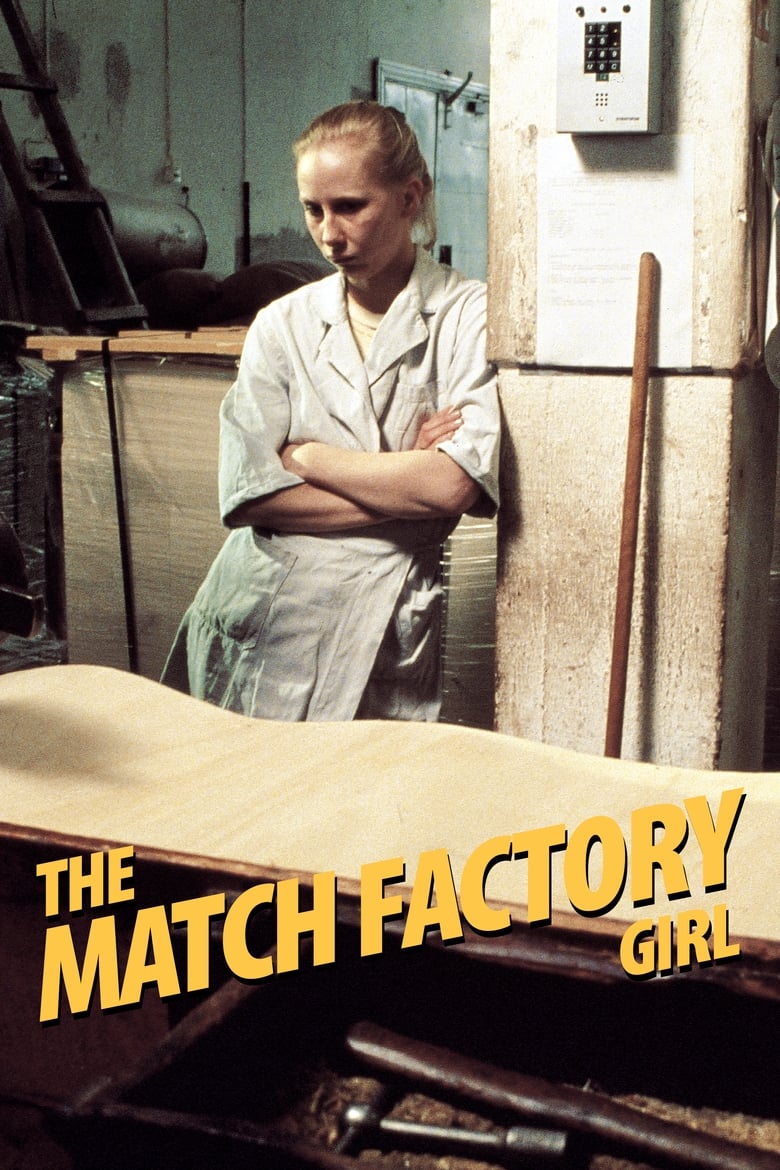
There's a moment early in The Match Factory Girl where you realise Aki Kaurismäki isn't going to give you an inch. No swelling score, no intimate close-up to invite you inside a character's head, no dialogue to fill the silence. Just a young woman, a conveyor belt, and the mechanical rhythm of a life measured out in matchboxes. And somehow, that's enough to make you feel the full, suffocating weight of her existence within minutes.
The film is barely over an hour long, which is just as well, because Kaurismäki's minimalism is so committed, so uncompromising, that it demands a particular kind of patience. The camera plants itself and holds. People move through grey Helsinki flats and factory floors like they're already ghosts. Meals are eaten in silence. A night out offers no escape. Our protagonist drifts through all of it, largely unseen, largely unheard, and Kaurismäki refuses to dramatise any of it for your comfort. Each frame really does feel like a sigh, like the image itself is exhausted on her behalf.
And for the bulk of its short runtime, this works beautifully as a character study. The loneliness is communicated through accumulation, through small humiliations stacked quietly on top of one another until the pile is enormous. You don't need to be told she's invisible. You feel it in your bones, the way you might feel it watching someone eat alone in a busy restaurant. It's the kind of film that makes you want to be a bit kinder to the quiet people around you.
But then the film pivots. Sharply, and without much ceremony. What starts as understated social realism tips into something darker, stranger, almost fable-like. There are acts of revenge, sudden and extreme, that carry a different kind of energy entirely. It's not clumsy filmmaking, not at all. Kaurismäki clearly knows exactly what he's doing. But it does create a tonal fault line that I'm not sure the film fully bridges. The earlier sections earn their restraint so thoroughly that when things shift gear, it feels like the rug being pulled, and I wasn't entirely sure whether to be impressed or thrown.
Some people will find that turn cathartic, even exhilarating. A silent woman finally speaking in the only language anyone around her seems to understand. I can see that reading. But I kept feeling that the film had built something fragile and precise, and then chose to shatter it rather than resolve it. The realism accumulated so carefully in the first two thirds took a knock it didn't quite recover from, at least for me.
That said, I kept thinking about it afterwards, which is never nothing. Films that sit in your head for days clearly did something right, even if you're not entirely sure what. There's a hypnotic quality to Kaurismäki's restraint that reminded me, in a roundabout way, of the stillness I found in Yi Yi (2000), that same willingness to trust the audience to sit with quiet observation rather than demanding emotional signposting at every turn. The instinct for radical understatement is genuinely compelling, even when I'm uncertain about where it leads.
It also pairs interestingly with Blue (1993), another film that strips away almost every conventional tool of cinematic storytelling and dares you to stay with it. Both films test your patience in ways that feel purposeful rather than self-indulgent, and both left me admiring the discipline involved even when the experience wasn't entirely satisfying.
Three stars. The Match Factory Girl is more interesting than it is satisfying, and I mean that as partial praise. Kaurismäki's style and mood are worth your time, and the central performance communicates worlds without saying barely a word. Just go in knowing that the ending may leave you scratching your head more than you expected. Whether that's a flaw or the whole point, I'm honestly still not sure.
Rating: ★★★ | Year: 1990 | Watched: 2026-04-10
Where to watch
Watch in the UK
Stream: Curzon Amazon Channel
Rent: Apple TV Store · Amazon Video · Google Play Movies · Curzon Home Cinema
Buy: Apple TV Store · Amazon Video · Google Play Movies · YouTube
Physical: Amazon UK · Zavvi
Watch in the US
Stream: Criterion Channel
Physical: Amazon US
Affiliate disclosure: Movies With Macca may earn a small commission on purchases or subscriptions started via these links. It costs you nothing extra.
Related on Movies With Macca
More from Finland: It's Not Silence (2018) · Unknown Soldier (2017)
More from the 1990s: Lessons of Darkness (1992) · Shinjuku Boys (1995) · Blue (1993) · Cemetery Man (1994)
More drama: Viy (1967) · Wonder (2017) · A Better Tomorrow (1986) · Beautiful Boy (2018)