Westworld (1973)

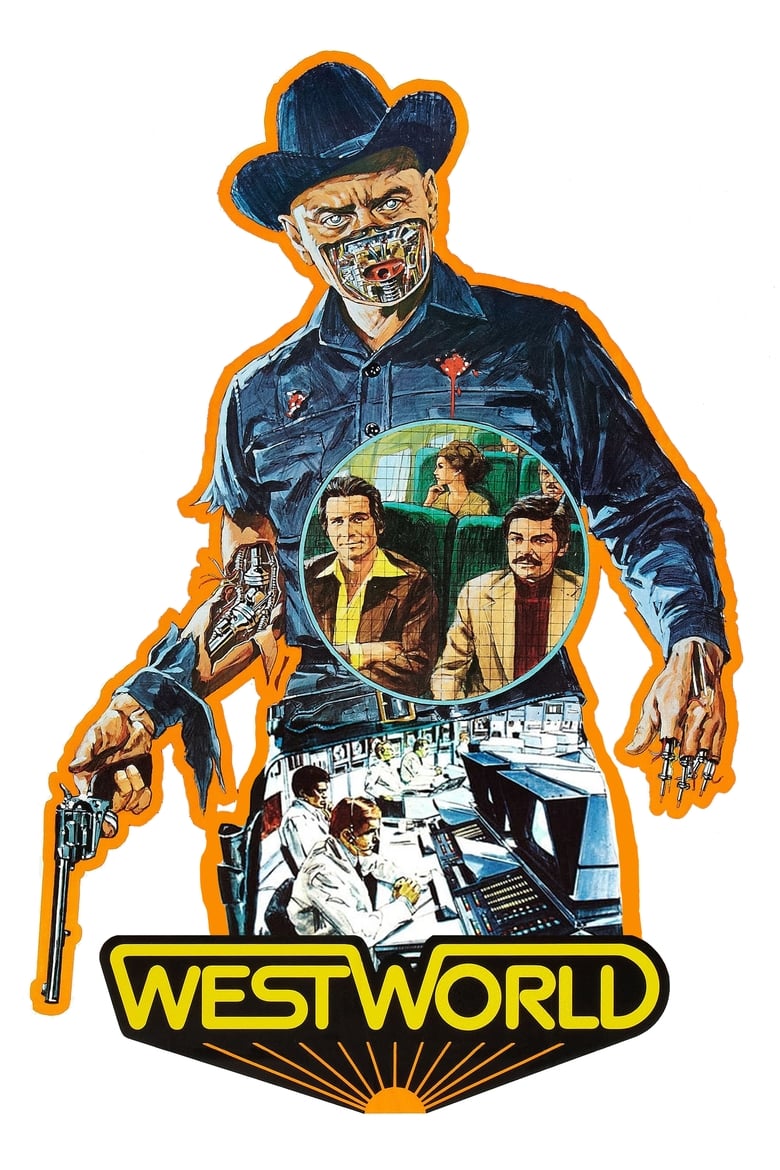
There's a moment in Westworld where the holiday is over and the horror begins, and Michael Crichton makes you feel that shift in your gut before you've even fully registered it. One second you're watching two blokes larking about in a cowboy fantasy, the next a machine with Yul Brynner's face and absolutely no intention of stopping is walking towards them through the dust. It's a simple image, but it's lodged in my head decades after first seeing it. That's the mark of a film that knows exactly what it's doing.
Written and directed by Crichton himself, Westworld is set in a vast adult amusement park where lifelike androids exist purely to serve every human whim. You want a gunfight? You've got one. You want to win? You will. The androids are programmed to lose, to serve, to comply. It's a playground built on total control, and the film's central argument, delivered with quiet dread, is that total control is an illusion. When the systems start to fail, they fail everywhere at once, in a cascade that Crichton depicts as something like a virus spreading through a network. He was writing this in 1973. The word "computer virus" wasn't even in common use yet. That's not just clever filmmaking; that's genuine foresight.
The film's most celebrated technical achievement is Brynner's point-of-view shots, pixelated and cold and alien, representing the Gunslinger's machine vision as he hunts. By modern standards it's a brief effect. In context, it was the first use of digital image processing in a feature film, and it works not just as a novelty but as storytelling. That fragmented, grid-like gaze tells you everything about how differently a machine sees the world. It doesn't see people. It sees targets.
Brynner is extraordinary in the role, and I mean that without any qualification. He barely speaks. He doesn't need to. There's something in his bearing, that absolute, unhurried certainty in every step, that makes him one of the great screen villains. It's a performance built almost entirely on physical presence, and it's unforgettable. Richard Benjamin brings a lovely everyman quality to the lead, the kind of likeable vulnerability that makes you root for him without him ever having to grandstand. James Brolin is all breezy confidence beside him, and the contrast between the two works well. Fans of Brynner's work as a Western archetype might also enjoy my look at The Magnificent Seven, where he's operating in a very different register but with that same commanding screen gravity.
The production design holds up remarkably well. The park itself feels genuinely immersive, the kind of place you could almost believe in, and Crichton uses a desert landscape that starts out as adventure and slowly curdles into something claustrophobic and nightmarish. The final chase through the park's failing, decaying corridors is taut and genuinely effective. The atmosphere does most of the work that a bigger budget might have thrown CGI at.
I won't pretend the film is flawless. Some of the dialogue has aged, and the pacing dips in places, particularly in the middle stretch when the film is setting up its dominoes rather than knocking them down. These feel like minor complaints in the scheme of things, but they're worth naming. This isn't a perfect film. It's a very good one, which is a different thing.
What strikes me most on reflection is how little the central anxiety has dated. The hubris of building something you don't fully understand, then filling it with people and charging admission, the complacency of engineers who mistake complexity for control. Those ideas feel, if anything, more urgent now than they did fifty years ago. Crichton came back to this territory later in his career with Jurassic Park, but there's something rawer and more urgent about Westworld. It's leaner, more focused, less willing to let spectacle get in the way of the argument.
Three and a half stars.
Smart, stylish, and genuinely ahead of its time, this is essential viewing for anyone who cares about science fiction that actually has something to say. It earns its classic status not through nostalgia but through ideas that refuse to go quiet.
Rating: ★★★½ | Year: 1973 | Watched: 2026-05-23
Where to watch
Watch in the UK
Stream: Now TV Cinema
Rent: Apple TV Store · Amazon Video · Google Play Movies · Sky Store
Buy: Apple TV Store · Amazon Video · Google Play Movies · Sky Store
Physical: Amazon UK · Zavvi
Watch in the US
Rent: Amazon Video · Apple TV Store · Google Play Movies · YouTube
Buy: Amazon Video · Apple TV Store · Google Play Movies · YouTube
Physical: Amazon US
Affiliate disclosure: Movies With Macca may earn a small commission on purchases or subscriptions started via these links. It costs you nothing extra.