
Spider-Man: Across the Spider-Verse (2023)

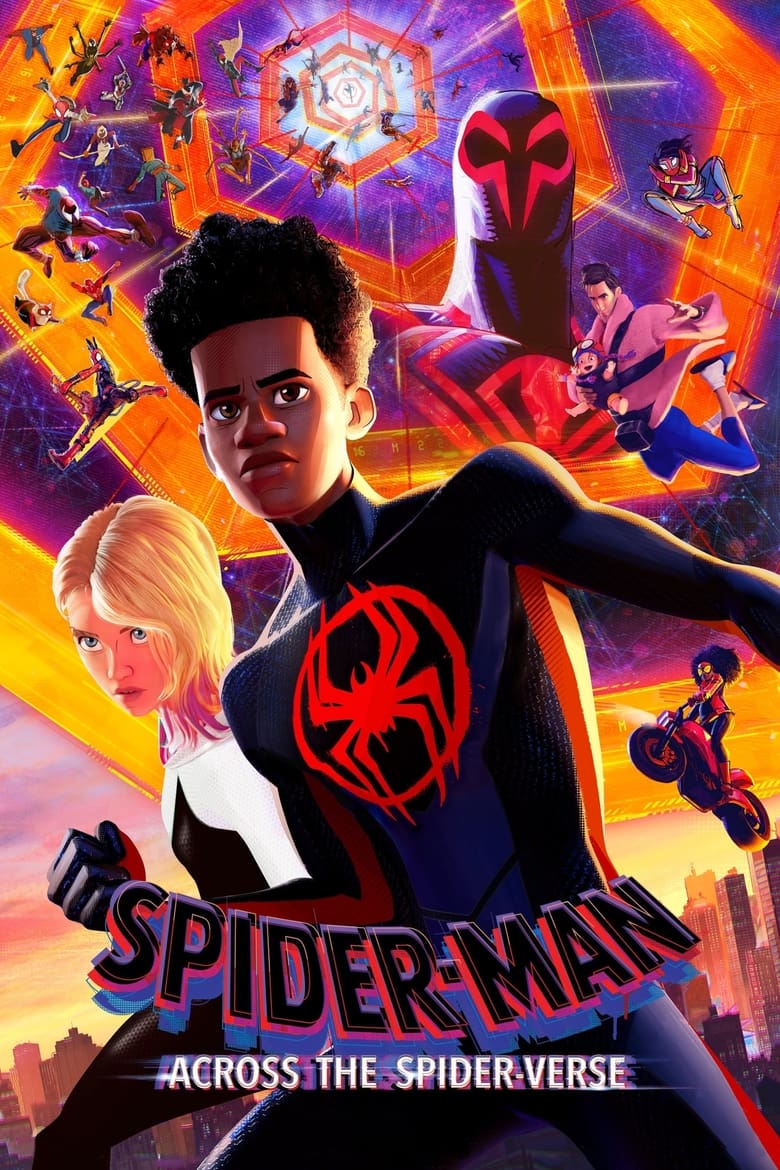
I'll be honest: seeing Spider-Man: Across the Spider-Verse sitting at a higher rating than its predecessor on Letterboxd left me genuinely baffled. Not angry, not defensive, just... baffled. Because while this 2023 sequel is an extraordinary piece of work in several respects, I came out of it feeling something I absolutely did not expect: mild disappointment.
And that stings, because Into the Spider-Verse completely rewired my brain on what superhero animation could achieve. That first film felt like a genuine revelation. So I went into this one with sky-high expectations, expectations that the deafening critical praise only pushed higher. What I got was something undeniably ambitious, visually staggering, frequently thrilling, and yet somehow a film that buckles under the sheer weight of its own sprawling, multiverse-spanning reach.
Let's start with what works, because plenty does. The animation is, again, absolutely top-notch. If anything, the team has surpassed the already staggering heights of the original, delivering a kaleidoscopic visual feast that constantly keeps your eyes glued to the screen. Each new Spider-variant brings its own distinct visual language, and the sheer craft on display is humbling. I think about films like Akira (1988), which redefined what animation could look like on a grand scale, and this film belongs in that same conversation about pushing the boundaries of the medium.
The introduction of the various Spider-variants is also a cracking highlight. I genuinely loved the vibrant energy of Pavitr Prabhakar, the Indian Spider-Man, whose sequences fizz with colour and infectious joy. And fair play to Daniel Kaluuya as the anarchic, collage-animated Hobie Brown, Spider-Punk. I'll admit it freely: I initially disliked Hobie's deliberately detached, scene-chewing delivery. It felt too cool for its own good. But the character absolutely grew on me as the runtime progressed, and by the end I was completely won over.
So where does it go wrong? A few places, and they're hard to ignore.
The central villain, The Spot, voiced by Jason Schwartzman, simply doesn't feel fleshed out enough. His motives are murky, and the actual threat he poses to our heroes never quite lands with the dramatic weight the film clearly intends. For a story this big and this loud, the antagonist feels strangely thin. That's a problem.
Then there's the pacing. There is a remarkably long, slow, drawn-out middle section in this already hefty runtime that genuinely tests your patience. You find yourself waiting for the plot to kick back into gear, only to be met with more exposition, more world-building, more setup for things that won't pay off here. The film is so busy constructing its universe that it occasionally forgets to tell a satisfying story within it.
And then the finale. I still cannot quite believe it. Leaving the story on an unresolved cliffhanger, a flat "to be continued" in the most literal sense, is a massive misstep. I understand the argument that serialised storytelling has its place, and I'm not against a film ending with threads left dangling. But this doesn't feel like a bold artistic choice. It feels like a corporate mandate, a way of ensuring the audience returns for the next instalment rather than a genuine narrative decision. That frustration is only compounded by the development hell that has since plagued the promised follow-up. You walk out feeling shortchanged.
Directors Justin K. Thompson, Kemp Powers, and Joaquim Dos Santos clearly had a massive canvas to play with, and there is a tremendous amount to admire in their ambition. The character work, when it lands, really lands. The visuals are beyond reproach. There are sequences here that I will genuinely not forget.
But a brilliant, beautiful film that is just a bit off is still a film that is a bit off. It should have been an absolute slam dunk. Instead, it's a swing that connects more often than not, yet leaves you aching for what might have been if someone had reined things in just slightly and actually stuck the landing.
Four stars.
Rating: ★★★★ | Year: 2023 | Watched: 2026-07-27
Where to watch
Watch in the UK
Stream: Amazon Prime Video · Amazon Prime Video with Ads
Rent: Apple TV Store · Rakuten TV · Amazon Video · Google Play Movies
Buy: Apple TV Store · Rakuten TV · Amazon Video · Google Play Movies
Physical: Amazon UK · Zavvi
Watch in the US
Stream: Disney Plus · fuboTV · HBO Max Amazon Channel · FXNow
Rent: Amazon Video · Apple TV Store · Google Play Movies · YouTube
Buy: Amazon Video · Apple TV Store · Google Play Movies · YouTube
Physical: Amazon US
Affiliate disclosure: Movies With Macca may earn a small commission on purchases or subscriptions started via these links. It costs you nothing extra.



