
Nanook of the North (1922)

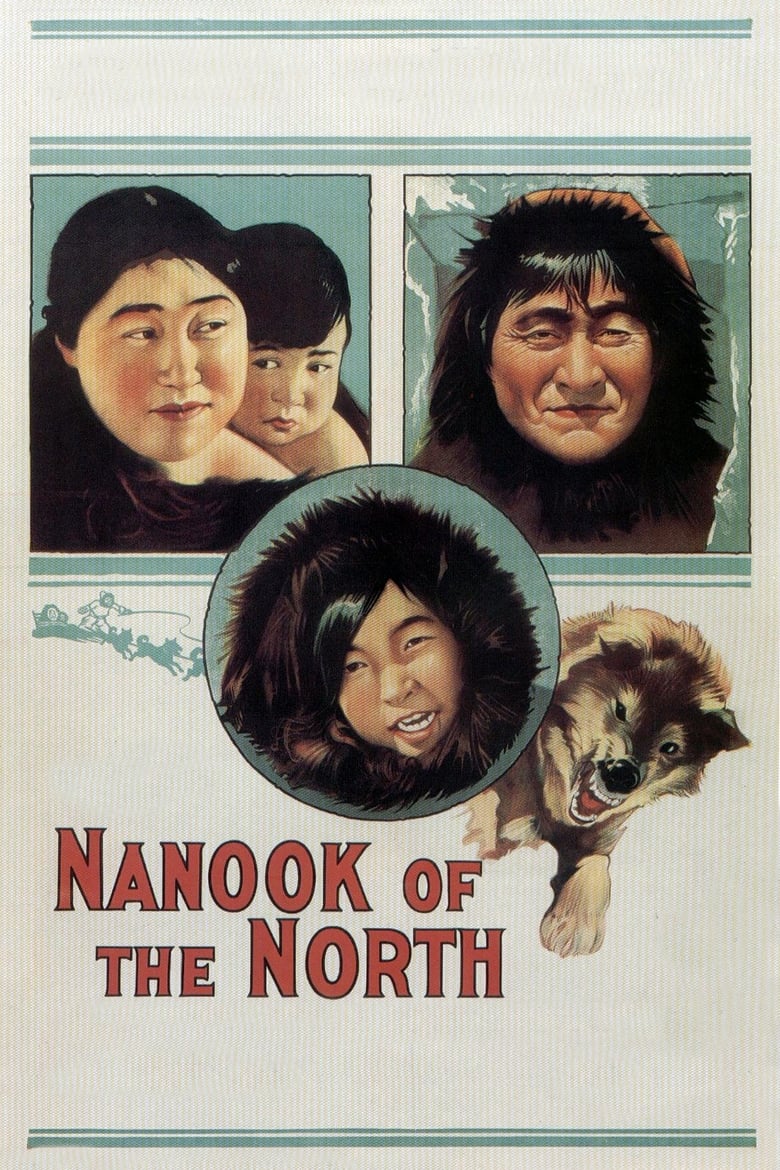
There are films that matter because of what they are, and there are films that matter because of what they started. Nanook of the North belongs firmly to the second category. Released in 1922 and produced under the banner of the French trading company Les Frères Revillon, it is widely regarded as one of the earliest feature-length documentary films ever committed to celluloid, a record of Inuit life in the Ungava Peninsula of northern Quebec that introduced the very idea of the form to audiences across the world. To appreciate it properly, you really do need to hold that context front and centre, because the film's significance is, at this point, almost entirely historical rather than experiential.
Robert Flaherty is the sole creative force behind virtually every aspect of the production: he wrote, directed, photographed and co-edited the film (alongside Charles Gelb), making it one of cinema's earliest examples of what we might now call a one-man documentary operation. Flaherty had spent years as an explorer and surveyor in the Canadian north before he ever picked up a camera in earnest, and that background shaped everything about how he approached his subject. He knew the landscape and had genuine relationships with Inuit communities, which gave the film an intimacy unusual for the period. It also, as later scholarship would reveal, meant he felt comfortable reshaping what he saw for the camera's benefit, reviving older hunting techniques and constructing a roofless igloo to let in enough light to film the interior. That tension between document and performance runs through the work in ways that were not especially controversial in 1922 but have attracted considerable discussion ever since. The principal subject of the film is Allakariallak, the hunter Flaherty casts as the figure he calls Nanook, and the screen presence Allakariallak brings to the role is genuinely striking for someone with no prior experience of cinema. Alice Nevalinga, Cunayou, Allegoo and Allee appear as his family, and the film frames them with an anthropologist's curiosity, for better and for worse.
Flaherty shot on orthochromatic film stock with the cameras available to him in the early 1920s, and given the conditions, the fact that usable footage exists at all is a minor miracle. The images have a particular quality to them: wide, unbroken expanses of white that flatten depth and reduce the human figures to small, dark shapes against an enormous sky. That visual grammar, the way the landscape dwarfs and indifferent-ly surrounds the people within it, gives the film its most enduring quality as a piece of photography. The original release was a silent film, and over the decades it has been distributed with a number of different musical accompaniments, so the score any particular viewer encounters will depend on which version they are watching. The edit, which Flaherty shaped with Gelb, moves at the pace of an earlier era of cinema, using intertitles to guide the audience through activities that might otherwise be opaque. I also reviewed Flaherty's Man of Aran (1934) and Louisiana Story (1948), two later works that show how his methods and preoccupations carried through the decades, and for a companion piece in a very different register, Moana (1926) is worth looking at alongside this one. It was, incidentally, the critic John Grierson's review of Moana in 1926 that first put the word "documentary" into print as a descriptor for this kind of filmmaking, a lineage that leads directly back to what Flaherty did here.
Nanook of the North is best understood not as something you sit down to watch today so much as something that happened, back in 1922, when almost nobody alive had seen anything like it.
It is one of the very first feature-length documentaries ever made: Robert Flaherty hauled a camera up into the Canadian Arctic and filmed an Inuit hunter and his family hunting, building and surviving out on the ice, then carried that world back to audiences who could scarcely have imagined it existed. Purely as a feat of nerve and endurance, shot on location in those conditions with the equipment of the day, it is a remarkable thing to have pulled off at all.
For the people who first saw it, it must have been earth-shattering, a startling glimpse of a life lived at the very edge of the world. And that is the frame you have to hold onto, because a fair amount of it is staged. The igloo was built open on one side so the camera could see in; the old hunting methods were revived for the lens rather than the rifles the men actually used by then. Today we would flag all of that in a heartbeat. In 1922, with the whole idea of the documentary still being invented as it went along, it barely registered, and it is hard to hold too harshly against the film now.
Watching it in the present day, of course, is a different experience entirely. It has aged terribly, as a silent film well over a century old was always going to, and I have found much the same with Flaherty since; his Man of Aran and Louisiana Story both struck me as more valuable as records than as living films. This is where all of it began, the staged authenticity, the ethnographer's careful eye, and there is a fascination in sitting at the source of a whole tradition. As entertainment it is heavy going. As a historical curiosity, the film that more or less invented the documentary, it holds you regardless. Three stars, more artefact than film now, and interesting above all for what it set in motion.
Nanook of the North sits at a peculiar crossroads that very few films ever occupy: it is a work whose importance to cinema history is essentially beyond argument, even as its pleasures as an evening's viewing have grown more qualified with every passing decade. The ethical questions around staged authenticity and the representation of indigenous peoples are ones the documentary tradition has never quite finished reckoning with, and they all have roots here. Whether that makes it essential viewing or obligatory viewing is a distinction worth sitting with. Some films earn their place in the conversation by being genuinely alive on screen; others earn it by being the room where the conversation began.
Rating: ★★★ | Year: 1922 | Watched: 2026-09-25
Trailer
▶ Watch the official trailer for Nanook of the North (1922) on YouTube
Where to watch
Watch in the UK
Stream: Amazon Prime Video · GuideDoc · Amazon Prime Video with Ads
Physical: Amazon UK · Zavvi
Watch in the US
Stream: HBO Max Amazon Channel · Philo · GuideDoc · Fandor Amazon Channel
Rent: Amazon Video · Apple TV Store · Google Play Movies · YouTube
Buy: Amazon Video · Apple TV Store · Google Play Movies · YouTube
Physical: Amazon US
Affiliate disclosure: Movies With Macca may earn a small commission on purchases or subscriptions started via these links. It costs you nothing extra.



