Man of Aran (1934)

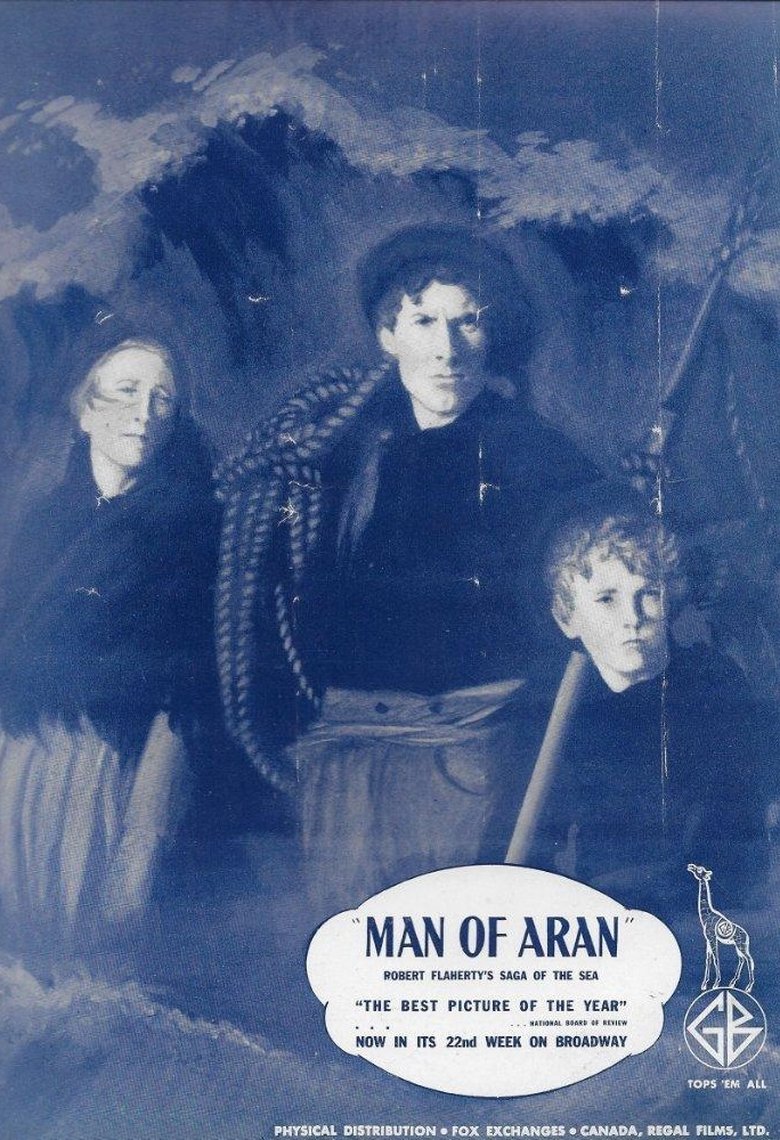
The Aran Islands sit off the west coast of County Galway, three limestone outcrops where the Atlantic has the run of things and the soil, such as it is, has to be coaxed from seaweed and sand. By the early twentieth century they had acquired a particular romantic charge in the Irish cultural imagination, associated with a way of life thought to carry some residue of the ancient Gaelic world, unspoiled and elemental. J.M. Synge had visited and written about them. The islands were, in the eyes of many on the mainland and further afield, a living argument for something older and truer than the industrialised modern world. When Robert Flaherty turned up in the early 1930s with a camera and the backing of Gainsborough Pictures, he was arriving into a landscape already laden with expectation, and his film arrived into cinemas in 1934 carrying that weight with it.
Flaherty was by then the closest thing the documentary form had to a name. His Moana (1926) had in fact given the form its most durable label: it was the critic John Grierson who, reviewing that film, first used the word "documentary" in the sense we still mean it. Flaherty's method, established from his earliest work, was to live among his subjects for extended periods, to observe, and then to reconstruct, which is a polite way of saying that the line between document and drama was always blurred in his hands. For Man of Aran he wrote the film himself, as well as operating the camera, and he worked with a cast drawn entirely from the islands: Colman "Tiger" King, Maggie Dirrane and Michael Dirrane anchor the central family unit, with Pat Mullin of Aran and Patch "Red Beard" Ruadh rounding out the ensemble. None of them are professional performers in any conventional sense, and the film presents them as if they were simply themselves, which is both its selling point and a source of the discomfort that has followed its reputation ever since.
The look of the film is what most people remember, and rightly so. Flaherty shot it himself, and his eye for the Atlantic light, for rock faces against sky, for the churning geometry of waves breaking over stone, gives the film a severe, elemental quality. There is a texture to the imagery, a granular quality born partly of the era's technology, that suits the subject matter even when it makes for uncomfortable viewing. John Greenwood's score works in broad, ceremonial strokes, underlining the film's sense of man-against-nature with the kind of orchestral earnestness that the period favoured. John Monck edited the film, and the cutting in the water sequences, where the pacing tightens and the images stack up in quick succession, is among the more effective craft decisions in the picture. The film is 76 minutes long, which is about right for the material, though the rhythms within those 76 minutes are uneven. For a companion piece in an adjacent register, Distant Voices, Still Lives (1988) offers a similarly unflinching portrait of working-class endurance, though by very different means and in a very different mode.
The questions the film raises about authenticity and reconstruction have only sharpened with time. The revelation that the shark hunt at the film's centre revived a practice that had already died out on the islands, staged expressly for Flaherty's cameras, sits awkwardly alongside the film's claims to document real life. It is a tension that runs through a good deal of early documentary practice, though Flaherty's version of it is particularly pronounced. I also reviewed Louisiana Story (1948), another Flaherty production, and found some of the same pleasures and frustrations at work there.
There is plenty to admire in Man of Aran, and much of it is undone by the plain fact of its age. Robert Flaherty's 1934 film sets out to capture life on the Aran Islands off the west coast of Ireland, a hard, wind-scoured existence wrung from rock and sea, and as a record of that world it is intriguing. It is a story of survival, often picturesque, and historically it is a fascinating thing to have on film at all.
The trouble is the delivery. The picture quality is rough, which you can forgive for 1934, but harder to forgive is how staged the whole thing feels. Like a lot of documentaries from the era it leans on obvious dramatisation, and in Flaherty's case that runs deeper than most: the islanders are essentially cast, and the film's big set piece, a perilous hunt out on the water, revives a practice that had already died out, restaged purely for the camera. I hit much the same wall with his Louisiana Story, which I liked even less. Flaherty keeps making things that work better as historical documents than as films.
And that is roughly where I land. The content is good, the delivery is what holds it back, and for all its merits it is, finally, a victim of its age. I am glad it exists, and I would send anyone curious about early documentary, or about the Aran Islands themselves, straight to it. As a thing to actually sit and enjoy in 2026, though, it has dated too far for me to wave everyone towards it. Two and a half stars, fascinating as a record, heavy going as a watch.
Man of Aran occupies a genuinely odd position in the canon: cited in histories, taught in film schools, and yet not quite comfortable to watch as an experience in itself. Its reputation as a document of the form's early conventions is probably more secure than its reputation as a film you would choose for an evening. What Flaherty built on those limestone outcrops is a kind of memorial dressed as an observation, a love letter to a world he was, in part, reconstructing from imagination. That it survives as both a historical curiosity and a point of ongoing debate about what documentary can and should do is, depending on your appetite for such things, either its best quality or its most frustrating one.
Rating: ★★½ | Year: 1934 | Watched: 2026-09-15
Where to watch
Watch in the US
Stream: Criterion Channel
Rent: Amazon Video
Buy: Amazon Video
Physical: Amazon US
Affiliate disclosure: Movies With Macca may earn a small commission on purchases or subscriptions started via these links. It costs you nothing extra.