Black Panther (2018)

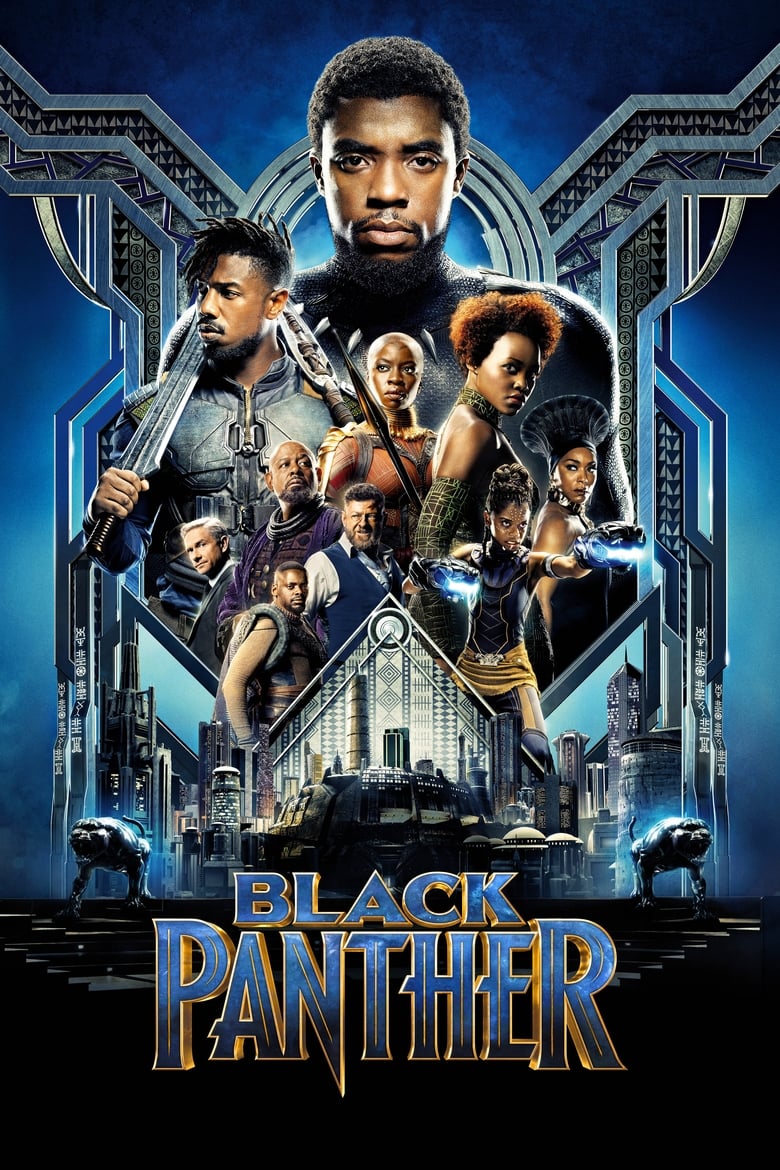
Ryan Coogler's Black Panther put me in a genuine quandary, and I've been trying to unpick exactly why ever since. Because on paper, this is everything I should want from a superhero film. Strong performances, real directorial ambition, a cultural significance that's impossible to overstate, and a cast that commits to the material with total conviction. And yet. It just didn't quite click for me, and I've had to sit with that for a while before I could say it with any confidence.
Let me get the praise in first, because it's well earned. Chadwick Boseman brings a quiet, regal dignity to T'Challa that feels genuinely rare in this genre. There's no mugging, no winking at the camera. He plays it straight, and it works. Danai Gurira is fierce and grounded throughout, and Forest Whitaker brings the kind of veteran weight that makes every scene he's in feel a little more serious. Fair play to all of them, because they are doing the absolute heavy lifting here. The performances carry the film across stretches where the script alone might not manage it.
My main stumbling block, and this is a personal one more than a critical flaw, is Wakanda itself. I tend to connect far more easily with superhero narratives when they're anchored in something recognisable. Think of Spider-Man swinging through a grimy, lived-in New York, or the X-Men navigating prejudices that mirror our own world's ugliest instincts. Wakanda, by contrast, is a fully self-contained fantasy kingdom. The production design is gorgeous, I won't dispute that for a second, but I found myself unable to bridge the gap between that hyper-advanced, isolated utopia and anything resembling my own reality. It kept me at arm's length throughout, and no amount of stunning visuals could quite close that distance.
That detachment bleeds into the plot, which is really where the film loses me. Because the story is so tightly contained within the borders of this fictional nation, the succession crisis and internal political conflict never quite land with the urgency they need to. When the stakes are confined to a place that doesn't exist, and the threat is almost entirely internal, it becomes very hard to muster genuine emotional investment. I kept waiting for the story to reach outward, to find some thread that connected Wakanda's troubles to something larger, but it stays firmly within its own lore. Which is a legitimate creative choice, but not one that worked for me.
It's a real shame, honestly, because the ambition here is hard to dismiss. Coogler has clearly poured himself into this, and having seen Chronicle (2012), a film that takes a completely different approach to superhero storytelling by rooting it in recognisable teenage reality, I know how much the grounding matters to my enjoyment of the genre. The action sequences in Black Panther are punchy and well-choreographed, and there are individual moments of real filmmaking quality scattered throughout. But the sum of the parts never quite coheres into something I can fully embrace.
What I keep coming back to is this: I can respect this film far more than I can love it. Coogler has crafted a vibrant, culturally meaningful milestone for mainstream cinema, and the cast earns every bit of goodwill the film generates. But for me, personally, the world it inhabits felt too sealed off, too self-referential, too removed from anything I could grab hold of emotionally. It's a thoroughly decent piece of blockbuster entertainment, and I'd never try to talk anyone out of their enthusiasm for it. It just didn't get its hooks into me the way I wanted it to.
Three stars.
Rating: ★★★ | Year: 2018 | Watched: 2026-07-16
Where to watch
Watch in the UK
Stream: Disney Plus
Rent: Apple TV Store · Rakuten TV · Amazon Video · Google Play Movies
Buy: Apple TV Store · Rakuten TV · Amazon Video · Google Play Movies
Physical: Amazon UK · Zavvi
Watch in the US
Stream: Hulu · Disney Plus
Rent: Amazon Video · Apple TV Store · Google Play Movies · YouTube
Buy: Amazon Video · Apple TV Store · Google Play Movies · YouTube
Physical: Amazon US
Affiliate disclosure: Movies With Macca may earn a small commission on purchases or subscriptions started via these links. It costs you nothing extra.