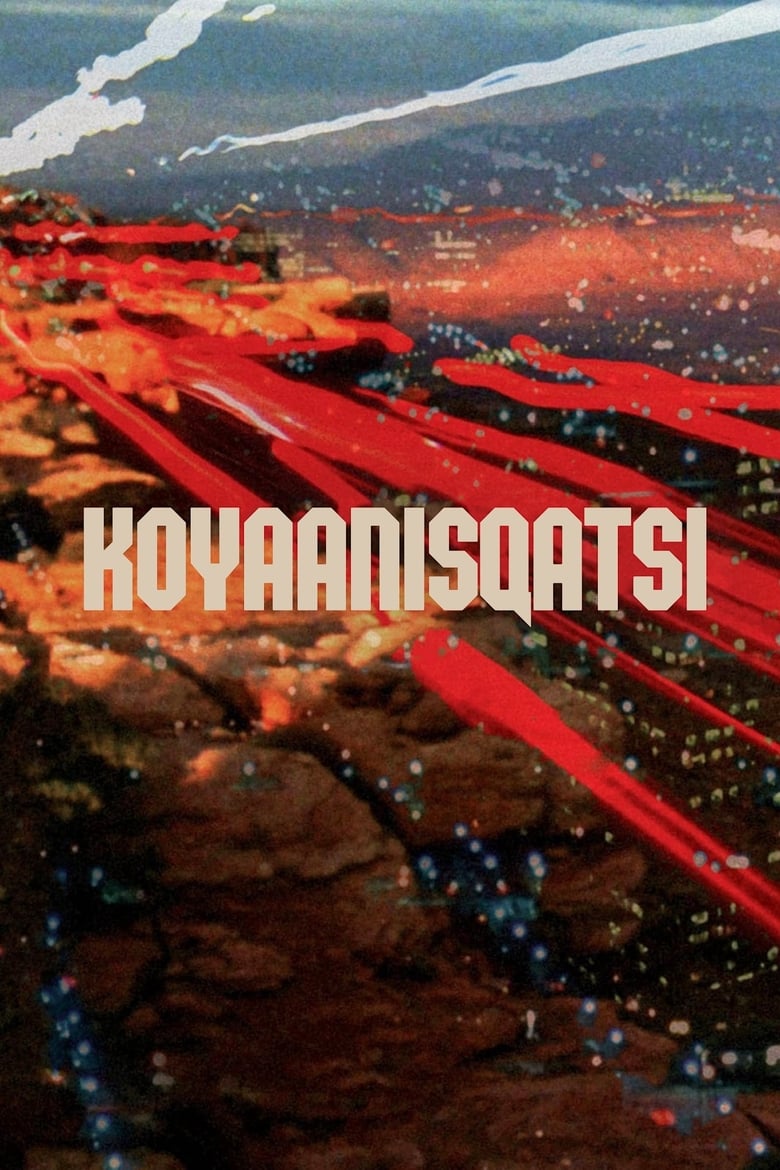
Koyaanisqatsi (1982)
There are films that tell you a story, and then there are films that simply confront you with the world and leave you to make of it what you will. Koyaanisqatsi, released in 1982 and directed by Godfrey Reggio, belongs firmly to that second, far less populated category. The title comes from the Hopi language and translates, roughly, as "life out of balance," which is about as succinct a one-line thesis statement as any film has ever had. Shot across the United States over a period of years beginning in the mid-1970s, the film places natural landscapes and industrial cityscapes side by side, using the contrast alone to make its argument. There is no narrator, no interview subject, no on-screen text explaining what you are looking at or why. You are, for eighty-six minutes, simply asked to watch and to feel. Whether that constitutes a triumph or a frustration rather depends on who is sitting in the seat.
The film arrived at an interesting cultural crossroads. The environmental and anti-nuclear movements of the late 1970s had given a large audience a ready appetite for images of an industrialised world running away from itself, and the early 1980s saw experimental film finding unlikely routes into wider distribution, partly through the growing prestige of the art-house circuit. Reggio, a former monk and social activist with no prior feature-film experience, made Koyaanisqatsi through his Santa Fe Institute for Regional Education, with support from Francis Ford Coppola's American Zoetrope lending the project a degree of credibility it might not otherwise have commanded. The budget was modest and the production stretched across years rather than weeks, which perhaps explains both the film's remarkable visual patience and the occasional sense that it is covering the same ground more than once. Cinematographer Ron Fricke, who would later go on to make his own wordless visual essays, was the other crucial creative force behind the camera, and the partnership between his imagery and Philip Glass's score is the engine that makes the whole machine run. Glass, already an established figure in the minimalist music world, composed a looping, pulsing soundtrack that does not so much accompany the pictures as fuse with them entirely. It is the kind of score that is almost impossible to imagine separated from its images, and vice versa. The two have been inseparable in the cultural memory ever since. If you've seen Akira, another film from roughly the same era in which the relationship between a city's pace and its soundtrack is absolutely central to the experience, you'll have some sense of what a genuinely committed audio-visual marriage can feel like.
The question of cast is an odd one here, because Koyaanisqatsi features no actors in any conventional sense. The names that appear in the credits, including Ed Asner, Pat Benatar, Johnny Carson, and Dick Cavett, appear as themselves, glimpsed briefly in television footage that is woven into the broader montage as just another piece of the American media landscape being observed and catalogued. They are not performers in this film so much as found material, cultural artefacts sitting alongside shots of cooling towers and freeway interchanges. It is a choice that says something, in itself, about how Reggio views celebrity and mass culture, though as with everything in the film, he offers no commentary on it. The documentary tradition that Koyaanisqatsi was working against or perhaps working outside of was one built on voice and argument, on films that wanted to persuade you of something through the accumulation of evidence and testimony. Reggio wanted something purer, or at least more abstract, than that. For a sense of how a documentary can engage with equally serious questions of land, politics, and human cost while still giving its subjects space to speak, it is worth looking at Life is Waiting: Referendum and Resistance in Western Sahara, which operates in a very different register but shares some of the same underlying concerns about what modern progress actually costs.
It is a rare thing to watch a feature-length film that operates entirely without dialogue, narration, or a traditional plot. Godfrey Reggio’s 1982 experimental documentary Koyaanisqatsi is exactly that: a nearly 90-minute sequence of visual vignettes showcasing the dizzying heights and depressing lows of the American dream.
I can absolutely admire the bold, uncompromising decision to let the images do all the talking. When you see this approach in a five-minute artistic short, it’s a brilliant, punchy statement. But stretched across a full runtime, it becomes a rather different, and somewhat more exhausting, beast.
The visuals are undeniably breathtaking. Reggio’s pioneering use of time-lapse and slow-motion photography transforms mundane urban sprawl and vast natural landscapes into something genuinely hypnotic. Fair play to the late, great Philip Glass, whose pulsing, minimalist score is the absolute lifeblood of the picture. The music doesn't just accompany the footage; it drives it, elevating a simple shot of traffic on a Los Angeles freeway into a frantic, rhythmic ballet. You cannot deny the sheer technical craft on display here, and the overarching message about humanity’s chaotic relationship with nature and technology is certainly clear.
However, I genuinely think this total absence of spoken context is exactly what holds the film back. When you strip away all narration and dialogue, you are occasionally left with what feels like a sequence of highly stylised, if somewhat repetitive, videoclips. It demands that the audience project their own meaning onto every single frame without ever offering a guiding hand. Compared to the gold standard of documentary filmmaking (think of the profound, contextual depth and narrative clarity you get from a David Attenborough production) Koyaanisqatsi can feel remarkably hollow. You are observing a fascinating phenomenon, but you are kept at a frustrating, clinical distance from it.
This is a picture that demands a very specific kind of patience and a willingness to embrace pure abstraction. It is a visually spectacular, historically significant piece of cinema that certainly achieves what it sets out to do. But admiring a film’s ambition and actually being fully engaged by it are two entirely different things. It remains a beautiful, hypnotic, yet ultimately distant experiment that falls just short of true documentary greatness.
Koyaanisqatsi occupies a curious and genuinely singular place in cinema history: polished but unremarkable in conventional terms, and yet almost impossible to categorise alongside anything else. Its influence is visible everywhere, from music videos to commercial advertising to prestige nature programming, which is either a mark of its importance or a sign of how thoroughly its innovations have been absorbed and diluted by the mainstream. Films that followed in the same wordless, image-driven tradition, including Reggio's own sequels Powaqqatsi and Naqoyqatsi, have never quite recaptured the peculiar force of the original, if force is even the right word for something so deliberately unhurried. If you are the kind of viewer who finds that abstract, non-narrative cinema opens something up in you, this may well be one of the most important films you ever sit with. If you are not, it may simply be a very beautiful thing that happens at you for an hour and a half. Either way, it is not nothing. It is just not quite everything it wants to be.
Rating: ★★★½ | Year: 1982 | Watched: 2026-08-01
Trailer
▶ Watch the official trailer for Koyaanisqatsi (1982) on YouTube

Where to watch
Watch in the UK
Stream: MGM Plus Amazon Channel
Rent: Apple TV Store · Amazon Video · Google Play Movies · Sky Store
Buy: Apple TV Store · Amazon Video · Google Play Movies · Sky Store
Physical: Amazon UK · Zavvi
Watch in the US
Stream: Amazon Prime Video · Amazon Prime Video with Ads
Rent: Amazon Video · Apple TV Store · Google Play Movies · YouTube
Buy: Amazon Video · Apple TV Store · Google Play Movies · YouTube
Physical: Amazon US
Affiliate disclosure: Movies With Macca may earn a small commission on purchases or subscriptions started via these links. It costs you nothing extra.