
Homework (1989)

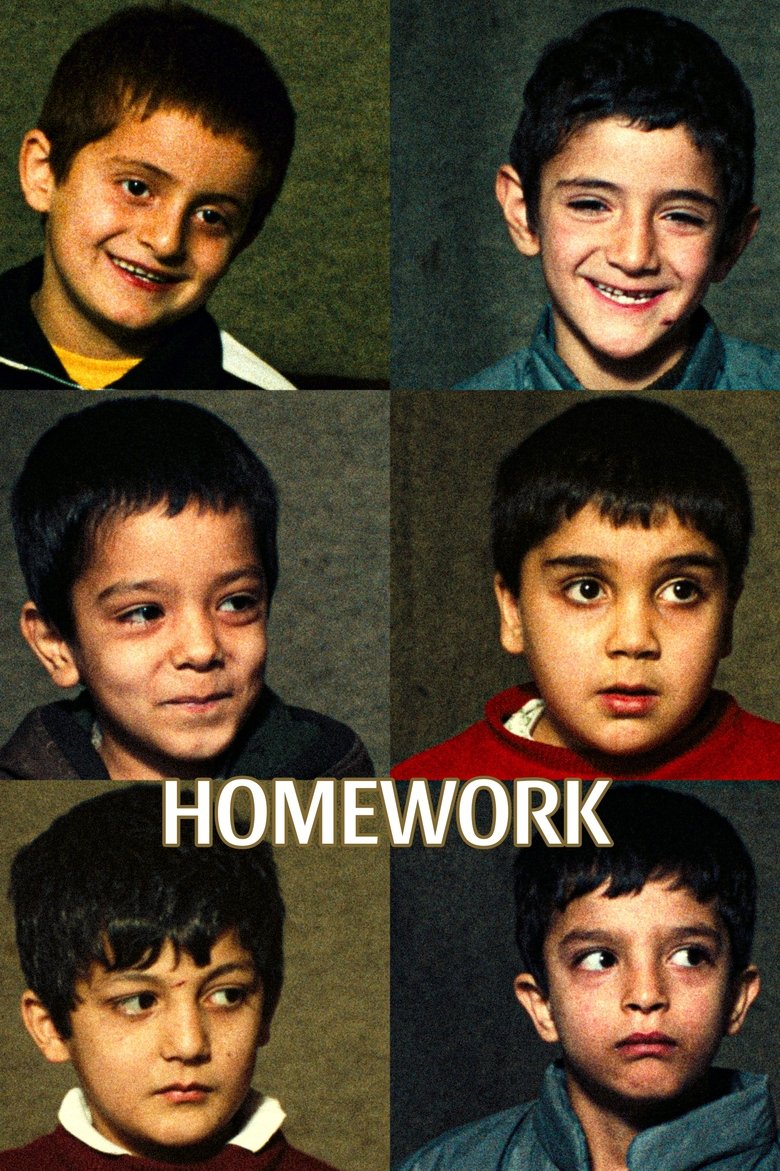
There's a moment somewhere in the middle of Homework where you realise Kiarostami isn't going to give you anything else. No music swells. No narrator arrives to contextualise what you're watching. No edit sharpens the rhythm. He's just going to keep sitting across from these Iranian schoolchildren, asking them about their homework, and letting the camera record whatever comes back. And your response to that realisation will probably determine whether you find the film quietly remarkable or quietly exhausting. Possibly both, which is where I've landed.
Made in 1989, this is about as stripped-back as documentary filmmaking gets. Kiarostami plants himself in a single location and interviews children, one after another, about school, homework, their teachers, their home lives. The questions are simple. The setting never changes. There's no narration, no score, no stylistic ornamentation of any kind. The film doesn't so much unfold as accumulate, and whether that accumulation amounts to something meaningful depends entirely on the patience you bring to it.
Here's the thing: as a time capsule, it's genuinely fascinating. These kids are growing up in post-revolutionary Iran, and their answers, sometimes earnest, sometimes anxious, sometimes clearly rehearsed and sometimes startlingly candid, carry the quiet weight of a specific historical moment. You pick up on the texture of authority, of what it meant to be a child moving through an educational system shaped by a theocratic state. The fear of getting the answer wrong. The deference. The occasional flash of something unguarded breaking through. That's real, and it's valuable, and no amount of polish could have captured it more honestly than this plain, unadorned approach does. If you've seen and admired A Separation (2011), there's a thread connecting that film's interest in how ordinary Iranians navigate systems of authority to what Kiarostami is quietly observing here, decades earlier.
But I want to be honest about the limits of that value. Watching Homework as a film, as a viewing experience you choose to have on a given evening, is genuinely hard going. The repetitive structure, question, answer, next child, question, answer, next child, doesn't build toward anything. There's no thematic development, no shift in perspective, no moment where the material is shaped into an argument or a feeling. Kiarostami refuses to interpret what he's collected, and while that restraint is philosophically defensible, it puts the entire burden of meaning onto the viewer. I found myself doing a lot of work for returns that were, honestly, modest.
It's not the age that's the problem. I've found plenty of older, simpler documentary work completely gripping. The House Is Black (1963), for instance, is a short, spare film made with minimal resources that still manages to feel crafted, shaped, alive with intention. Homework feels more like an archival deposit than a made thing. Which might be exactly what Kiarostami intended, but it does leave you wondering who the film is really for.
The honest answer is: Kiarostami completists, scholars of Iranian cinema and social history, and documentary enthusiasts with a particular appetite for observational work at its most unmediated. For those people, it offers something rare and worth the effort. As a portrait of childhood under a specific set of pressures, it has a raw authenticity that more polished, structured documentaries often sand away entirely. The children feel real in a way that's almost uncomfortable.
For general audiences looking for story, emotion or any kind of dramatic momentum, though, I'd be doing you a disservice if I pretended otherwise. Homework is austere to the point where the austerity becomes the defining quality rather than a stylistic choice in service of something larger. It's more artifact than film, more historical document than cinema. There's genuine interest here, but you'll need to go looking for it. It won't come to you.
Worth watching with the right context and the right mindset. But go in knowing exactly what you're signing up for.
Rating: — | Year: 1989 | Watched: 2026-05-26
Where to watch
Watch in the US
Stream: Criterion Channel
Physical: Amazon US
Affiliate disclosure: Movies With Macca may earn a small commission on purchases or subscriptions started via these links. It costs you nothing extra.



