Deep End (1970)

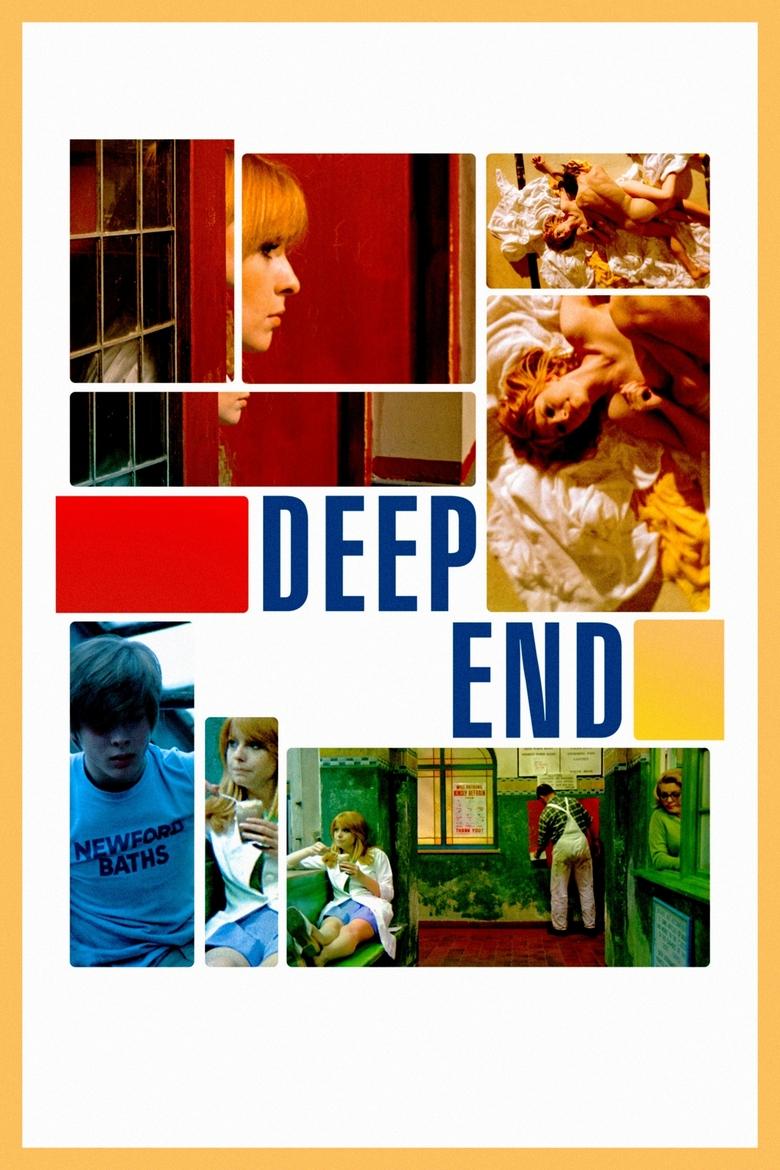
Jerzy Skolimowski made Deep End in 1970, between his Polish-language early work and the international art-house reputation he would cement through the following decade, and it has the feeling of a film made by someone testing how far he can push a relatively simple premise. A co-production between British and West German companies (Maran Film and Kettledrum-Lownes Productions), it was shot largely on location in London, with some sequences filmed in Munich standing in for the city's grittier public spaces. The script was written by Skolimowski alongside Bolesław Sulik and Jerzy Gruza, and the three of them build the story around a fifteen-year-old boy called Mike who takes a job at a municipal bathhouse and becomes consumed by his feelings for Susan, the young woman who works alongside him. What begins as a period comedy of manners, set against the fading, slightly seedy world of public baths and their regular clientele, gradually curdles into something more troubling: a portrait of infatuation that refuses to stay charming.
The film belongs, in many ways, to a particular strain of early-seventies British cinema that was willing to look at unglamorous corners of London life without flinching and without romanticising. Get Carter (1971), which I also reviewed, shares something of that quality, though it heads somewhere considerably more violent. Deep End is quieter but no less unnerving in its way, interested in the texture of ordinary places and how desire warps a person's perception of them. The bathhouse itself, all cracked tiles and chlorine-coloured light, becomes a kind of pressure chamber for Mike's fixation.
Jane Asher plays Susan, and she is the gravitational centre of the film. She was already well-known in Britain by 1970, both for her stage work and for the kind of public visibility that came with being a recognisable face of the sixties. John Moulder-Brown plays Mike with a physical awkwardness that feels entirely right for the character, all restless energy and poorly suppressed longing. Karl Michael Vogler and Christopher Sandford appear in supporting roles, and Diana Dors turns up in a small but memorable part, her presence carrying the weight of an era all on its own.
Cinematographer Charly Steinberger shoots the film with a quality that is polished but deliberately unglamorous, finding a kind of greasy beauty in neon signs reflected in puddles and the institutional interiors of the baths. The colour palette runs warm and slightly overripe, which suits the story's atmosphere of something slightly off. The editing by Barrie Vince is assured, with the film's pace shifting between loose and observational in its comedy scenes and something tighter and more pressurised as Mike's behaviour escalates. The score is one of the film's most immediately striking features: Cat Stevens contributes two songs that give certain scenes a wistful, period-specific texture, while the German experimental group Can provide the more unsettled, percussive underlay. It is an unusual combination, but it works, the two musical voices pulling in different directions in ways that mirror the film's own tonal shifts. For another film where the soundtrack does a great deal of heavy lifting, see also my review of The Wicker Man (1973). And if the idea of a coming-of-age story that refuses easy comfort interests you, Ghost World (2001) is worth reading about alongside this one.
There is something oddly magnetic about Jane Asher's voice, which caught my ear in The Masque of the Red Death too, and Deep End makes fine use of it. More than that, though, the film captures its time and place beautifully: this is 1970 London rendered so vividly you can almost smell it, grubby and garish and alive.
The story follows Mike, a fifteen-year-old who takes a job at a public bath-house and falls, hard, for Susan, an older woman already working there.
From there it becomes a study of teenage infatuation curdling into obsession, as Mike fawns over Susan and trails after her with mounting desperation. The standout, oddly, is a scene in which he wolfs down something like nine hotdogs purely so he can loiter outside her place, which is both funny and faintly pathetic in exactly the way the film intends. I will say the content is a touch troublesome; the boy is fifteen, and the film's frankness about his desire sits somewhat uneasily.
It does not entirely stick the landing. The ending is abrupt and left me unsatisfied, cutting off just as you brace for it to resolve. But the atmosphere, the mood and the queasy pull of it carry it a long way, and I came out thinking well of it on balance. Three and a half stars. A strange, vivid and slightly unsettling time capsule of a film, and a better one than its abrupt finish might suggest.
Deep End is the kind of film that gets filed away and rediscovered, valued more as time passes and its particular London starts to feel genuinely remote. The combination of a strong central performance, an unusually adventurous score and Steinberger's colour-saturated images gives it a sensory distinctiveness that most films of its budget and era simply do not have. Its flaws are real, and they are not small flaws, but there is something in the film's atmosphere that lingers in a way a tidier, more resolved picture might not. It is, in the end, a film that knows exactly how uncomfortable it wants to make you, even if it does not always know when to stop.
Rating: ★★★½ | Year: 1970 | Watched: 2026-10-26
Trailer
▶ Watch the official trailer for Deep End (1970) on YouTube
Where to watch
Watch in the UK
Stream: BFI Player · BFI Player Amazon Channel · BFI Player Apple TV Channel
Physical: Amazon UK · Zavvi
Watch in the US
Stream: FlixFling
Rent: FlixFling
Buy: FlixFling
Physical: Amazon US
Affiliate disclosure: Movies With Macca may earn a small commission on purchases or subscriptions started via these links. It costs you nothing extra.