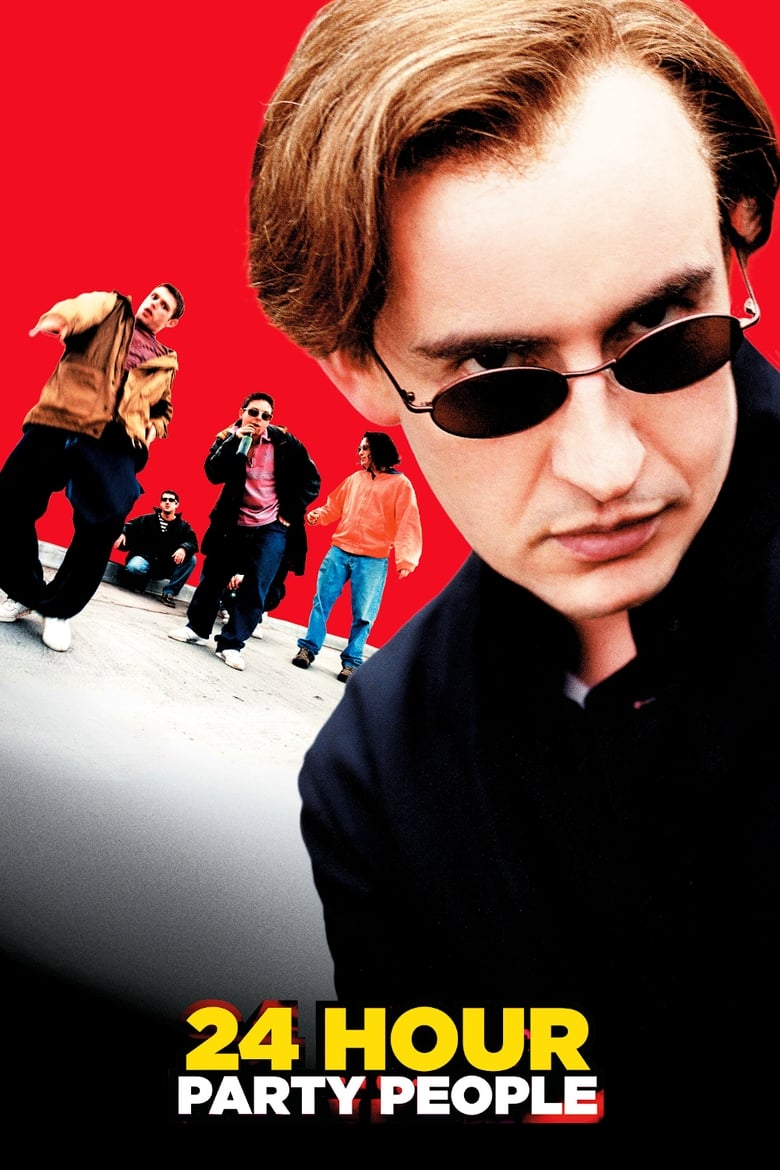
24 Hour Party People (2002)

Manchester in the mid-to-late 1970s was, by almost any conventional measure, a city on the slide: industrial decline, high unemployment, and a civic mood that had soured well before punk gave young people a reason to make noise about it. What grew out of that particular soil, however, was one of the most mythologised chapters in British music history. Factory Records, the label founded by television presenter and self-styled cultural provocateur Tony Wilson alongside Alan Erasmus, gave the world Joy Division, New Order, and a nightclub called the Haçienda that would later become the accidental ground zero of the rave era. It is the kind of story that practically dares a filmmaker not to fictionalise it, and in 2002, Michael Winterbottom took up the challenge.
Winterbottom had already demonstrated a restless willingness to work across genres, from the Thomas Hardy adaptation Jude to the Balkan war drama Welcome to Sarajevo, and 24 Hour Party People fits neatly into a period when he was making three or four films in quick succession, each one formally distinct from the last. Screenwriter Frank Cottrell Boyce, a long-standing collaborator who had worked with Winterbottom on several pictures by this point, structures the film around Wilson as an unreliable narrator, a man who knows he is in a film and occasionally turns to the camera to say so. It is a device borrowed loosely from the tradition of the picaresque, and it gives the whole enterprise a loose, almost shaggy quality that suits the subject matter. The production drew together a consortium of British film bodies: Film4 Productions, The Film Consortium, and Revolution Films (Winterbottom's own company), with United Artists providing American distribution. The budget was modest, which, as it turns out, was entirely appropriate.
The cinematography is handled by Robby Müller, the Dutch lenser best known for his long association with Wim Wenders and his work on Jim Jarmusch's Dead Man and Mystery Train. Here he shoots on digital video with a handheld looseness that keeps the camera perpetually in motion, images that feel grainy and slightly overlit, as though they have been dragged out of someone's home recordings from the period rather than composed for posterity. There are moments where the frame practically shakes with the energy of a live performance, and others where the mundanity of a deal being struck in a dingy office is rendered with the same documentary texture. It is a consistent visual register, one that refuses to glamourise what it is showing you. Editor Trevor Waite cuts with a rhythm that mirrors the music rather than the conventional grammar of drama, scenes ending sometimes abruptly, sequences building through accumulation rather than through classical crosscutting. The film's sound design leans heavily on the actual recordings of the era, which serves both as period authenticity and as a reminder of just how good some of that music genuinely was. For a companion piece in the music documentary mode, see also Oasis: Don't Look Back in Anger, which covers a later wave of Manchester music culture, or, for another film in which documentary technique bleeds into dramatised reconstruction, Aileen: Life and Death of a Serial Killer, which I also reviewed and which uses a similar blurring of the factual and the performed.
Steve Coogan takes the central role, playing Wilson as a man simultaneously aware of his own ridiculousness and utterly convinced of his importance, which is probably an accurate portrait. Alongside him, the supporting cast is a roll-call of British character acting at its early-2000s peak: Lennie James, Paddy Considine, Shirley Henderson, and Andy Serkis, a group that between them can make almost any scene feel lived-in and specific. Paddy Considine in particular brings a particular physicality to his role that is easy to forget is even a performance. I also covered Half Nelson, another film in which a charismatic but self-destructive lead performance threatens to overwhelm everything else around it, and there are points of comparison worth considering.
24 Hour Party People is a perfectly fine film, and in truth, a perfectly fine film is more or less all it is. It tells the story of Tony Wilson and the rise of Manchester's Factory Records and the Hacienda, and it is shot in a grainy, handheld, almost mockumentary style. Given that it is based on a true story, that approach suits it, lending the whole thing a scrappy, you-are-there immediacy.
Steve Coogan takes the lead as Wilson, and here is my trouble: he is so unmistakably Alan Partridge throughout that I found it hard to see anyone else. That is not quite a criticism, more an observation that his comic persona is so familiar it crowds out the character. Around him is a tremendous roster of British talent, Lennie James, Paddy Considine, Andy Serkis, Ralf Little, even Peter Kay, and it is a pleasure to see them all turn up. But a strong cast can only lift a film so far, and this one stays stubbornly in slightly-above-average territory.
The thing I found most compelling, oddly, was the story itself, more than the acting or the style or anything else. The true tale of Factory, all its chaos and its larger-than-life characters, is fascinating in its own right, and the film is at its best when it simply lets that history carry it. The music is fine too, if post-punk is your sort of thing. Three stars. A likeable, well-cast and watchable account of a remarkable moment in British music, but one that never quite rises above the material it is drawing on.
24 Hour Party People sits comfortably in the tradition of the polished but unremarkable British music biopic, elevated by its source material and its cast but content, more often than not, to let both do the heavier lifting. Winterbottom's freewheeling approach keeps it from ever feeling stiff, and Boyce's script has enough genuine wit to sustain the runtime without outstaying its welcome. What lingers, perhaps most of all, is a sense of the real history pressing through the fiction, which is both the film's greatest strength and the quiet argument that the story, told plainly, might have been enough on its own.
Rating: ★★★ | Year: 2002 | Watched: 2026-10-31
Trailer
▶ Watch the official trailer for 24 Hour Party People (2002) on YouTube
Where to watch
Watch in the UK
Stream: Disney Plus
Rent: Apple TV Store · Amazon Video · Sky Store · YouTube
Buy: Apple TV Store · Amazon Video · Sky Store · YouTube
Physical: Amazon UK · Zavvi
Watch in the US
Stream: Amazon Prime Video · fuboTV · MGM+ Amazon Channel · Philo
Rent: Amazon Video · Apple TV Store · Google Play Movies · YouTube
Buy: Amazon Video · Apple TV Store · Google Play Movies · YouTube
Physical: Amazon US
Affiliate disclosure: Movies With Macca may earn a small commission on purchases or subscriptions started via these links. It costs you nothing extra.