You Were Never Really Here (2017)

Share
You Were Never Really Here (2017)

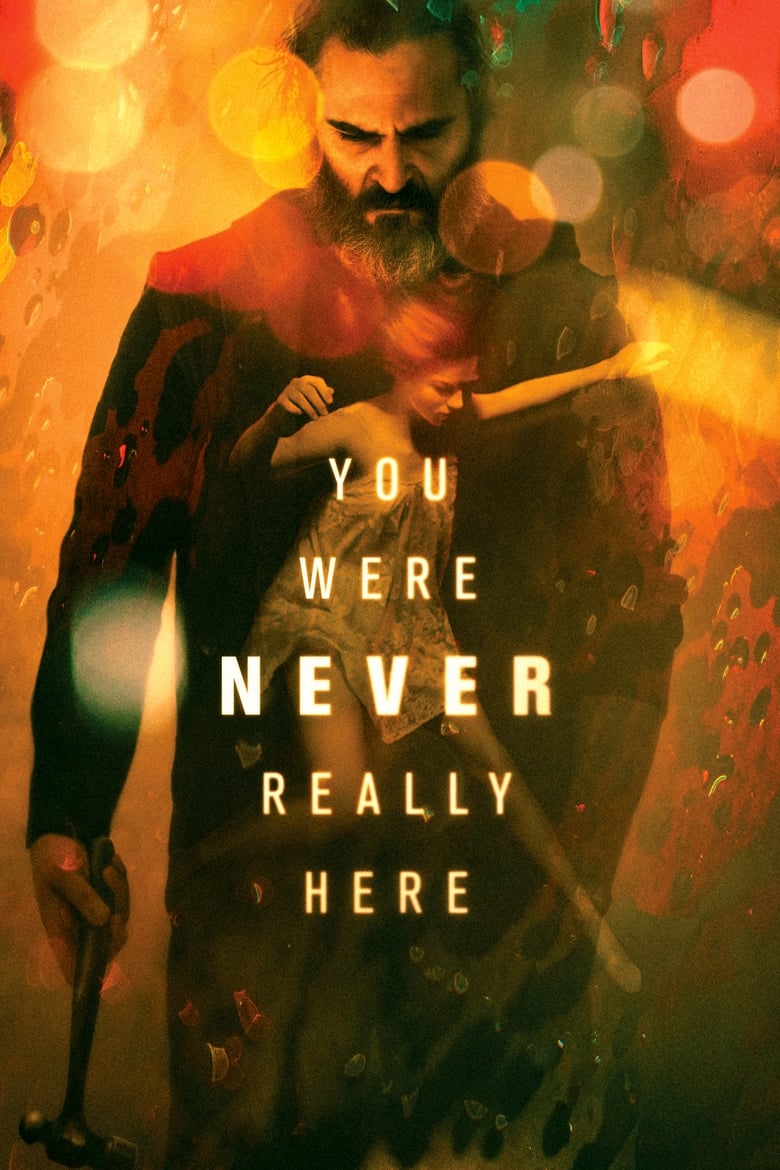
Lynne Ramsay has never been a director interested in comfort. From the suffocating council-estate grief of Ratcatcher (1999) to the cold, forensic dread of We Need to Talk About Kevin (2011), she has spent her career making films that sit in the chest like a stone. You Were Never Really Here, released in 2017 and co-produced between Why Not Productions, Film4 Productions, and Sixteen Films, is no different. It arrived at Cannes that year and left with two prizes: Best Screenplay for Ramsay herself and Best Actor for its lead, Joaquin Phoenix, a pairing that tells you more or less everything about where the film's strengths lie. Adapted from Jonathan Ames's novella, Ramsay wrote the screenplay alone, and the result is an 89-minute film that runs lean, discarding exposition, conventional narrative momentum, and almost any interest in plot mechanics in favour of something rawer: a portrait of a man who is, in almost every meaningful sense, already gone.

That man is Joe, a hired enforcer who finds and recovers trafficked girls using methods that are blunt rather than slick. Joaquin Phoenix plays him, and the casting is, in retrospect, the only casting. Phoenix, who earned considerable attention that same year for his work in Paul Thomas Anderson's The Master, belongs to a rare bracket of performers whose physical presence alone changes the atmosphere of a scene. He is built large for the role and moves through it like a man carrying invisible weight. Opposite him, Judith Roberts plays Joe's elderly mother, and their domestic scenes together provide the film's only real warmth, though even that warmth is fragile. Ekaterina Samsonov takes on the role of Nina, the young girl at the centre of the job that unravels Joe's already precarious hold on things, and she brings a quietness to the performance that matches the film's overall register. John Doman and Alex Manette fill out the supporting cast in a story that, once it starts to spiral, begins to implicate people with serious institutional power.

Ramsay works here with cinematographer Thomas Townend, and together they produce images that are deliberately fragmented and off-kilter. Security camera footage, fractured memory sequences, and sudden cuts away from violence rather than into it give the film a visual texture that feels more like a damaged mind processing the world than a conventional thriller moving through it. There is a specific palette at work: rooms lit low and grey, skin that looks pallid under fluorescent light, the odd intrusion of something almost beautiful, a body of water, a song on the radio, that sits wrong against the surrounding ugliness. Editor Joe Bini, whose work with Werner Herzog across many years has given him a particular fluency with difficult, non-linear material, cuts the film in a way that prioritises feeling over coherence, which is either a feature or a fault depending on your tolerance for ellipsis. Jonny Greenwood's score, his third feature film collaboration after his Radiohead commitments made him a late entrant to film composing, layers electronic dissonance and sudden silence to keep the audience physiologically unsettled in a way that conventional orchestration simply could not. It is the kind of score that does not announce itself so much as get under your skin without asking permission.

For a point of comparison, it is worth thinking about other films built around solitary, damaged men operating outside the law with a private moral code. Phoenix's later turn in Joker (2019) covers adjacent territory in a very different register, broader in its ambitions and considerably more interested in being watched. Gus Van Sant's Paranoid Park (2007) is perhaps a closer formal cousin, sharing that same interest in fractured chronology and a protagonist whose interiority the camera circles without ever fully entering.

Imagine Léon: The Professional with every last scrap of warmth surgically removed, and you are somewhere close to You Were Never Really Here.

Both films pair a haunted hired killer with a young girl he is trying to save, but where Léon finds an unlikely tenderness in that bond, Lynne Ramsay's film wraps the whole thing in a sheen of relentless, bone-deep despair. Joe, her protagonist, is a traumatised enforcer who rescues trafficked children with a hammer and would plainly rather not be alive to do it; this is a revenge thriller filtered through the fog of severe, unspoken PTSD.

It takes an actor of real stature to hold a film this internal together, and Joaquin Phoenix is exactly that. He belongs, for me, in the same rarefied bracket as Daniel Day-Lewis, whom I last watched chewing up the scenery in There Will Be Blood: the kind who does not churn out a film a year, but whose mere presence tends to guarantee a performance worth the price of admission, even when the film around him wobbles. Here he is extraordinary, hulking and broken and wordlessly sad, carrying almost the entire picture on his slumped shoulders. Take a performance of this calibre out of it, and I am not sure there is a film left standing.

Ramsay is a formidable film-maker, and she shoots the violence with a bracing, matter-of-fact realism, brief and ugly and never once balletic or cool. There is a whole lineage of stylish loner-with-a-code thrillers I have a lot of love for, the Drives and the Léons of the world, but this one deliberately strips away their glamour and leaves something rawer and far harder to enjoy. Jonny Greenwood's score works away underneath it all to deeply unsettling effect, and the whole thing is assembled with real control.

And yet. For all that I can see how good it is, the performance, the direction, the sheer uncompromising vision of it, the film left me feeling utterly hollowed out, and not altogether in a way I enjoyed. That is plainly the intended effect, and I respect a film that commits so completely to its own bleakness, but it does make it a hard one to love, or to be in any rush to revisit. It is superbly made and superbly performed, and about as much fun as a punch to the gut, which is precisely what it is going for. Three and a half stars, and a remarkable film I doubt I will ever quite have the stomach to sit through twice.

You Were Never Really Here is the kind of film that prompts genuine admiration and something close to reluctance in equal measure, and the fact that those two responses coexist without either cancelling the other out is itself a mark of how seriously Ramsay takes her craft. It sits in a tradition of British and European art-house crime films that prioritise psychological weight over genre satisfaction, and it arrives at that position with honesty and rigour rather than affectation. Whether that is a recommendation depends almost entirely on what you are in the mood for on a given evening. Some films you want to revisit often; others you are glad exist precisely once.


Rating: ★★★½ | Year: 2017 | Watched: 2026-08-24

View on Letterboxd →


Trailer

▶ Watch the official trailer for You Were Never Really Here (2017) on YouTube


Where to watch

Watch in the UK
Stream:
Studiocanal Presents Amazon Channel
Rent: Apple TV Store · Amazon Video · Google Play Movies · Sky Store
Buy: Apple TV Store · Amazon Video · Google Play Movies · Sky Store
Physical: Amazon UK · Zavvi

Watch in the US
Stream:
Amazon Prime Video · Amazon Prime Video with Ads
Rent: Amazon Video · Google Play Movies · YouTube · Spectrum On Demand
Buy: Amazon Video · Google Play Movies · YouTube
Physical: Amazon US

Affiliate disclosure: Movies With Macca may earn a small commission on purchases or subscriptions started via these links. It costs you nothing extra.

Film images and data courtesy of TMDB. This product uses the TMDB API but is not endorsed or certified by TMDB.