What Goes Up.... (2003)

Share
What Goes Up.... (2003)

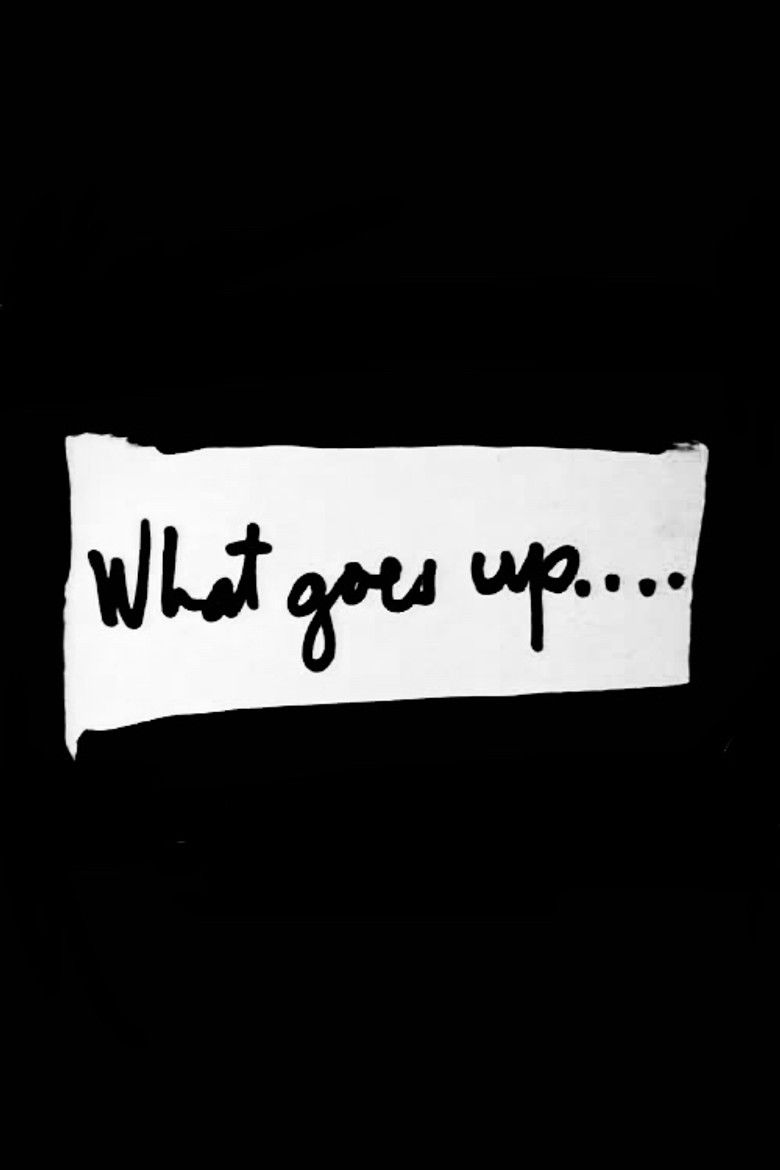
Robert Breer is not a name that comes up often in casual film conversation, and that is, in its own way, rather telling. Born in Detroit in 1926, Breer spent decades working at the margins of mainstream cinema, producing short experimental films that sat comfortably in the world of gallery art and avant-garde festivals rather than anything resembling a Saturday night multiplex. He began his career as a painter in Paris in the early 1950s, fell in with the abstract art scene there, and gradually shifted toward film as a medium for exploring the same preoccupations: rhythm, form, movement, the relationship between the flat image and the illusion of depth. By the time he was producing work in the early 2000s, he had been at it for over fifty years, and What Goes Up... (2003) arrived as one more entry in a long, consistent body of work rather than any sort of departure.

At just five minutes in length, the film sits firmly in the tradition of short experimental cinema, a tradition with its own lineage running back through Maya Deren, Stan Brakhage, and the broader American avant-garde movement of the mid-twentieth century. Breer's method here is sometimes described by critics as a "kitchen sink" approach, throwing together hand-drawn animation, photographic imagery, abstract shapes, and rapid-fire editing into a single, compressed experience. The title nods to the familiar idiom about what goes up coming down, and the film circles around ideas of aspiration, failure, and the particular physics of imagination, including a recurring motif of flight and aircraft that appears throughout Breer's work across several decades. It is the kind of film that arrives with a certain amount of critical apparatus already built around it, having found a place on the They Shoot Pictures, Don't They? list of significant 21st-century films, a list that tends to reward exactly this sort of formally rigorous, resolutely non-commercial work. Whether that critical pedigree translates into an enjoyable ninety minutes for the average viewer is, of course, a rather different question (and here the average runtime is five minutes, which may or may not feel like ninety depending on your disposition toward abstract cinema). For a point of contrast in short-form animation, you might find it worth reading Macca's take on The OceanMaker (2014), another brief film that uses animation to carry thematic weight, or his thoughts on the documentary short tradition in his review of Moana (1926), a film equally committed to a very particular, personal vision of the world.

Production details for What Goes Up... are sparse in the way that experimental shorts typically are: no major studio, no notable budget, no household names in the credits. Breer functioned as his own creative engine, as he did throughout his career, doing the work himself rather than through any conventional industry pipeline. That self-sufficiency is both the strength and the limitation of the form. There is nobody here to second-guess an idea or ask whether a general audience might follow along, which produces work of total artistic integrity and, sometimes, total inaccessibility in roughly equal measure.

I am not the biggest fan of avant-garde cinema at the best of times. So, when I sat down to watch Robert Breer’s 2003 experimental short What Goes Up…, I knew I was in for a massive challenge. It’s a film that somehow secured a prestigious spot on the "They Shoot Pictures, Don't They?" top 1000 films of the 21st century list, but to my grounded sensibilities, it feels utterly alien.

Breer employs what critics call a "kitchen sink" approach, cramming in as many disparate elements as possible to explore the dual nature of cinema as both an illusion of movement and a mere succession of stills.

In terms of actual narrative, there isn't one to speak of. Instead, the picture is essentially a relentless barrage of abstract images shot together to resemble a frantic, disjointed form of stop-motion animation. Breer is clearly trying to combining various rhythmic patterns, abstract shapes, and flat illusions of depth. But if I’m being entirely truthful, watching it felt less like a profound cinematic exploration and much more like sitting through a hyperactive compilation of 1990s MTV channel outros. It’s a sensory overload of colours and textures that, while undeniably vibrant, completely lacks the accessible storytelling I usually look for in a film.

That being said, you have to give Breer a massive amount of credit for his sheer, unadulterated artistic ambition. The film is deeply layered with thematic tension, particularly around the concept of failure and failed aspirations. It’s a fascinating, if deeply bizarre, intellectual exercise, and I can genuinely appreciate the ecstatic, rhythmic energy he’s trying to inject into the viewer's psyche, even if the execution completely flew over my head.

What Goes Up… is a fascinating piece of avant-garde trivia that I simply could not connect with on any enjoyable level. It’s a relentless, abstract visual puzzle that demands a level of patience and interpretive energy that I just didn't have to give on this viewing.

However, I can respect it as a bold, boundary-pushing experiment that perfectly encapsulates Breer’s lifelong dedication to the mechanical and rhythmic possibilities of the medium. It might be a celebrated masterpiece for the avant-garde faithful, but for the rest of us, it’s just a bewildering, colourful mess that leaves you desperately waiting for the credits.

Where you land on What Goes Up... will depend almost entirely on what you want from a film and how much interpretive goodwill you are prepared to bring through the door. Breer's reputation among experimental film scholars is well-earned and not trivially dismissed, and there is genuine rigour in what he spent his career doing. But rigour and accessibility are not the same thing, and a film that rewards patient, theoretically-minded viewing is not obligated to reward any other kind. Experimental cinema has always existed in a somewhat separate conversation from mainstream film culture, and reviews like this one, from a critic writing for an audience that might equally enjoy The Last Samurai (2003) or Honey, I Shrunk the Kids (1989), are a useful reminder of how wide that gap can be. Some films are made for everyone. Some films are made for someone. And some films seem to have been made primarily to settle an argument about the nature of cinema that most of us did not know was happening.


Rating: ★ | Year: 2003 | Watched: 2026-07-08

View on Letterboxd →

Film images and data courtesy of TMDB. This product uses the TMDB API but is not endorsed or certified by TMDB.