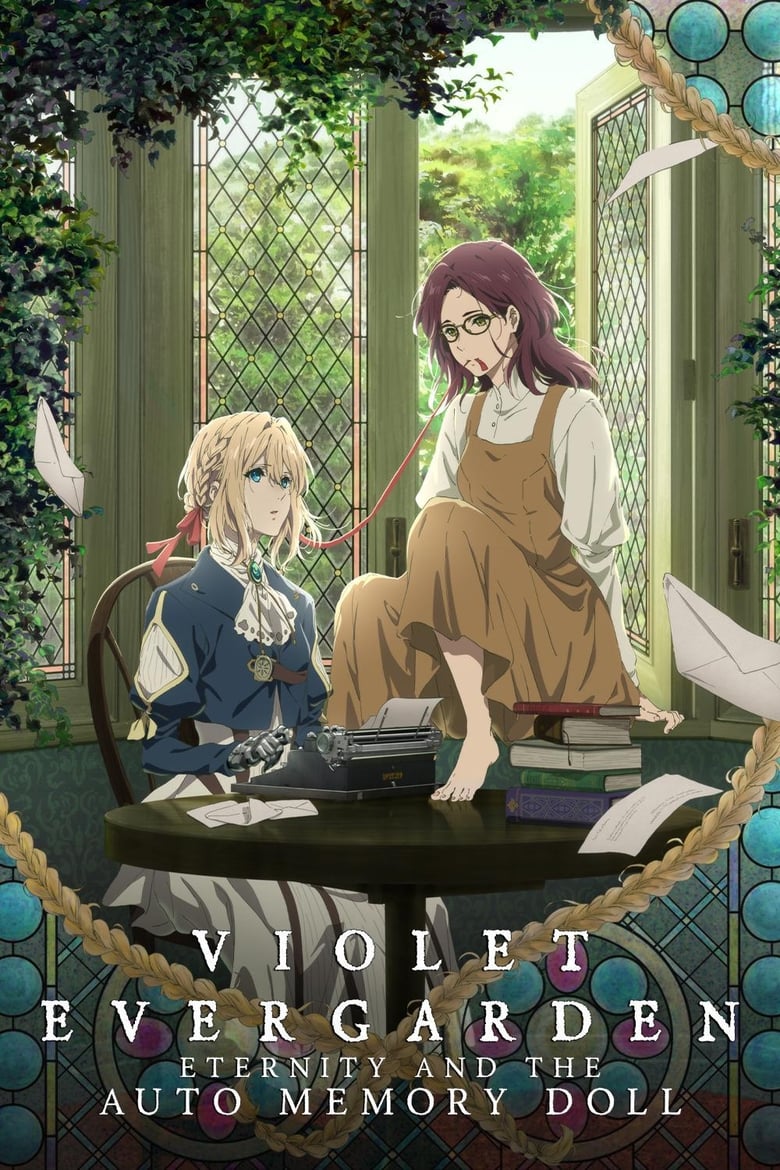
Violet Evergarden: Eternity and the Auto Memory Doll (2019)

There is a particular kind of frustration that has nothing to do with a film being bad, and everything to do with realising, somewhere around the halfway point, that you have walked into the middle of someone else's conversation. That is more or less where I found myself with Violet Evergarden: Eternity and the Auto Memory Doll.
I came to it by a fairly roundabout route. It was sitting on Netflix, it appears on Letterboxd's Top 250 Women-Directed list, and that combination was enough to get me clicking play. What I completely failed to clock beforehand was that this is not a standalone film in any meaningful sense. Directed by Haruka Fujita, it is a self-contained side-story that slots in between episodes of the Violet Evergarden television series before jumping forward in its second half. I only pieced that together afterwards, doing a bit of digging. Going in, I had none of it.
And that context, it turns out, matters enormously. Because the film itself is visually extraordinary. Kyoto Animation's work here is lush and painterly and genuinely delicate, the kind of hand-crafted beauty that reminds you why animation as a medium can do things no other form can quite manage. Frame by frame, it is close to wonderful. It reminded me of the quiet, considered beauty I found in Flavors of Youth (2018), another animated film where the artistry is so present you almost feel you could reach out and touch it.
But here is the problem. This is a talky, gentle, deeply interior piece. Its emotional power depends almost entirely on you already caring about these characters, on having spent hours with them, on knowing what they have been through before this story even begins. Coming in cold, I spent much of the runtime with a nagging feeling that I was supposed to feel far more than I actually did. The quiet moments that are clearly meant to land with some weight kept gliding past me. I was watching emotion rather than feeling it, which is a strange and somewhat deflating experience when the film around you looks this good.
The structure adds another layer of strangeness if you are not prepared for it. The first half functions almost like an extended episode, intimate and character-focused. Then the second half makes a significant leap forward in time, and if you do not have the series anchoring you, that shift lands with less impact than it should. I can see exactly what Fujita is going for, and I suspect for viewers who have done the homework it works beautifully. For me, it just highlighted how much I was missing.
So scoring this fairly is genuinely difficult. On pure craft, it is close to four stars without breaking a sweat. On the actual experience of watching it the way I watched it, dropped in without the necessary grounding, it is something closer to two. What I have settled on is two and a half, and I want to be upfront that this is a provisional verdict with an asterisk the size of an entire television series attached to it.
I am not writing it off. If anything, the glimpses of what it could be, what it probably is for the right viewer, are enough to make me want to go back and do this properly. Watch the series, then watch this, then move on to the 2020 film in the right order. My instinct is that revisiting it that way would be a meaningfully different experience, and I would not be at all surprised if the score went up considerably.
For now, though, I can only review the experience I had. And that experience was a gorgeous but oddly weightless one. Two and a half stars. Go watch the series first.
Rating: ★★½ | Year: 2019 | Watched: 2026-08-20
Where to watch
Watch in the UK
Stream: Netflix · Netflix Kids · Netflix Standard with Ads
Physical: Amazon UK · Zavvi
Watch in the US
Stream: Netflix · Netflix Standard with Ads
Rent: Amazon Video · Fandango At Home
Buy: Amazon Video · Fandango At Home
Physical: Amazon US
Affiliate disclosure: Movies With Macca may earn a small commission on purchases or subscriptions started via these links. It costs you nothing extra.