The Red Turtle (2016)

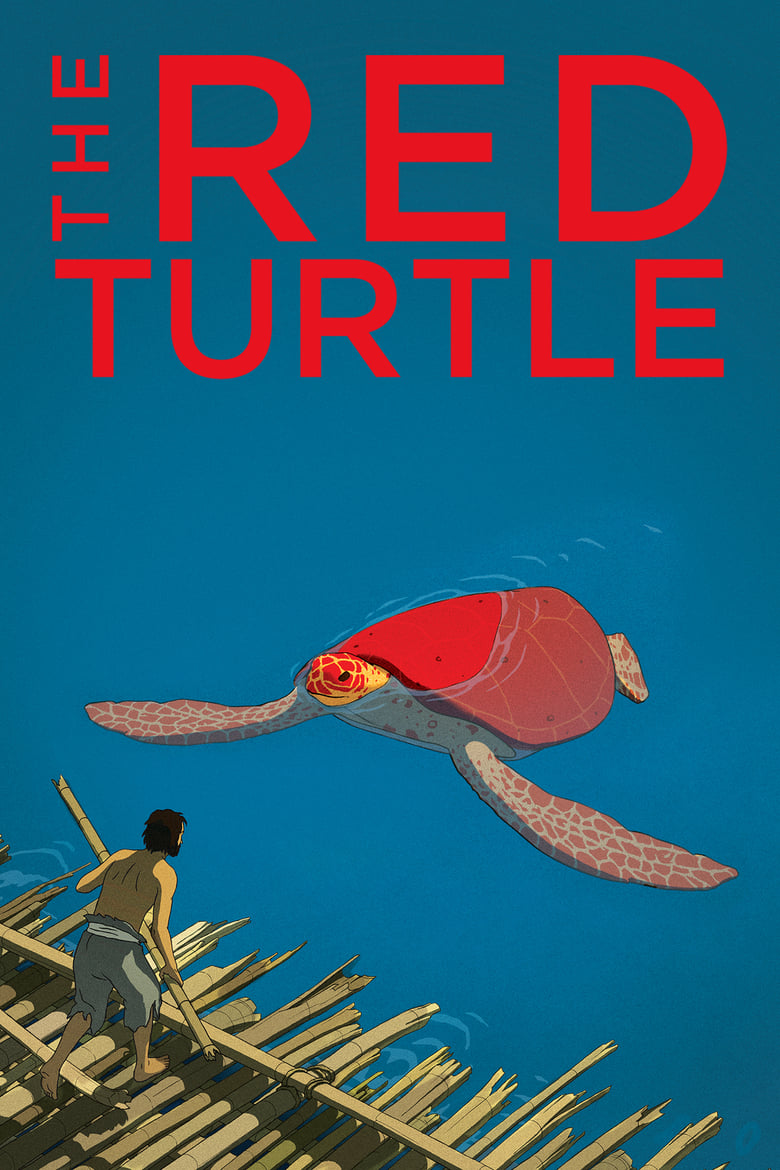
There's a version of The Red Turtle that I think I could love. The version that exists purely as a sequence of images, a moving watercolour book you'd leave open on a coffee table and let wash over you. Michael Dudok de Wit has made something genuinely extraordinary to look at. Every frame, every sweep of ocean, every character silhouetted against a bruised sky, it's all crafted with such loving, meticulous attention that it functions as a real visual spectacle. I found myself genuinely wanting to pause the film just to sit inside a particular shot for a while. As a beautiful object, it's close to faultless.
Which makes it all the more frustrating that, as a film, it left me almost completely cold.
The most celebrated thing about The Red Turtle is its complete absence of dialogue. Not a single spoken word for 81 minutes. And I want to be clear: I'm not instinctively opposed to that kind of storytelling. I've seen it done brilliantly. Dudok de Wit himself, whose short film Father and Daughter is a miniature masterpiece of wordless emotional precision, knows how to tell a human story without language. That film made me well up in under ten minutes. So I came into this with genuine goodwill, ready to be moved.
But the silence here doesn't feel like a considered artistic choice so much as a void the film never manages to fill. There's a difference between a story that doesn't need words and a story that is actively missing them. The Red Turtle falls squarely into the second camp. You spend the entire runtime waiting for a character to communicate something, anything, that the animation simply cannot carry on its own. The emotional beats arrive and pass like small waves on a flat sea. You register them, and then they're gone, because there's no dialogue, no internal monologue, no verbal texture to anchor you to these people or to what they're going through.
That lack of narrative momentum makes 81 minutes feel like considerably more. I'll be honest about the circumstances: I tried watching this as a family film, thinking the gentle, nature-focused aesthetic might work as a Saturday afternoon watch with the kids. It was a misjudgement. Neither of them lasted more than five minutes before they were squirming and asking when something was going to happen. I can't fully blame them. When a story offers you no verbal hooks and no real propulsion, it becomes a chore regardless of how gorgeous the scenery is. At least they were honest about being bored. I was just quietly checking my watch.
The frustrating thing is that the film clearly has ambitions beyond mere aesthetics. There's something mythological being attempted here, a fable about life, solitude, love and the sea. I can see the shape of it. But a film needs to make you feel its ideas, not just gesture at them from a distance. The imagery alone, beautiful as it is, can't do all that heavy lifting. It's a bit like being handed a stunning illustrated edition of a story you've never heard, with all the text removed. You can appreciate the pictures. You just don't really know what happened, or why it should matter to you.
Two and a half stars. Watch it on mute with something else on in the background, and it might be one of the finest screensavers ever committed to film. As a piece of narrative cinema, it's a visually spectacular and profoundly tedious experience that asks for your patience and, in my case at least, gave very little back.
Rating: ★★½ | Year: 2016 | Watched: 2026-07-22
Where to watch
Watch in the UK
Stream: Studiocanal Presents Amazon Channel
Rent: Apple TV Store · Rakuten TV · Amazon Video · Google Play Movies
Buy: Apple TV Store · Rakuten TV · Amazon Video · Google Play Movies
Physical: Amazon UK · Zavvi
Watch in the US
Rent: Amazon Video · Apple TV Store · Google Play Movies · Fandango At Home
Buy: Amazon Video · Apple TV Store · Google Play Movies · Fandango At Home
Physical: Amazon US
Affiliate disclosure: Movies With Macca may earn a small commission on purchases or subscriptions started via these links. It costs you nothing extra.