Something Pointless: Asa Bailey in Conversation

Something Pointless was one of the loveliest surprises I have had all year. It runs a mere fourteen minutes, and in that time it takes on illness, mortality and childhood bullying and lands an emotional punch that plenty of two hour dramas spend their whole runtime reaching for and miss. I gave it four stars, and you can read my full review here.
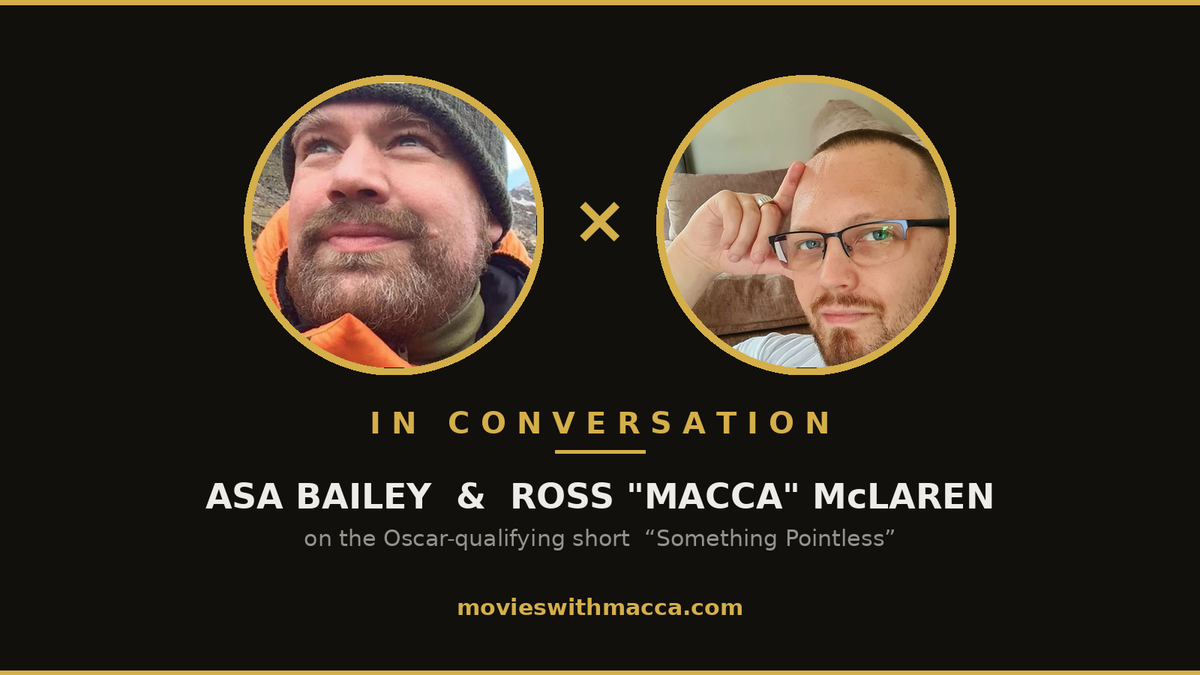
Directed by Asa Bailey from a screenplay by Neil Graham and David Cormican, the film is currently on an Academy Award qualifying run, and I was delighted when Asa agreed to answer some questions about it. We talked about trusting the audience to do the work, the strange beauty of that eggshell wall, drawing career-best tenderness from Owen Teale and Sophie Thompson, guiding a young performer through a role that lives almost entirely in the face, and carrying a small Welsh story onto the world stage. His answers were as generous and thoughtful as the film itself, so I have kept them in full below.
The film takes on illness, mortality and childhood bullying, and somehow does it all in fourteen minutes without ever feeling rushed. When you are working at that length, how do you decide what to leave unsaid and trust the audience to fill in?
Underestimating the audience is a big sin for me. I don't want everything understood in an obvious way; you need to engage the audience through a bit of mystery and a bit of work. When they work for it, they earn it, and that means something. So it's not about leaving things out, it's about making the audience think it up for themselves.
The eggshell wall is such a beautiful, strange central image. Where did that idea come from, and how much of the artwork you see on screen was actually built for the shoot?
The idea was from Neil Graham, the writer; I just brought it to life and let the humanity of the situation come out in the work. It's not perfect, and that's the point! Our production designer came from a very hands-on background. She is an artist, and we asked her to make a mural for a massive wall in no time and with a very limited budget. She did an amazing job, and that effort and craft is what makes it real.
Owen Teale gives Aldous such quiet dignity, and Sophie Thompson brings real tenderness to Eleri. What did each of them find in these characters that you maybe had not seen on the page?
Owen and Sophie educated me. They have such a deep experience with roles and how to do just the right thing. I don't need to direct them; I just build the world for them to play in, and they come to life as if they are the characters. They are true artists.
Leo Harris is remarkable as the Boy Who Never Smiles, a role that lives almost entirely in the face. How did you direct a young performer through a part with so little dialogue and so much feeling?
Young Leo has incredible energy, he's like a ball of explosive atoms that cannot wait to expand, make mischief, explore, play, and love. I just gave him a small opportunity to explore what it's like to put that energy to use. He's a child, but he has a mass of energy to be shared with the world. We just needed to make sure we guarded and directed his young energy, giving him chances to play with his inherent talent.
The finale, where the wall comes alive with animation, is a gorgeous turn. You come from a background at the frontier of visual storytelling, so how did you approach using that craft for emotion here rather than spectacle?
Some will use AI to build spectacle, but I use it to extend the emotional, to make a point, and to drive home an idea in a way that is as simple, natural, and complementary to the shot footage as possible. I did not want the audience to see AI; I wanted them to see images that help extend the story in ways I could never afford before. Sequences like the water at the door and the wall would have been way out of the film's budget, but I have the experience to blend reality with the virtual. I love real life, and I just wanted to enhance reality a little.
The screenplay reportedly began with Neil Graham's award-winning script back in 2010, and it has taken fifteen years to reach the screen. What kept the belief in it alive over that time, and did the story change much along the way?
That just shows you that a good story can be one day old, one week old, or ten years old, a good story is a good story, and they outlast everything. I was just so happy when I read it. I am a director who loves exploring the human condition, and this script offered the chance to explore such things in a condensed and elegant way in under 20 minutes.
It is a proudly Welsh film, shot in Newport, now on an Academy Award qualifying run in San Francisco. What does it mean to you to carry a small Welsh story onto that kind of stage?
I have a saying: "From Wales to the World." I have spent the last 14 years living in Wales honing my craft, making my first feature film, writing, and making my art. For me, it is a sanctuary and a deep cultural well of stories; I literally live with stories at the end of my garden. Newport has a story, it has lived, it is alive, and it goes hand in hand with my love of humans. I also love where they live, and there were so many layers of reality to shooting in a real school and using real kids from that school. It was the place where we brought the locations and the people together, and that is what I capture.
My thanks to Asa Bailey for his time, and to Shelly at Strike Media. Something Pointless is on an Academy Award qualifying run. You can read my review of Something Pointless here.