

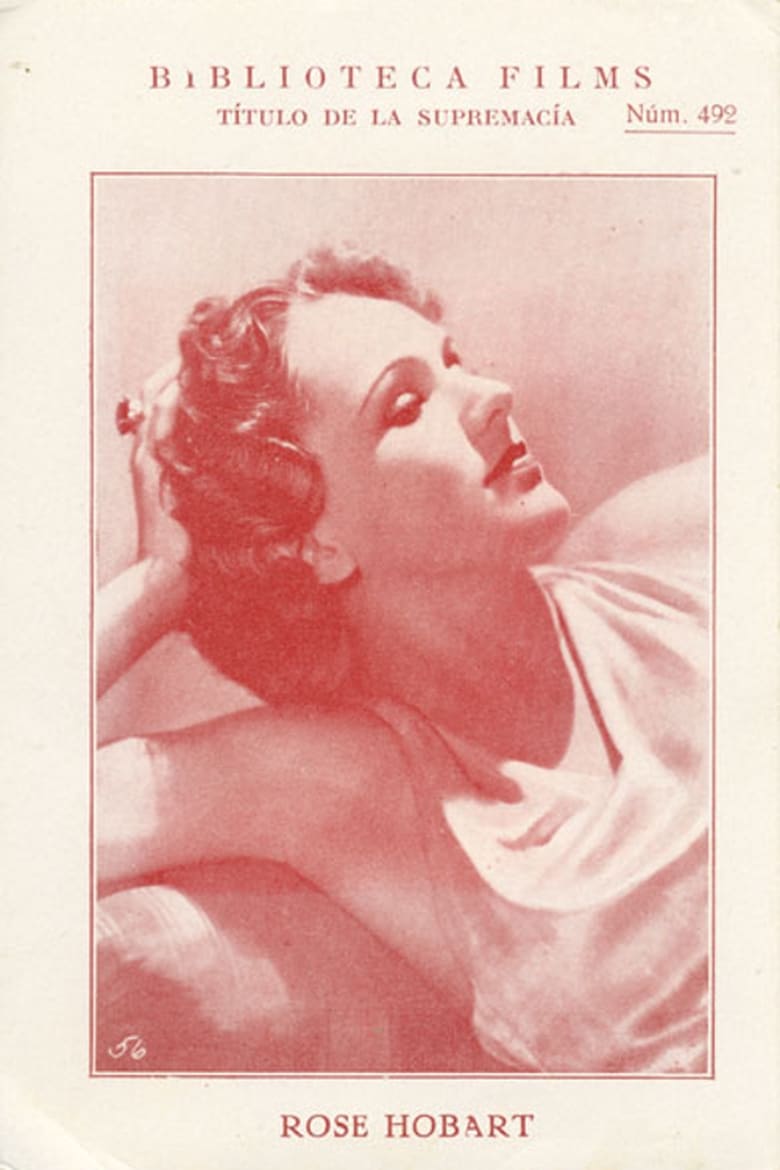
Rose Hobart (1936)
In the mid-1930s, the American visual artist Joseph Cornell was making a name for himself in New York's surrealist circles, constructing elaborate shadow boxes filled with found objects and ephemera. His only foray into filmmaking, Rose Hobart (1936), applied the same found-object logic to moving image: he took a print of the 1931 B-picture East of Borneo, a studio jungle melodrama of the kind that Hollywood was churning out with some regularity at the time, and reworked it entirely. What emerged was a twenty-minute short stripped of its original plot, its dialogue, and most of its supporting incident, with attention fixed almost exclusively on its lead actress. The result sits at an odd crossroads in film history, claimed by academics as an early example of appropriation art and frequently cited alongside the broader European surrealist movement that Cornell admired from across the Atlantic. Whether it constitutes cinema in any conventional sense is, to put it gently, a matter of some debate.
Cornell had no conventional directorial career to speak of. He was, first and foremost, a collagist, and Rose Hobart reads as a collagist's experiment with celluloid rather than a filmmaker's considered work. The source material, East of Borneo, was a Universal Pictures production directed by George Melford, a serviceable if unremarkable adventure picture of its era. Cornell is reported to have screened the finished short at a New York gallery in 1936, with a recording of Brazilian popular music playing over the images and the footage projected through a piece of blue glass to tint the picture. Salvador Dalí, who was present at that screening, reportedly flew into a rage, claiming Cornell had stolen an idea from his own dreams, which is either the most surrealist reaction imaginable or simply the behaviour of a man with a high opinion of himself. The film has circulated in various forms since then, and no single definitive version with Cornell's original musical accompaniment has been consistently preserved. For a work that historians treat as a landmark, its material history is surprisingly scrappy.
Rose Hobart herself was a working Hollywood actress of the 1930s, a reliable presence in studio pictures without ever quite breaking into the first rank of stardom. Her performance in East of Borneo is polished but unremarkable by the standards of the era, the sort of turn that kept actors employed rather than making them famous. Charles Bickford, Noble Johnson, and the rest of the original cast appear only in fragments here, their roles reduced to occasional background texture. Cornell's edit places Hobart at the centre of nearly every sequence, holding on her face and reactions in a way that the original film's narrative never required. If you are coming to this having recently spent time with the more assured Hollywood craftsmanship of Little Caesar (1931) or The Invisible Man (1933), both products of the same early sound era, the contrast in formal intention is immediately noticeable.
Joseph Cornell’s 1936 experimental short Rose Hobart is a piece of cinema that is often heralded by academics as a groundbreaking work of the avant-garde. The premise is incredibly simple, bordering on the non-existent: Cornell essentially hijacked footage from the 1931 jungle melodrama East of Borneo and re-edited it to focus almost exclusively on its lead actress, the beautiful Rose Hobart.
While film historians love to champion this as the very first "fan video" or a pioneering work of cinematic collage, watching it today, I couldn't help but feel like I was just staring at a deeply obsessive tribute rather than a coherent, meaningful piece of art.
When you apply a critical lens to the actual execution, the film's intentions become incredibly murky and, frankly, a bit stalkerish. Cornell slows the footage down, strips away the original narrative context, and loops Hobart’s expressions until she becomes a singular, almost unsettling object of desire and dread, trapped in a perpetual exotic paradise. But here is the glaring issue: it serves absolutely no narrative or emotive purpose. It doesn't tell a story, it doesn't explore a broader theme, and it doesn't even really honour the original performance. It is, at its core, just a director’s unfiltered, somewhat creepy admiration for one particular actress from one particular film, projected onto a screen for the rest of us to endure.
Furthermore, from a purely creative standpoint, it is entirely unoriginal content. Cornell didn't write a script, direct actors, or shoot a single frame of celluloid; he simply took another filmmaker's hard work and chopped it up to suit his own highly specific, niche tastes. I will concede that the final product is at least watchable. The eerie, slowed-down pacing and the disquieting, dreamlike atmosphere give it a certain hypnotic quality that might appeal to hardcore fans of surrealism. But being "watchable" is a remarkably low bar to clear, and a hypnotic mood cannot compensate for the sheer lack of substance or original vision on display.
Rose Hobart is a fascinating piece of cinematic trivia, but it is a deeply flawed and ultimately hollow viewing experience. Joseph Cornell might be a respected figure in the history of experimental art, but this short film feels more like a self-indulgent scrapbook project than a legitimate piece of cinema. It’s a bizarre, meandering 20 minutes that demands a level of patience and interpretive generosity that I simply wasn't willing to give. It’s a historically curious footnote that proves you can make a movie out of nothing, but it also proves that sometimes, you really shouldn't.
Wherever one lands on the film's artistic merits, Rose Hobart does function as a useful pressure test for what we actually mean when we talk about authorship and cinema. It raises questions that later found-footage and appropriation artists, from the structural filmmakers of the 1960s through to the video essay makers of today, have continued to wrestle with. Those questions are genuinely interesting. Whether this particular twenty minutes answers any of them is another matter entirely. Films that make you think about cinema can be worthwhile even when the thinking is mostly frustration, but it helps if the work gives you something to hold onto while you do it. Macca's verdict here suggests that, for all its reputation, Rose Hobart offers rather less than the art world has long insisted it does. Sometimes the emperor's new clothes are just, well, no clothes.
Rating: ★ | Year: 1936 | Watched: 2026-07-09



