Network (1976)

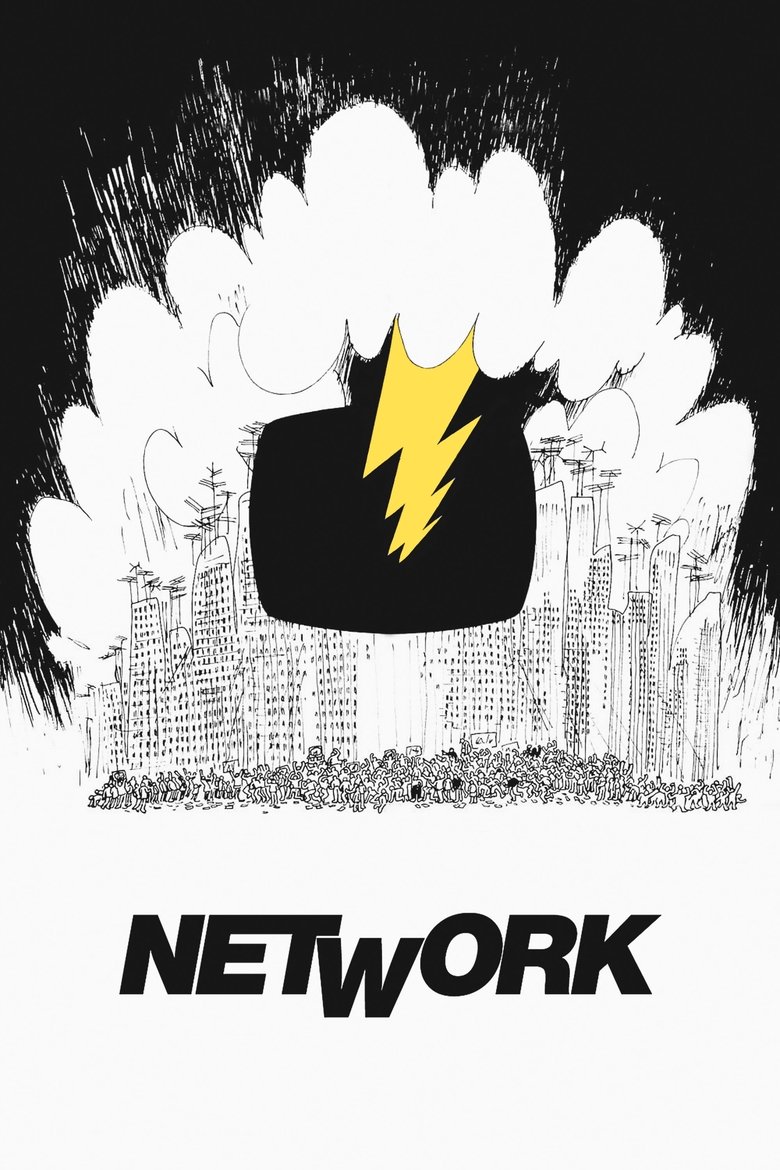
There are films that arrive as provocations and spend fifty years becoming more relevant, not less. Sidney Lumet's Network, released in 1976 by Metro-Goldwyn-Mayer, is one of them. The premise is simple enough on paper: Howard Beale, a veteran news anchor facing forced retirement, announces on live television that he intends to kill himself during his final broadcast. What follows is not a tragedy but something closer to a grotesque comedy of institutional cynicism, as the network responsible for airing his public breakdown realises that crisis, performed live, is excellent for business. Paddy Chayefsky's script, which won him the Academy Award for Best Original Screenplay, was written with genuine fury at the direction American television was taking. That it would eventually read less like satire and more like a documentary is not something even Chayefsky could quite have predicted.
Lumet was at a remarkable peak of productivity in the 1970s, turning out serious, city-inflected American dramas with a consistency few directors have matched. I covered two of his earlier films from this period separately, and if you want a sense of the range: Serpico shows him working with institutional corruption from the inside out, while Dog Day Afternoon, made the year before Network, demonstrates his gift for keeping confined, pressurised situations alive and crackling for a full two hours. Network sits in the same loose company, though it is considerably more theatrical in its ambitions, owing as much to the traditions of television drama (Chayefsky had made his name in that world) as to anything you would call pure cinema. The collaboration between Lumet and Chayefsky produced a film of almost programmatic anger, one that knows exactly what it wants to say and finds actors capable of saying it with absolute conviction.
The cast assembled here is, by any measure, formidable. Peter Finch plays Beale himself, a performance of controlled unravelling that earned him a posthumous Academy Award, the first ever awarded. Faye Dunaway plays Diana Christensen, the programming executive who sees opportunity where others see a breakdown, and she won the Oscar for Best Actress for a portrayal that is cold, precise and genuinely unsettling. William Holden anchors the film emotionally as Max Schumacher, Beale's long-time friend and something of the audience's moral compass, while Robert Duvall brings his customary weight to the network management side of things. The film collected four Academy Awards in total, including that rare distinction of two acting awards in separate lead categories, and the performances are the primary reason it has lasted. Wesley Addy, in a smaller role, adds further texture to the network's boardroom world without ever overshadowing the leads.
Owen Roizman, who had shot Chinatown-era Hollywood with distinction and whose eye for American urban spaces was already well established by the time he came to this film, gives Network a particular visual quality: fluorescent, slightly airless, the kind of light that makes boardrooms and television studios feel equally dehumanising. It is a film that looks deliberately polished but unremarkable in its surfaces, which is part of the point. Elliot Lawrence's score is used with restraint, allowing Chayefsky's dialogue the room it demands, and Alan Heim's editing keeps the film's many monologue-heavy scenes taut enough that the rhythm rarely becomes monotonous, even when the speeches pile up. The combination produces something that feels, aesthetically, like a high-end television production of the period commenting on itself from the inside.
The remarkable thing about Network is how fresh it still feels.
Here is a film from 1976, a savage satire of American television and what it will do for ratings, and half a century on it plays less like satire than prophecy. Sidney Lumet and writer Paddy Chayefsky imagined a network that turns a mentally unravelling news anchor into a primetime sensation because his on-air breakdowns draw a crowd, and if anything the modern world has run ahead of them. Watching it now, you come away half wanting a sequel about social media.
Sidney Lumet is one of my favourite directors, and while this is nowhere near his best, that says more about the company it keeps than any failing of its own. It is packed with sharp, dry humour, it has scenes of blistering intensity, and the performances are extraordinary across the board, so much so that the cast walked off with a fistful of Oscars, three of them for acting alone. Everyone here is working at the very top of their game, and Chayefsky's script hands them dialogue you could chew on for hours.
If it has a weakness, and for me it does, it is the pacing. For a two-hour film it can feel a touch long, sagging in the stretches where the speechifying piles up and the momentum slips.
It never quite drags, but I was aware of its length in a way I never am with, say, 12 Angry Men, which remains the Lumet to beat as far as I am concerned. Four stars, then, a whip-smart, furious and weirdly prophetic film that only its own pacing keeps from the very top rank.
Network occupies a particular position in American film history: the kind of work that critics initially received as sharp but potentially overwrought, only for time to reveal that it wasn't overwrought enough. The questions it raises about spectacle, exploitation and what an audience will watch have not become quieter in the decades since, and the performances, particularly Finch and Dunaway, remain the standard by which this kind of arch, satirical dramatic acting is still measured. For a companion piece in a similar vein on social unease filtered through a very different genre, see also Get Out. Network is, in the end, a film about the machinery of attention and what it does to people unlucky enough to become its fuel. It hasn't dated. It's just got company.
Rating: ★★★★ | Year: 1976 | Watched: 2026-09-30
Trailer
▶ Watch the official trailer for Network (1976) on YouTube
Where to watch
Watch in the UK
Stream: MGM Plus Amazon Channel
Rent: Apple TV Store · Amazon Video · Sky Store
Buy: Apple TV Store · Amazon Video · Sky Store
Physical: Amazon UK · Zavvi
Watch in the US
Rent: Amazon Video · Apple TV Store · Google Play Movies · YouTube
Buy: Amazon Video · Apple TV Store · Google Play Movies · YouTube
Physical: Amazon US
Affiliate disclosure: Movies With Macca may earn a small commission on purchases or subscriptions started via these links. It costs you nothing extra.