Five Dedicated to Ozu (2003)

A film called Five Dedicated to Ozu invites you, right there in the title, to think of one of cinema's great masters of stillness and quiet contemplation. It is a bold invocation. It is also, I'm sorry to say, one this film has absolutely no business making.
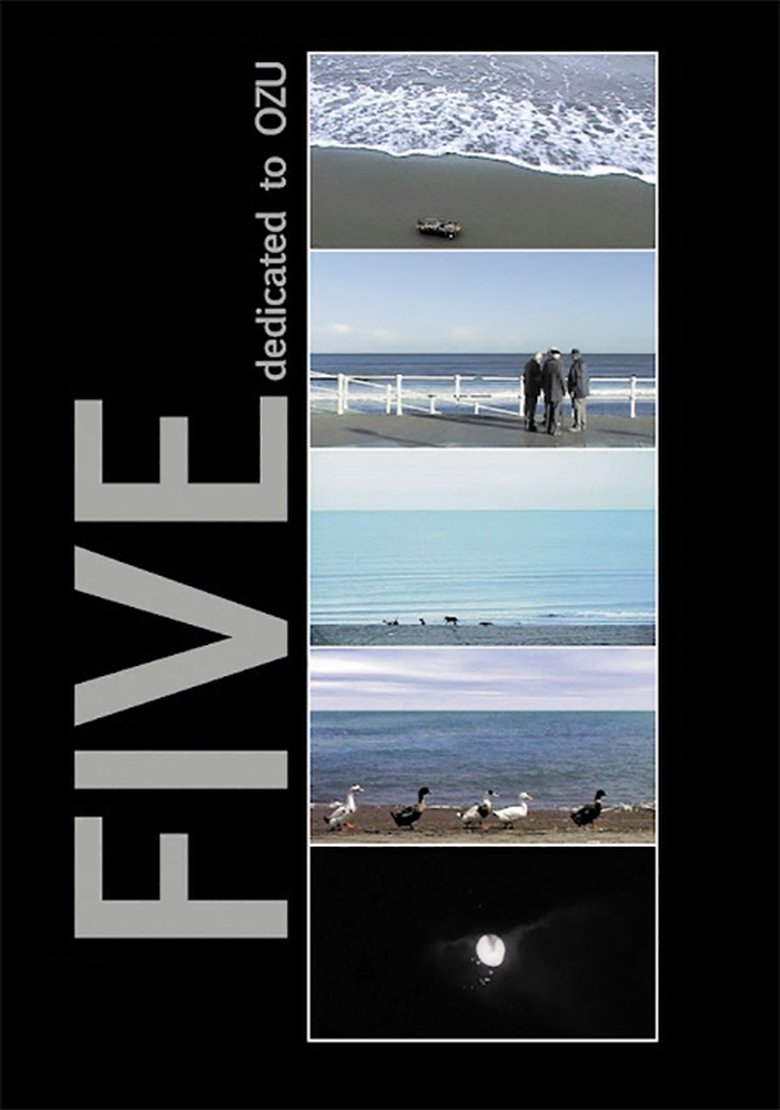
Having sat through Ozu's Tokyo Story and loved it, I can tell you that Abbas Kiarostami's 2003 experiment is emphatically not that. It is, quite literally, five long static shots of not very much: driftwood on a shoreline, people ambling along a promenade, dogs on a beach, ducks, a moonlit pond, well over an hour of them, with no dialogue, no narration and no score. It is roughly one small step removed from a security camera left running, and I found myself wondering, only half joking, whether unedited CCTV footage is the next frontier of acclaimed film-making. Someone just needs to point one at a canal, submit it to a festival, and wait.
I do understand the intention. It is an invitation to slow down, to notice the quiet beauty of the ordinary world, to watch light and water and movement the way we never normally bother to. And I say this as someone who has genuinely grown to love Iranian cinema, and who found real substance in Kiarostami's own Homework, a documentary that pointed its camera at real children with a real purpose. But there the camera was in service of something. It was asking questions, drawing you into lives, making you feel the weight of a child's silence. Here the camera is the entire show, and an hour of watching ducks cross a frame, however serenely composed, is simply not enough to hold me.
There is a version of slow cinema that earns its patience. Long takes that let a scene breathe, that let you settle into a world and feel it from the inside. But there is a difference between stillness that opens something up and stillness that asks you to project meaning onto an empty screen and do all the work yourself. This, for me, falls into the latter camp. I kept waiting for something to shift, for the film to make a move, to offer even the smallest gesture of intent. It never came.
I'll admit to a slightly heretical thought, too, one the film rather invites: if this is the calibre of work that lands on lists of the century's most acclaimed films, then I do quietly wonder where we're heading. Acclaim can create a kind of emperor's new clothes effect, where the blankness of a thing gets mistaken for profundity because pointing that out feels philistine. I don't think I'm being philistine here. I think I'm being honest. Sitting in front of a moonlit pond for twenty-odd minutes is a perfectly pleasant thing to do in life. I'm just not sure it's a film.
I have no doubt there are viewers for whom this is a serene, meditative marvel, and I would not begrudge them a second of it. Different films reach different people, and the ones who find this genuinely moving are not wrong to feel that way. But I am not among them, and I am not going to pretend otherwise. For me it was an hour of patience with next to nothing offered in return. The closest cinema has come, in my experience, to simply pointing a camera out of a window and calling it a day.
One star.
Rating: ★ | Year: 2003 | Watched: 2026-09-01