Dunkirk (2017)

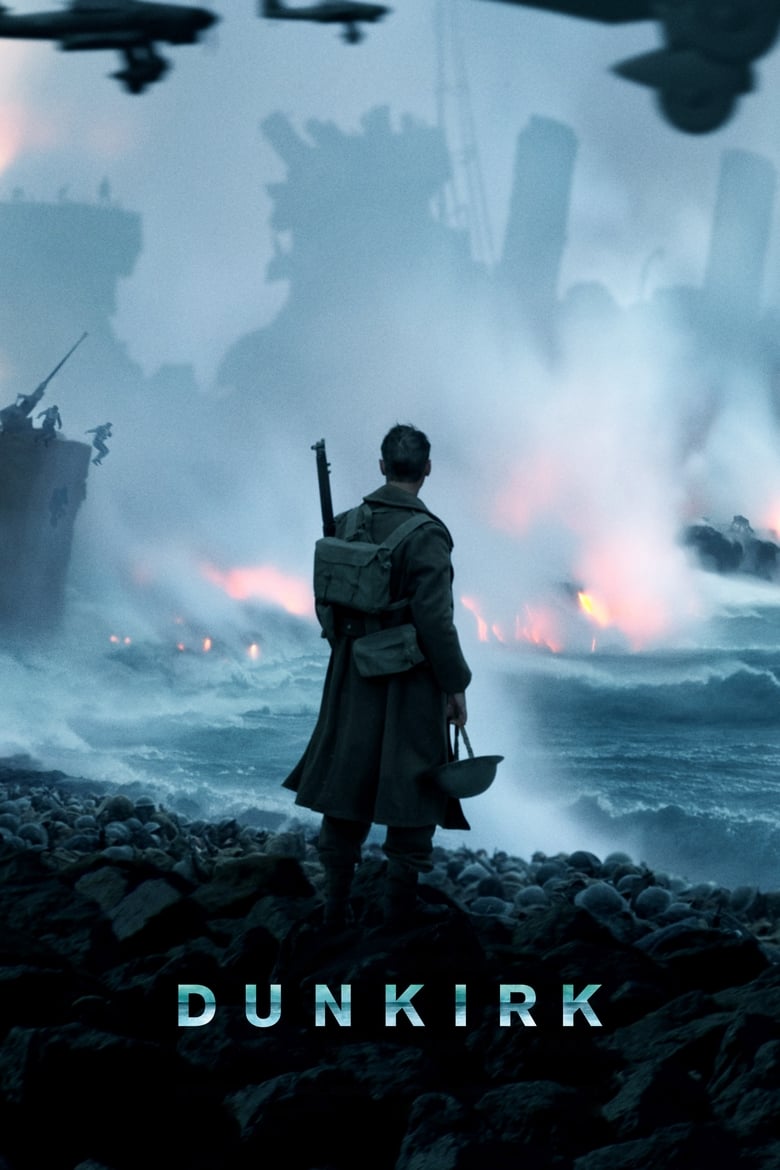
There's a moment early in Dunkirk where the camera simply pulls back and you see it: hundreds of thousands of men, packed onto a beach, staring out at a sea that offers no obvious salvation. No character tells you how bad things are. No general delivers a grim speech spelling out the stakes. Nolan just shows you, and trusts you to feel the dread in your stomach. Fair play to him for that, because it works completely. The opening beach sequences are absolutely phenomenal, some of the finest purely visual storytelling I've seen in years, communicating the overwhelming scale of the catastrophe without a single line of exposition.
From there, the film locks into its triple-timeline structure, splitting its attention across the land, sea, and air, with each thread operating on a different timeframe that eventually folds back in on itself. It's a bold narrative gamble, and it largely pays off. The aerial sequences are the real standout. Watching Spitfires banking and dogfighting low over the Channel, with Tom Hardy bringing a quiet, stoic intensity from behind a mask and a pair of goggles, is gripping stuff. He does extraordinary work with extraordinarily little to work with. And the sound design across all three strands is genuinely great, turning every bullet whizz, groaning hull creak, and engine roar into something you feel in your chest rather than just hear. Hans Zimmer's score burrows into your brain and refuses to leave.
But here's where I have to be honest about my mixed feelings, because Dunkirk is not quite the towering masterpiece some were ready to crown it. This highly stylised, deliberately cold approach comes with a real cost. The severe lack of dialogue, which in theory should heighten the tension, sometimes has the opposite effect during those long stretches on the beach. Men trudging, men waiting, men staring. Without deeper character arcs to anchor you, the middle act occasionally tips from taut to sluggish, feeling more like an endurance test than a gripping narrative. You end up admiring the craft from a slight distance rather than being completely swallowed by it. I never stopped being impressed, but I wasn't always gripped.
That's the thing with Nolan at this stage of his career. He's brilliant at constructing elaborate, technically dazzling puzzles, and I say that as someone who genuinely loves Inception and still thinks about Memento regularly. But where those films use their formal trickery to draw you deeper into their characters' emotional states, Dunkirk uses it almost as a substitute for emotional investment. The structure is the experience, which is an interesting choice, but it does leave you feeling a bit like you've witnessed something rather than lived through it.
For contrast, I'd point to Hacksaw Ridge, which came out the year before and took almost the opposite approach: messy, sentimental at times, but anchored so fiercely in one man's inner life that the battle sequences hit you like a freight train. Dunkirk is technically the more accomplished film, probably. But it's the colder one.
None of which means you shouldn't see it, because you absolutely should, and ideally on the biggest screen you can find. As a sensory experience, as an act of immersive filmmaking, it's remarkable. Nolan has made something genuinely unique here, a war film that strips away the genre's usual scaffolding and leaves you with nothing but noise, scale, and the raw, animal fact of survival. It just stops short of being truly great because it trusts the spectacle more than the people inside it.
Three and a half stars.
Rating: ★★★½ | Year: 2017 | Watched: 2026-07-25
Where to watch
Watch in the UK
Stream: HBO Max Amazon Channel · Sky Go · Now TV Cinema · HBO Max
Rent: Apple TV Store · Rakuten TV · Amazon Video · Google Play Movies
Buy: Apple TV Store · Rakuten TV · Amazon Video · Google Play Movies
Physical: Amazon UK · Zavvi
Watch in the US
Stream: fuboTV · Paramount Plus Premium · Paramount Plus Essential · Paramount+ Amazon Channel
Rent: Amazon Video · Apple TV Store · Google Play Movies · YouTube
Buy: Amazon Video · Apple TV Store · Google Play Movies · YouTube
Physical: Amazon US
Affiliate disclosure: Movies With Macca may earn a small commission on purchases or subscriptions started via these links. It costs you nothing extra.