
Wolff Von Amerongen: Did He Commit Bankruptcy Offences? (2004)

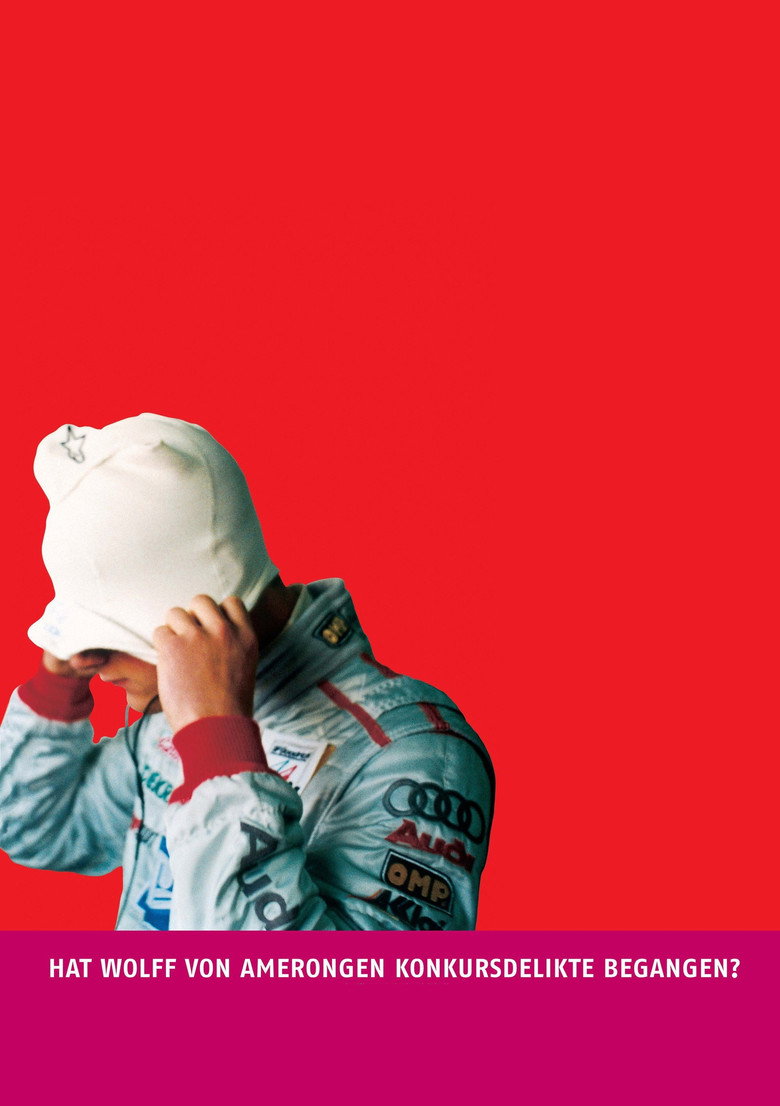
For just over seventy minutes, a calm, unhurried voice recites the tangled affairs of Germany's post-war industrial dynasties: the bankruptcies, the frauds, the convenient deaths, the dynastic feuds. Over the top of it runs a stream of images that, as far as I could ever tell, has nothing whatever to do with a single word being spoken. Not loosely connected. Not obliquely related. Nothing.
That mismatch is not a fault in Gerhard Friedl's essay film. It is the entire design. Part documentary, part fiction, part deadpan provocation, Hat Wolff von Amerongen Konkursdelikte begangen? is less a film to follow than one to surrender to. Friedl's method is to sever information from anything that might illustrate or anchor it, so that capital itself starts to feel like the opaque, faintly sinister abstraction he plainly takes it to be. As a formal proposition, it has a certain rigorous logic. I get it. I genuinely do.
I have worked through a fair amount of this sort of thing by now, and I tend to go in well disposed towards it. This sits on the same shelf as other formal experiments I have chewed over, films like Instructions for a Light and Sound Machine, where the distance between image and meaning is itself the subject, where you are being asked to notice the gap rather than close it. That film stuck with me. This one, I am less sure about.
The snag is that admiring the idea and enjoying the film are two very different things, and here they part ways fairly early on. The voice never shifts register. It does not build to anything, does not modulate, does not let the material breathe in a way that invites you to lean in. The footage never resolves into meaning, never offers even a sly visual rhyme with what is being described. And even across so short a runtime, seventy-odd minutes, the whole thing settles into a kind of drone. I kept finding my attention slipping sideways, not in the productive, wandering way that the best durational cinema can produce, but in the way where you glance at the clock and feel faintly guilty about it.
There is a version of this approach that becomes genuinely hypnotic. Slow cinema, when it works, earns its stillness. What Friedl is doing is different: he is using flatness as critique, arguing through the monotony of his form that the world of high finance is itself monotonous in its corruption, repetitive in its crimes, boring in the way that true power tends to be boring. I think that is a coherent argument. I am just not sure it makes for a film I would want to revisit, or press into someone's hands with any real urgency.
The people at the centre of the story, the industrialists, the bankruptcy proceedings, the web of names and holding companies, remain stubbornly abstract throughout. Whether that is a feature or a bug depends entirely on your patience with the project. Mine ran out somewhere around the halfway mark, which tells me something. Not that the film has failed exactly, more that it is working on a frequency I could not quite tune into on this occasion.
I would not talk anyone curious out of giving it a go. If you are drawn to the wilder edges of documentary form, to films that use structure as argument, this is at least doing something genuinely unusual with its material. But I have to be honest about where I landed. Two and a half stars: an experiment I respect a good deal more than I actually enjoyed.
Rating: ★★½ | Year: 2004 | Watched: 2026-09-10



