
The Princess and the Frog (2009)

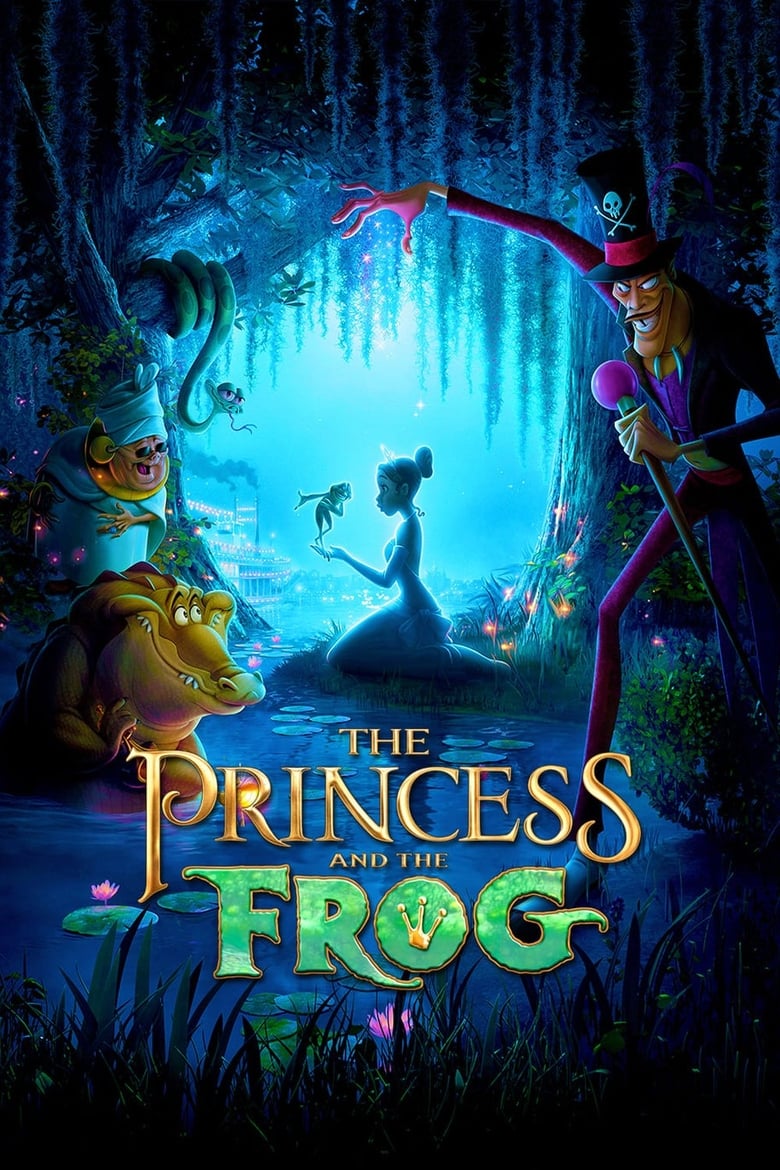
By 2009, Walt Disney Animation Studios had spent the better part of a decade in something of an identity crisis. The golden run of the late 1980s and 1990s, the period critics tend to call the Disney Renaissance, had petered out, and the studio had spent the intervening years releasing work that was polished but unremarkable, caught between a legacy it could not quite recapture and a digital future it had not yet fully committed to. The Princess and the Frog arrived as a deliberate act of recollection: a return to hand-drawn, traditionally animated features for the first time since Home on the Range in 2004, and a conscious look back at what the studio had once done better than anyone on earth. It is set in 1920s New Orleans, a city that functions here almost as a character in its own right, its bayous and jazz clubs and Mardi Gras excess giving the film a specific, rooted sense of place that the more generic fairy-tale settings of its era often lacked.
The film was directed by Ron Clements and John Musker, the partnership responsible for some of the most beloved work of that Renaissance period. I reviewed The Little Mermaid (1989) separately, and it was Clements and Musker who made that film too, along with Hercules (1997). Their fingerprints are on a significant chunk of the studio's most commercially and critically successful output, and bringing them back for what would prove to be Disney's last traditionally animated theatrical feature feels, in retrospect, both fitting and a little melancholy. The screenplay came from the duo alongside Greg Erb, and it is an adaptation of a fairly familiar fairy-tale structure, drawing loosely on the old Grimm story of the frog prince while grounding everything in American folklore, Louisiana voodoo, and the specific social textures of the Jazz Age South.
The voice cast centres on Anika Noni Rose as Tiana, a performance that carries warmth and a genuine sense of purpose without ever tipping into sentimentality. Bruno Campos provides the comic counterweight as the frog prince Naveen, and Keith David, always a reliable presence, brings a real sense of menace to the villain of the piece. Jim Cummings and Michael-Leon Wooley round out a supporting cast that keeps the energy moving through the film's more episodic middle passages. The score and songs come from Randy Newman, who leans into the New Orleans setting with evident enthusiasm: the music has a blues-and-Dixieland flavour that sits comfortably alongside the film's visual identity rather than fighting it for attention, and there is a looseness and specificity to his work here that distinguishes it from the more Broadway-adjacent approach of many Disney soundtracks. Jeff Draheim edited the film, and the cutting is particularly assured in the musical sequences, where the rhythms of the animation and the rhythms of Newman's arrangements are kept in close, satisfying conversation with one another. Visually, without a named cinematographer in the traditional sense (hand-drawn animation distributes that responsibility across a large team of artists and layout supervisors), the film achieves a warmth of colour and a fluidity of line that reads as genuinely considered rather than merely competent.
The most bittersweet thing about The Princess and the Frog is not on the screen but around it.
This was Disney more or less waving goodbye to the hand-drawn animation that built the studio, one last lovely flourish of the old craft before the whole industry went over to computers, and there is a certain ache in watching it now. Set in a gorgeously drawn Jazz-Age New Orleans, it follows Tiana, a hard-working young woman chasing a dream of opening her own restaurant, whose life takes a sharp turn when a run-in with a prince and a dab of voodoo leaves her, of all things, a frog.
It is good, classic-shaped Disney. The animation is warm and expressive in the way only hand-drawn work manages, the Randy Newman songs bring a welcome jazz-and-blues flavour, and the story, familiar as it is, is told with a good deal of care. It comes from Ron Clements and John Musker, the pair behind Aladdin and Hercules, two films I rate a fair bit higher, and while this never scales those heights, you can feel the same sure hands at the wheel.
It is nowhere near vintage Disney, and it does not pretend to be. But it is a warm, handsome, good-hearted film, and one of the better latter-day entries the studio has managed. Mostly, though, I came away wishing they still made them this way. Three and a half stars, decent Disney with a lovely lost art at its fingertips.
The Princess and the Frog sits in an interesting position in the broader Disney catalogue: too late to belong fully to the Renaissance, too traditional to sit comfortably alongside the Pixar-influenced wave that followed with films like Moana (2016), and too self-aware of its own valedictory quality to simply be enjoyed without that awareness hovering somewhere in the background. For viewers who grew up on Beauty and the Beast (1991) or its contemporaries, there is something genuinely affecting about watching a studio attempt, one last time, to do what it once did almost casually. Whether that extra layer of feeling adds to the experience or simply makes you a little sad rather depends on where you are sitting when the lights go down.
Rating: ★★★½ | Year: 2009 | Watched: 2026-09-21
Trailer
▶ Watch the official trailer for The Princess and the Frog (2009) on YouTube
Where to watch
Watch in the UK
Stream: Disney Plus
Rent: Apple TV Store · Rakuten TV · Sky Store
Buy: Apple TV Store · Rakuten TV · Amazon Video · Google Play Movies
Physical: Amazon UK · Zavvi
Watch in the US
Stream: Disney Plus · fuboTV
Rent: Amazon Video · Apple TV Store · Google Play Movies · YouTube
Buy: Amazon Video · Apple TV Store · Google Play Movies · YouTube
Physical: Amazon US
Affiliate disclosure: Movies With Macca may earn a small commission on purchases or subscriptions started via these links. It costs you nothing extra.



