
Beauty and the Beast (1991)

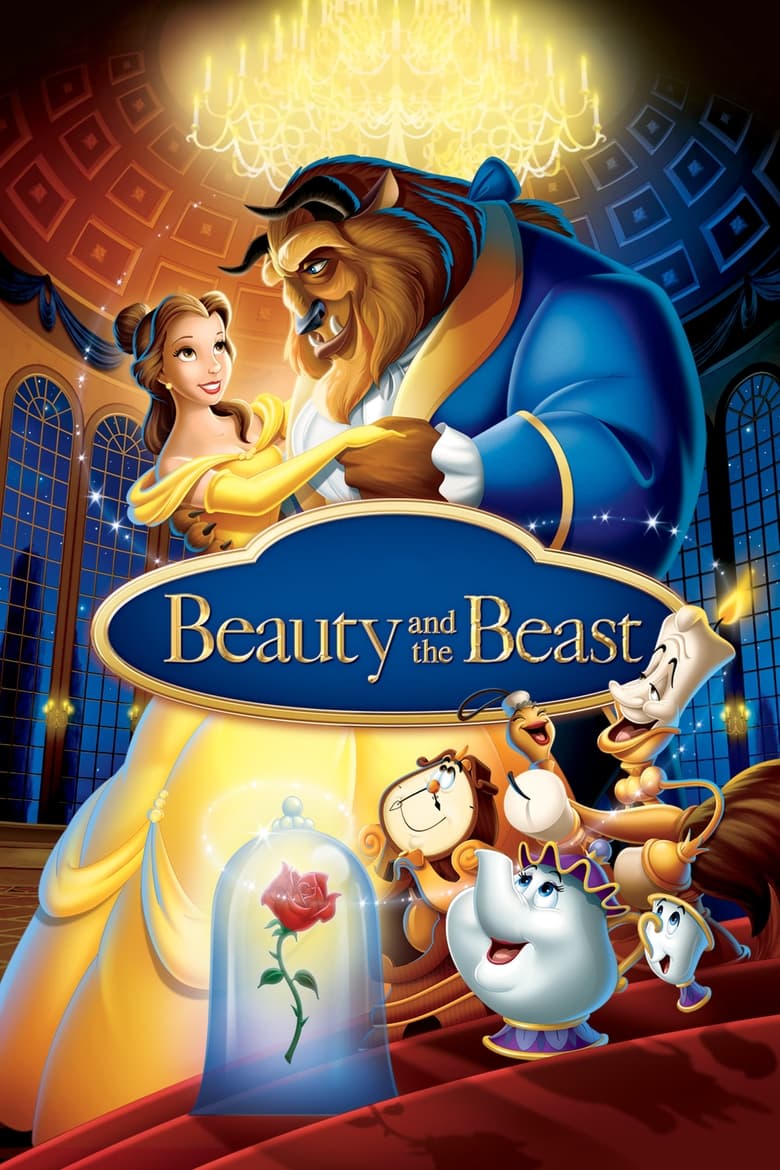
There is a reasonable argument that the two years between 1989 and 1991 represent the single most important stretch in the history of American feature animation. The Little Mermaid had already announced the so-called Disney Renaissance with considerable force, and now the studio followed it with Beauty and the Beast, a film that would go on to become the first animated feature ever nominated for the Academy Award for Best Picture. That nomination alone tells you something about the cultural moment the film landed in: this was not a production that anyone, inside or outside the industry, was inclined to dismiss as mere children's entertainment. Based on the old French fairy tale most associated with the 18th-century version by Gabrielle-Suzanne Barbot de Villeneuve (and later condensed by Jeanne-Marie Leprince de Beaumont), the story of a young woman who finds herself living under the roof of a cursed and monstrous prince had been told many times before 1991, most memorably in Jean Cocteau's celebrated 1946 film. Disney's version, produced through Silver Screen Partners IV and Walt Disney Pictures, had no particular anxiety about the competition. It arrived confident in its own skin, and that confidence, as I also found when I reviewed The Hunchback of Notre Dame five years its junior, is something Disney's Renaissance-era output wears consistently well.
The film was directed by Gary Trousdale and Kirk Wise, both relatively early in their feature careers at the time, working from a screenplay by Chris Sanders, Brenda Chapman, and Robert Lence. The story keeps its shape familiar: Belle, a bookish young woman from a provincial French village, ends up a guest, then a prisoner, then something more complicated, in the enchanted castle of the Beast, a prince transformed by a sorceress's curse. The enchanted household staff, frozen in their own object forms, are there to nudge the two principals together before time runs out. What the screenplay does well is give Belle a genuine interiority rather than reducing her to the role of someone things happen to, and it finds space for comedy in the castle's supporting cast without letting that comedy crowd out the romantic centre of the piece. The production ran to a budget substantial enough to incorporate early CAPS (Computer Animation Production System) digital colouring across the film, with the famous ballroom sequence making particularly striking use of CGI-assisted camera movement, a technique that drew genuine attention at the time for what it did to the sense of depth and sweep in an otherwise hand-drawn world.
The voice cast assembled here is, on paper and in practice, well suited to the material. Paige O'Hara brings a warmth and a dry wit to Belle that stops the character from tipping into mere goodness. Robby Benson's work as the Beast is a more demanding assignment than it might first appear, requiring him to project size and menace while still making the character's emotional arc feel earned. Richard White is a nicely self-satisfied Gaston, Jerry Orbach brings a light theatrical touch to Lumière, and David Ogden Stiers gives Cogsworth an enjoyably fusspot quality. The score is the work of Alan Menken, who was at this point in an extraordinary productive run of Disney collaborations, and his work here operates in the full Broadway register, the orchestrations full and warm, the title song built around a slow romantic swell that borrows from the classical ballad tradition without quite dissolving into pastiche. The film was edited by Bill Wilner and John Carnochan, and the cutting moves efficiently through its eighty-four-minute runtime, rarely pausing longer than the material needs. For a companion piece from the same year that approaches very different material with similar craft ambitions, see also my thoughts on Let Him Have It, a film that could hardly be more tonally removed but which equally rewards close attention to performance. And for a sense of where fairy-tale romance as a genre intersects with questions of illusion and longing, the Woody Allen of The Purple Rose of Cairo is a useful, if oblique, point of comparison.
Some films you can admire wholeheartedly while knowing full well they are not quite your own favourite, and Beauty and the Beast is one of those for me. It is my wife's best-loved Disney film of all, and sitting down to it with her, I could see exactly why, even as I filed it a notch below my personal favourites.
This is Disney in its early-nineties pomp, retelling the old French fairy tale with considerable polish: the animation is lovely, the story is sturdy, and the whole thing has the confident glow of a studio at the very top of its game.
The voice work is the standout for me. The cast is excellent across the board, but the Beast in particular is superb, bringing a tenderness and a hurt to what might so easily have been a growling slab of a character. The songs are not, I would argue, Disney's finest, and they never quite scale the studio's absolute peak, but they are still quite good, and the title number has more than earned its place in the canon.
If it falls short of anything, it is only my own favourites. It sits nowhere near the top of my personal Disney pile, where Aladdin, Hercules and The Jungle Book are all comfortably ahead of it, but that says more about how high those set the bar than about anything wrong here.
Taken on its own, this is a lovely, generous film, beautifully made, and I understand completely why it is the one my wife comes back to. Three and a half stars, a bona fide classic, even if it is not quite my classic.
Beauty and the Beast is the kind of film that earns its reputation by being genuinely good rather than by being loudly important, which is perhaps the more durable kind of reputation to have. It sits at the centre of a period when Disney was producing work that could reasonably be discussed alongside live-action cinema rather than alongside it only in a qualified sense, and it bears the weight of that context without straining. Whether it lands at the very top of your personal Disney order or sits, as it does here, a rung or two below the favourites is probably a matter of which particular qualities you prize most in the studio's output. What is harder to dispute is that it does what it sets out to do with considerable skill and a genuine generosity of spirit. Some films make you glad they exist. This is one of them.
Rating: ★★★½ | Year: 1991 | Watched: 2026-09-17
Trailer
▶ Watch the official trailer for Beauty and the Beast (1991) on YouTube
Where to watch
Watch in the UK
Stream: Disney Plus
Rent: Apple TV Store · Rakuten TV
Buy: Apple TV Store · Rakuten TV · Amazon Video · Google Play Movies
Physical: Amazon UK · Zavvi
Watch in the US
Stream: Disney Plus
Rent: Amazon Video · Apple TV Store · Google Play Movies · YouTube
Buy: Amazon Video · Apple TV Store · Google Play Movies · YouTube
Physical: Amazon US
Affiliate disclosure: Movies With Macca may earn a small commission on purchases or subscriptions started via these links. It costs you nothing extra.



