Soleil O (1970)

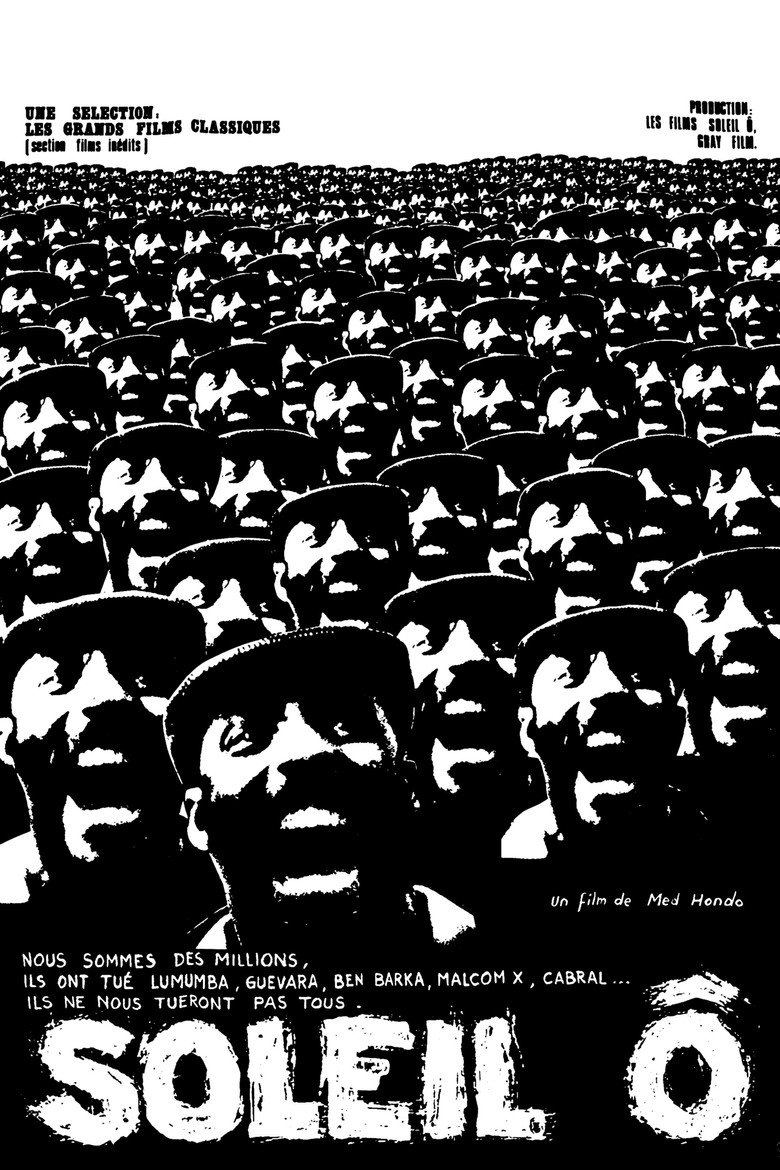
Some films hit you like a fist. Soleil O is one of them. Med Hondo's 1970 debut feature follows an educated man from Mauritania who arrives in Paris with every reason to believe in the promise of the colonial "motherland," only to find door after door slammed shut in his face, not because of his qualifications, not because of his character, but purely because of the colour of his skin. It's a brutal, furious, deeply uncomfortable watch, and I mean all of that as high praise.
What makes the film so striking, even now, is how Hondo refuses to play it safe. This isn't a tidy, linear story of struggle and redemption. It's something rawer and stranger than that. He mixes stark realist sequences with surreal dream logic and documentary-style montages, shifting register almost without warning. At first that restlessness can feel disorienting, and I won't pretend there aren't moments where the non-linear structure frays slightly at the edges. But once you surrender to it, you realise the form is the point. The fractured, lurching quality of the film mirrors exactly the fractured, lurching experience of a man being systematically stripped of his dignity and his sense of self in a city that boasts "liberté, égalité, fraternité" on its walls while treating him as invisible.
Robert Liensol anchors the whole thing with a performance of real restraint and depth. He plays the protagonist, who is never given a name, which feels entirely deliberate. He is every man in this situation, not a singular case study but a representative of thousands. Liensol carries the weight of each humiliation quietly, and watching the quiet erode into something closer to rage and despair is genuinely heartbreaking. The supporting cast are equally strong, capturing the specific texture of casual racism in all its forms: the bureaucratic brush-off, the polite smile that hides contempt, the exhausting performance of gratitude expected from someone who has every right to be furious.
It's worth saying clearly: the fact that Hondo made this on what was clearly a micro-budget, in 1970, and pulled off something this assured and this ambitious stylistically, is remarkable. The financial constraints are visible, but they never feel like a limitation. If anything, the roughness gives the film an urgency and an authenticity that a more polished production might have smoothed away.
What lingers longest, though, is the sheer contemporaneity of it all. That's the thing that really gets under your skin. These experiences, being treated as a second-class citizen in a country that owes you something, navigating a world designed to exclude you, being made to feel like your presence is an inconvenience rather than a contribution, are not historical artefacts. They are someone's Tuesday. Hondo knew that, and he made a film that refuses to let you forget it. In that sense it pairs naturally in my mind with Capernaum, another film that forces you to sit inside a kind of systemic injustice rather than observe it safely from a distance.
My one honest reservation is that the experimental structure, bold and right as it is, will occasionally lose viewers expecting something more traditionally plotted. There are passages where the momentum dips and the collage-like approach feels slightly more scattered than purposeful. That stops me from calling it a flawless film. But it doesn't stop me from calling it an essential one.
Three and a half stars.
Soleil O is a film that earns its place in the conversation about great anti-colonial cinema, not as a museum piece but as a live wire. It's angry, it's moving, it's formally inventive, and it has lost absolutely nothing in the intervening decades. If you haven't seen it, fix that.
Rating: ★★★½ | Year: 1970 | Watched: 2026-07-07
Where to watch
Watch in the US
Stream: MUBI · MUBI Amazon Channel
Physical: Amazon US
Affiliate disclosure: Movies With Macca may earn a small commission on purchases or subscriptions started via these links. It costs you nothing extra.