
Nomadland (2020)

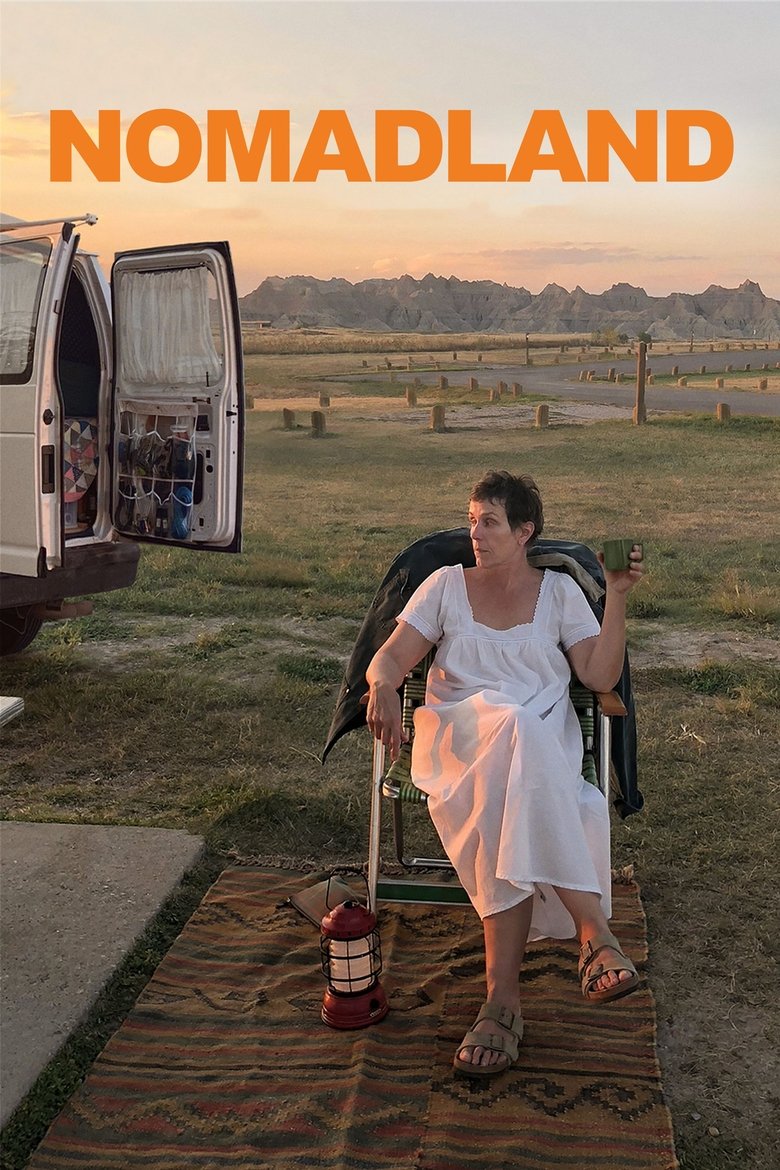
Nomadland arrived in late 2020 carrying the particular weight that certain films do when they feel tuned to the precise frequency of their moment. Released during a period when questions about economic precarity, community and what it means to belong somewhere had a fresh, uncomfortable urgency, Chloé Zhao's film drew on Jessica Bruder's 2017 work of narrative non-fiction of the same name, which documented the real communities of older Americans who took to the roads after the 2008 financial crisis stripped away their savings, their homes and, in some cases, the towns they had grown up in. Zhao adapted the book herself, weaving fictional characters into a landscape populated by real van-dwellers, some of whom appear here under their own names. It is a formally unusual approach, sitting somewhere between drama and documentary, and the result feels less like a constructed story and more like time spent in the company of actual people. The film swept awards season with some force, collecting the Academy Award for Best Picture, Best Director for Zhao and Best Actress for Frances McDormand, among a considerable haul of other prizes.
Zhao had already announced herself as a filmmaker worth watching closely with The Rider (2017), which used a similar method of casting real people to portray versions of themselves, and Nomadland extends and deepens that approach. The three production companies behind it, Cor Cordium Productions, Hear/Say Productions and Highwayman Films, kept the budget modest, which suited the material entirely. A glossy, expensive production would have been a category error. The principal cast is led by Frances McDormand, who also served as a producer, and David Strathairn, a quietly authoritative screen presence who brings warmth and a certain melancholy to his role as a fellow nomad Fern encounters on the road. Alongside them, Linda May, Swankie and Gay DeForest appear as themselves, non-professional performers whose real histories and personalities give the film a texture that no amount of casting could have manufactured. McDormand had already won Best Actress Oscars for Fargo and Three Billboards Outside Ebbing, Missouri, and Nomadland became the film that made her a three-time winner, a distinction shared by very few in the Academy's history.
The look and sound of the film are inseparable from what it is trying to do. Cinematographer Joshua James Richards, a regular collaborator of Zhao's, shoots the American West in wide, patient frames, favouring natural light and the particular quality of the low sun across Nevada, South Dakota and Arizona that makes the landscape feel at once vast and intimate. His camera never rushes Fern, sitting with her in the grey pre-dawn as she lights a small stove or watching her cross a plain that seems to go on without end. It is the kind of photography that makes an audience feel the temperature and the silence. Zhao also edited the film herself, a choice that feels entirely consistent with the measured, accumulative rhythm the picture sustains across its 108-minute running time. There is no sense of anything cut away in a hurry. The score is by Italian composer Ludovico Einaudi, whose spare, repetitive piano writing has a quality of patient waiting about it, notes placed carefully in the space around them rather than filling it. It is music that moves alongside the film rather than telling you how to feel about it, which is entirely in keeping with Zhao's wider approach. I also covered another documentary-adjacent portrait of an artist's inner life in my review of Ryuichi Sakamoto: CODA, which shares something of that same quality of unhurried, attentive observation.
Frances McDormand is, for my money, one of the finest actors of her generation, full stop, and Nomadland is one more reminder why.
It won her a third Best Actress Oscar, after Fargo and Three Billboards, both of which are terrific in their own right, and once again she shows she can shoulder an entire film on her own. She plays Fern, a widow who, after the small town built around her all but dies, packs her life into a van and takes to the roads of the American West, living as a modern nomad and picking up seasonal work wherever she can find it.
I have always loved a good road movie, that particular energy that lets the scenery, the solitude and the self-reflection do the talking, and Chloé Zhao captures every bit of it beautifully. The landscapes are extraordinary, the pace unhurried in the best way, and Fern's inner life, her grief, her stubbornness, her small flickers of connection with the fellow nomads she meets along the road, comes through without ever being spelled out. It is dry and funny in patches too, which keeps you close to her rather than admiring her from a distance.
The music is perfect for it, all spare, aching piano that carries you down the road at her side, and the whole film has a poetry to it, in the way it finds beauty and dignity in a hard, marginal existence. It is elegiac without being mournful, and moving without ever tugging at your sleeve.
Four stars, a beautiful, poetic road movie held together by an actress who does not seem to know how to be anything less than compelling.
Nomadland is the kind of film that resists being summarised neatly, which is probably a mark in its favour. It works as a portrait of grief, as a piece of social observation about the forgotten edges of American economic life, and as a road movie that earns every mile of its running time. For those who respond to it, it tends to leave a residue that lingers rather than fading cleanly. For those who find its pace too gentle, the counter-argument is difficult to make without giving too much away. What is not really in dispute is the quality of the central performance, the photography and the quiet formal intelligence behind the whole enterprise. See also my thoughts on Between Revolutions, which examines a very different kind of displacement and loss across a comparably understated register. Nomadland earned its prizes the old-fashioned way: by being about something real, and caring about how it showed it. Some films ask you to admire them. This one simply asks you to ride along.
Rating: ★★★★ | Year: 2020 | Watched: 2026-09-26
Trailer
▶ Watch the official trailer for Nomadland (2020) on YouTube
Where to watch
Watch in the UK
Stream: Disney Plus · Channel 4 Plus
Rent: Apple TV Store · Rakuten TV · Amazon Video · Google Play Movies
Buy: Apple TV Store · Rakuten TV · Amazon Video · Google Play Movies
Physical: Amazon UK · Zavvi
Watch in the US
Rent: Amazon Video · Apple TV Store · Google Play Movies · YouTube
Buy: Amazon Video · Apple TV Store · Google Play Movies · YouTube
Physical: Amazon US
Affiliate disclosure: Movies With Macca may earn a small commission on purchases or subscriptions started via these links. It costs you nothing extra.



