Love Is the Message, the Message Is Death (2017)

Share
Love Is the Message, the Message Is Death (2017)

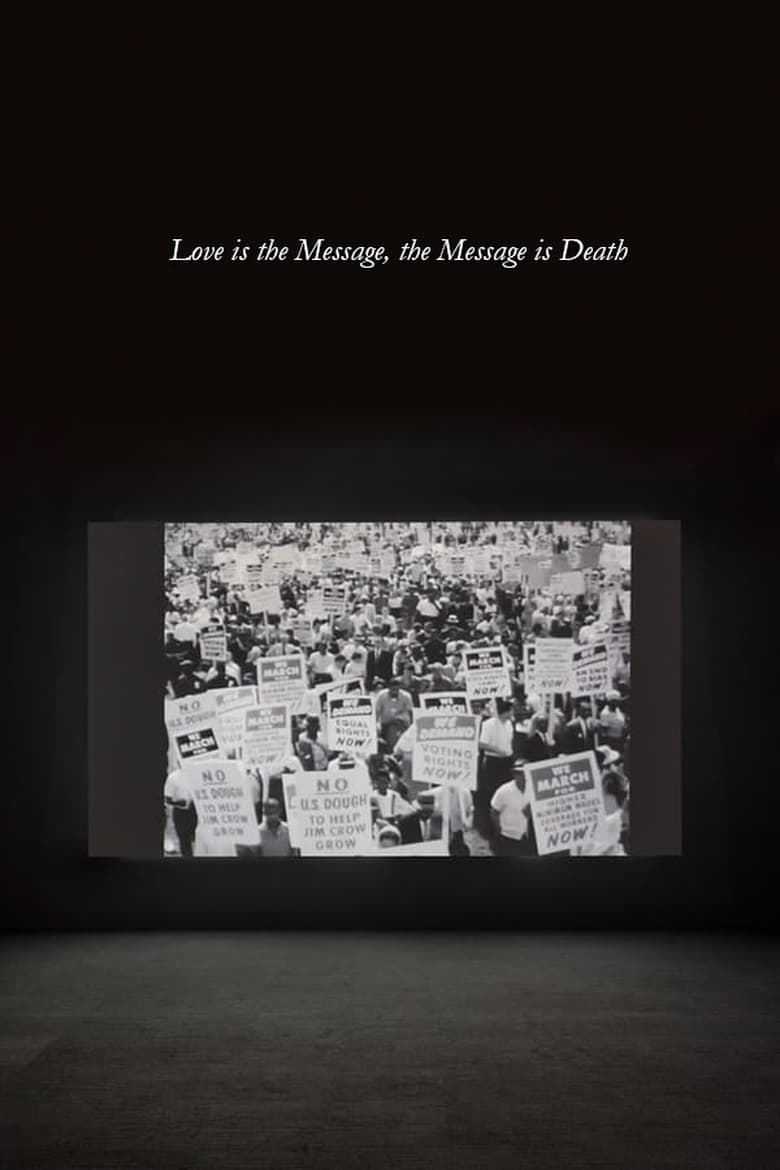
Arthur Jafa is a name that carries considerable weight in American visual culture, even if mainstream audiences might not immediately place it. A cinematographer by training (his credits include Spike Lee's Crooklyn and Julie Dash's landmark Daughters of the Dust), Jafa spent decades thinking seriously about what a cinema rooted in Black experience might actually look like, not just in terms of subject matter, but in its very rhythm and structure. That sustained intellectual project found one of its sharpest expressions in 2017, when he released Love Is the Message, the Message Is Death through his production company TNEG. The piece ran for just eight minutes, yet it caused something of a stir when it began circulating online and then found its way into gallery spaces and museums. It is the kind of work that refuses to sit comfortably in a single category: too considered to be called a video essay, too raw and urgent to be filed away as an art installation, and far too short to be assessed by the usual metrics of cinema. Whatever you call it, it arrived at a precise cultural moment, somewhere in the middle of an ongoing, agonising public conversation in the United States about race, policing, and the accumulated weight of Black American history.

The piece is built entirely from found footage: clips pulled directly from the internet, sourced from news broadcasts, sporting events, music videos, mobile phone recordings, and feature films. There is no newly shot material, no narration, no written commentary. What holds it together is Kanye West's "Ultralight Beam," a gospel-inflected track from his 2016 album The Life of Pablo, all swelling choir and searching lyrics about grace and light. Jafa uses that music not simply as a backdrop but almost as a structural argument, letting the editing pulse and cut against the beat in ways that feel simultaneously intuitive and very precisely calibrated. The result sits in interesting company alongside other short-form works that use montage to do the heavy lifting: pieces like Jonah (2013) and No Dogs or Italians Allowed (2022) demonstrate, in their very different ways, how much emotional and political freight a film can carry when conventional narrative is set aside in favour of image, sound, and rhythm. Jafa's work pushes that approach further than most, building something that feels less like a film and more like an argument made in moving pictures.

There is no principal cast to speak of in any conventional sense. The faces on screen range from anonymous citizens caught in mobile phone footage to some of the most recognisable figures in Black American public life, athletes, musicians, politicians, victims, survivors. None of them are performing for Jafa's camera; they have been observed, recorded, broadcast, and subsequently recontextualised. That recontextualisation is the work. The budget, presumably modest, is beside the point: the raw materials were free, or near enough, and the real investment was curatorial and editorial. It is worth noting, though, that the piece has since been exhibited in some of the most prestigious art institutions in the world, suggesting that whatever Jafa spent assembling it, the return in cultural terms has been considerable.

Arthur Jafa’s 2017 visual essay Love Is the Message, the Message Is Death, is a profoundly different kind of cinematic experience. Knowing my own appreciation for films that serve as vital social and political commentaries on historical injustice and ethnic discrimination, I was immediately drawn to Jafa’s ambitious project.

It’s not a traditional narrative film by any stretch, but rather a staggering, meticulously curated montage set to a booming, gospel-infused Kanye West soundtrack. From the opening frames, the sheer auditory and visual weight of the piece grabs you, setting the stage for a deeply moving exploration.

When you strip it down to its core, this is undeniably an effort in editing more than anything else. Jafa takes a sprawling, chaotic array of footage (capturing both the absolute best and the most harrowing worst of pop culture and Black history) and stitches it together into a relentless, rhythmic tapestry. I’ll be honest and say there is nothing "original" here in the sense of newly shot cinematography; it’s entirely composed of found footage. However, the critical brilliance lies in Jafa’s curation. By juxtaposing moments of profound joy, everyday normality, and devastating police brutality, he creates a searing, unflinching commentary on real-life events that demands your attention and forces you to confront the intersectional realities of race and identity.

While I usually find highly abstract, avant-garde cinema to be a bit ungrounded and difficult to connect with, Love Is the Message succeeds because its imagery is so deeply rooted in our shared, tangible reality.

I’m always open to being surprised by experimental formats when they address powerful social themes, and this film does exactly that. The journey it takes you on is entirely propelled by the brilliant synergy between the visuals and Kanye’s music. The editing pulses perfectly to the beat, transforming what could have been a disjointed slideshow into a hypnotic, almost spiritual experience. You aren't just watching a collection of clips; you are being taken on an emotional rollercoaster that highlights the resilience and vibrant culture of a community, proving that a powerful soundtrack can absolutely elevate the overall impact of a movie.

Love Is the Message, the Message Is Death is a fascinating, deeply important piece of cultural documentation that earns its place in the cinematic conversation. It might not offer a traditional plot or original footage, but the journey it takes the viewer on is undeniably powerful, educational, and emotionally resonant. Arthur Jafa has crafted a triumph of editorial storytelling that speaks volumes without needing to shoot a single frame of new film.

It’s a cracking, vital visual essay that might not be for those seeking a conventional story, but for anyone willing to let it wash over them, it’s a truly unforgettable ride.

Love Is the Message, the Message Is Death is the kind of film that sits with you in the way that genuinely probing art tends to, not because it is comfortable, but because it refuses to let its subject matter be tidied into something easier to digest. It asks questions about what cinema is for and what it owes to the realities it draws upon, questions that have occupied filmmakers across very different contexts, from the intimate historical reckoning of I'm Still Here (2024) to the documentary impulse buried inside more conventional genre work. Eight minutes is a short time in which to make a serious case for anything, but Jafa manages it, which is perhaps the most honest thing you can say about the piece. You might argue about whether it fully succeeds on its own terms, but you are unlikely to argue that it did not try. And trying, with this much precision and this much at stake, is not nothing.


Rating: ★★★ | Year: 2017 | Watched: 2026-07-09
View on Letterboxd →

Film images and data courtesy of TMDB. This product uses the TMDB API but is not endorsed or certified by TMDB.