HyperNormalisation (2016)

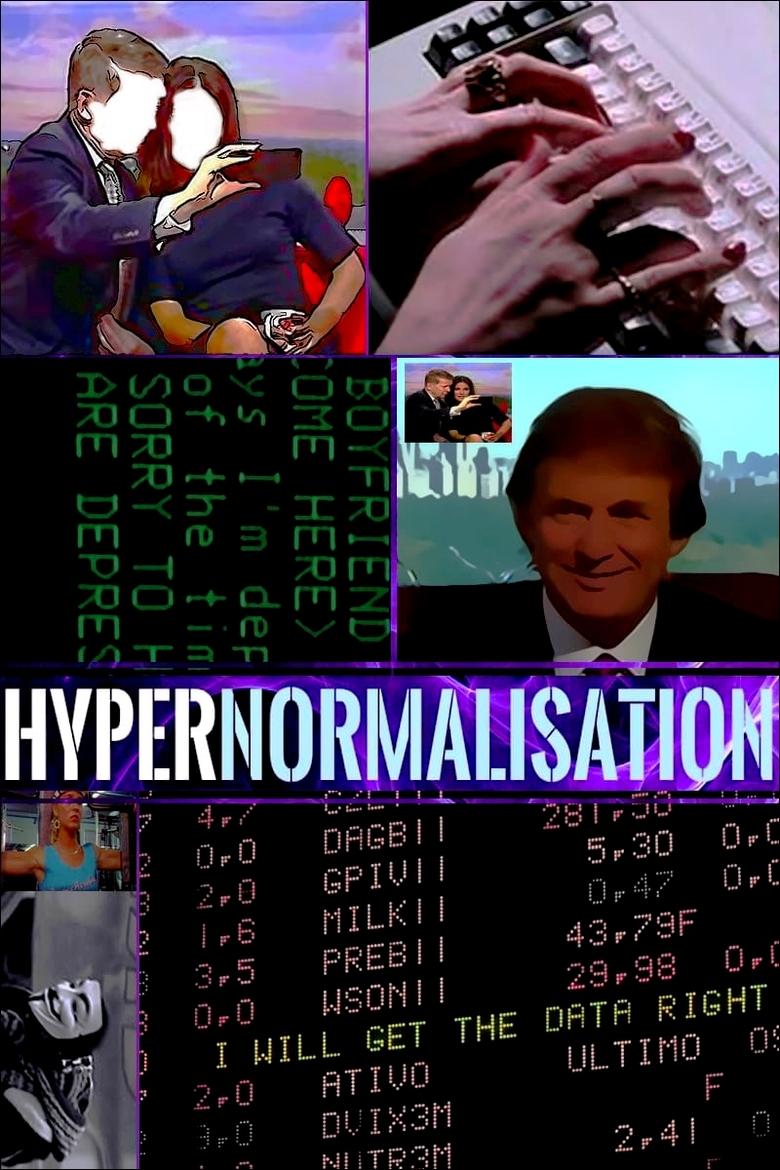
There is a particular kind of documentary that does not simply report on the world but attempts to reframe the entire way you perceive it. Adam Curtis has spent the better part of four decades making exactly that kind of film, and HyperNormalisation, released by the BBC in October 2016, is perhaps his most ambitious attempt yet. The title is borrowed from the Soviet scholar Alexei Yurchak, who used it to describe the late Soviet condition: a society in which everyone knew the system was broken, everyone knew everyone else knew, and life carried on regardless, propped up by shared, unspoken performance. Curtis takes that concept and applies it wholesale to the Western world from the 1970s to the present day, tracing a line from the fiscal collapse of New York City through the rise of Syria's Assad dynasty, the financialisation of global economies, the emergence of Donald Trump as a public figure, and the strange, hall-of-mirrors quality of contemporary politics. That it runs to two hours and forty-seven minutes is not an accident. Curtis is building a case, brick by archive brick, and he gives himself the room to do it.
Curtis wrote, directed and narrated the film himself, as is his established practice. Since The Mayfair Set (1999) and through landmark works like The Power of Nightmares (2004) and The Century of the Self (2002), he has refined a method that is immediately recognisable: vast quantities of repurposed archive footage, laid under a narration delivered in a calm, slightly mournful register, and cut to music that ranges from abrasive electronic pieces to unexpectedly tender pop songs. The effect is somewhere between an essay film and a fever dream, and it is a method that provokes strong reactions in both directions. Figures who appear throughout the film as subjects rather than participants include Ronald Reagan, Henry Kissinger, Vladimir Putin and, prominently, Donald Trump, whose public career Curtis uses as a case study in the willing manufacture of unreality. The BBC produced and broadcast the film, releasing it online in full, which meant it reached an unusually wide audience for a work of this length and density, arriving just weeks before the American presidential election and feeling, to many viewers, uncomfortably timely.
Because the cinematographer, editor and composer are not individually credited in the conventional sense, HyperNormalisation resists the usual kind of craft breakdown. What can be said is that the film's visual texture is entirely constructed from archive material, and the choices made in that construction are expressive in themselves: grainy news footage sits alongside slick corporate imagery, hand-held protest video against polished political broadcast, the collisions doing rhetorical work that the narration often leaves unstated. The music functions similarly, lurching between menace and melancholy, sometimes undercutting the images, sometimes amplifying them to an almost uncomfortable degree. Curtis has spoken in interviews about selecting music emotionally rather than illustratively, and the result here has the quality of a soundtrack that seems to know something the pictures are not quite saying aloud. For companion pieces in formally unconventional non-fiction filmmaking, see also Of Time and the City (2008), Terence Davies's deeply personal essay film built almost entirely from archive, and I also reviewed The White Diamond (2004), Werner Herzog's documentary that similarly uses found and constructed imagery to pursue an argument that exceeds its surface subject matter.
HyperNormalisation left me rattled in a way few documentaries manage, which is, I suspect, exactly what Adam Curtis intended.
Across nearly three hours, Curtis assembles a vast collage of archive footage, unsettling music and his own flat, hypnotic narration to build one sweeping argument: that since the 1970s, those with actual power, the politicians, the bankers, the tech visionaries, gave up on the messy complexity of the real world and built us a simpler, fake one instead, a managed version of normal we have all learned to accept. It is bleak, it is enormous in scope, and it is horribly persuasive.
It landed hard for me personally, because I have always been the sort who wants to know how the world works, front of house and behind the curtain both, and this plays like a smoking gun for a good deal of what I had long half-suspected. I will say, in fairness, that Curtis is a master persuader, and his method, sweeping decades of tangled history into one tidy, ominous thread, is as much art as argument. You want to keep some grip on where the compelling story ends and the provable case begins. But even taken as one man's grand narrative rather than gospel, it is a chillingly convincing one.
What stays with me is the strange aftertaste. It will not change anything, and I did not feel one bit better for having watched it; if anything it left me more uneasy about the years ahead than I was going in. And yet it is gripping, provocative and endlessly thought-provoking, the sort of film you go on arguing with in your head for days. Four stars, a terrifying, formidable piece of work that I would not undo watching, even if it has left me rather more afraid of what is coming.
HyperNormalisation sits in a tradition of essay documentaries that are less interested in balanced reportage than in the force and coherence of a single, prosecutorial vision. Whether that approach is a strength or a limitation is a question worth sitting with. What is not really in dispute is that Curtis has made something that lodges itself in the mind and refuses to leave quietly, a film that asks uncomfortable questions about collective complicity and the stories we allow to be told on our behalf. For a work that arrives from a public broadcaster and carries no theatrical release, no star-studded premiere, no marketing campaign beyond a URL, its cultural footprint has been remarkable. If you have found yourself circling the kind of questions it raises, my thoughts on Kings (2017) touch on similar territory around power, social fracture and the gap between political narrative and lived experience. Some films inform you. Some films disturb you into thinking. This one, stubbornly, does both, and then leaves you with the bill.
Rating: ★★★★ | Year: 2016 | Watched: 2026-09-20
Trailer
▶ Watch the official trailer for HyperNormalisation (2016) on YouTube
Where to watch
Watch in the UK
Rent: Amazon Video
Buy: Amazon Video
Physical: Amazon UK · Zavvi
Watch in the US
Rent: Amazon Video
Buy: Amazon Video
Physical: Amazon US
Affiliate disclosure: Movies With Macca may earn a small commission on purchases or subscriptions started via these links. It costs you nothing extra.