Force of Evil (1948)

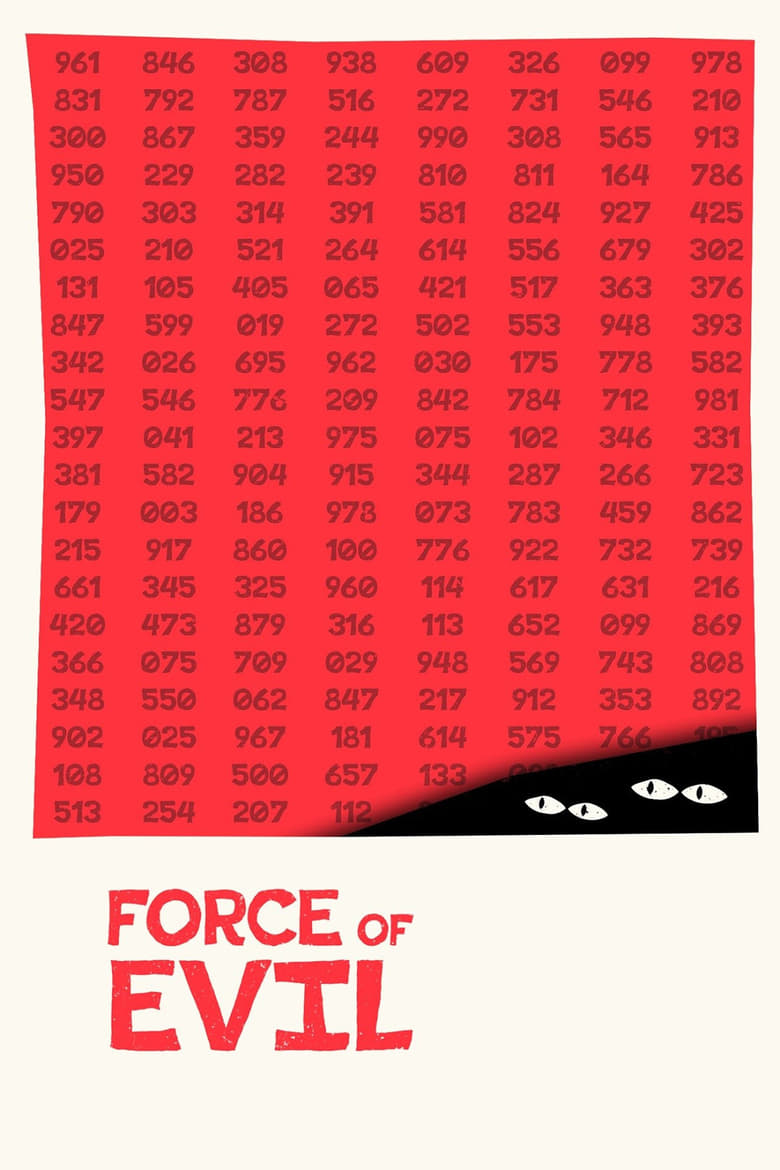
By 1948, film noir had already carved out its own corner of Hollywood, and the crime picture was a reliable commercial form, polished but unremarkable in many hands. Force of Evil arrives at that moment with rather more ambition than the genre usually demanded. It is based on Ira Wolfert's 1943 novel Tucker's People, a book that treated the numbers racket as a vehicle for examining organised crime and capitalism with a degree of seriousness that most pulp fiction did not bother with. Wolfert co-wrote the screenplay alongside the director Abraham Polonsky, which gives the adaptation an unusual coherence: the man who knew the source material was also shaping every line of the finished film.
Polonsky is a figure whose biography sits uncomfortably alongside his work. Force of Evil was only his second film as director, and it would be his last for over two decades. He was blacklisted in 1951 after refusing to cooperate with the House Un-American Activities Committee, and did not direct again until Tell Them Willie Boy Is Here in 1969. That gap matters when you consider how Force of Evil reads now: a film made by a man who would almost immediately be silenced by the political machinery his film, in its sideways fashion, was criticising. The production itself was a collaboration between Roberts Pictures and Enterprise Productions, with Metro-Goldwyn-Mayer handling distribution, a more respectable backer than the material might have attracted elsewhere. For a companion piece in late 1940s noir with a similarly troubled production context, see also The Reckless Moment, made just a year later.
John Garfield leads as Joe Morse, a lawyer who operates in the grey zone between legitimate practice and outright criminality, smooth-talking and self-assured in the way Garfield always was, carrying a particular kind of American masculine anxiety just below the surface. Thomas Gomez plays Leo, his older brother, small-time and stubborn, and the friction between them provides whatever emotional current the film generates. Marie Windsor appears in a smaller role, and Howland Chamberlain and Roy Roberts fill out the world of anxious men with money on the line. Garfield in particular had a talent for making moral compromise feel lived-in rather than theatrical, and that quality is central to what the film is trying to do.
Cinematographer George Barnes shoots New York in a way that leans on shadow and architecture, catching the city's financial district as something vertiginous and slightly hostile: low angles on stone buildings, faces half-lit in offices and stairwells, the streets below looking distant and precarious. Barnes had already shot Rebecca for Hitchcock earlier in the decade, and he brings a similar eye for spaces that feel both grand and threatening. The score is by David Raksin, who was, by this point, already known for his work on Laura (1944), and his music here keeps its distance from the more romantic end of noir, sitting closer to something tense and procedural. Art Seid's editing holds the film at a fairly measured pace, which suits Polonsky's dialogue-led approach and allows scenes to breathe, perhaps, at times, a little too generously. I also reviewed The Red Shoes, another 1948 film doing something formally distinctive with its craft, if in an entirely different register.
Force of Evil is, for most of its runtime, people talking very sternly at one another, and how much you get from it will come down to how much you enjoy that. It is a film noir about the numbers racket, the illegal street lottery, following a slick lawyer caught up in a scheme to swallow the small operators whole, his own brother among them. On paper that is a strong noir setup, all family, money and moral rot.
In practice, though, it felt awfully dated to me, and settled fairly quickly into a single stern register. The script and the dialogue are fine, well turned even, but the film runs almost entirely on people delivering grave speeches at one another, and once you have the measure of that rhythm, it does not offer up a great deal else. The individual lines are good. The whole, for me, mostly just sat there.
I can see why it has its champions, and I would not argue anyone out of it, because there is clearly craft and conviction in it. But it simply did not do much for me. Two and a half stars, a well-written noir that I found more stern than gripping, and that has, to my eye, aged more than most.
Force of Evil is the kind of film that accumulates serious admirers, and it is not hard to understand why: the political subtext, the literary ambitions of the script, and the circumstances of Polonsky's subsequent blacklisting all lend it a weight that straightforward genre pictures rarely carry. Whether the film itself earns that weight on screen, in the room, in real time, is a different question, and an honest one. Crime pictures that take language seriously are worth your attention, and for those who enjoy the genre's more verbal, morally loaded strain, I also covered Inside Man and Collateral, two later crime films that share some of that same preoccupation with complicity and system. Force of Evil is a film with real convictions. Whether those convictions translate into a satisfying experience is where reasonable people will part ways.
Rating: ★★½ | Year: 1948 | Watched: 2026-09-25
Trailer
▶ Watch the official trailer for Force of Evil (1948) on YouTube
Where to watch
Watch in the UK
Rent: Amazon Video
Buy: Amazon Video
Physical: Amazon UK · Zavvi
Watch in the US
Stream: YouTube TV
Rent: Fandango At Home
Buy: Fandango At Home
Physical: Amazon US
Affiliate disclosure: Movies With Macca may earn a small commission on purchases or subscriptions started via these links. It costs you nothing extra.