
Fantasia (1940)

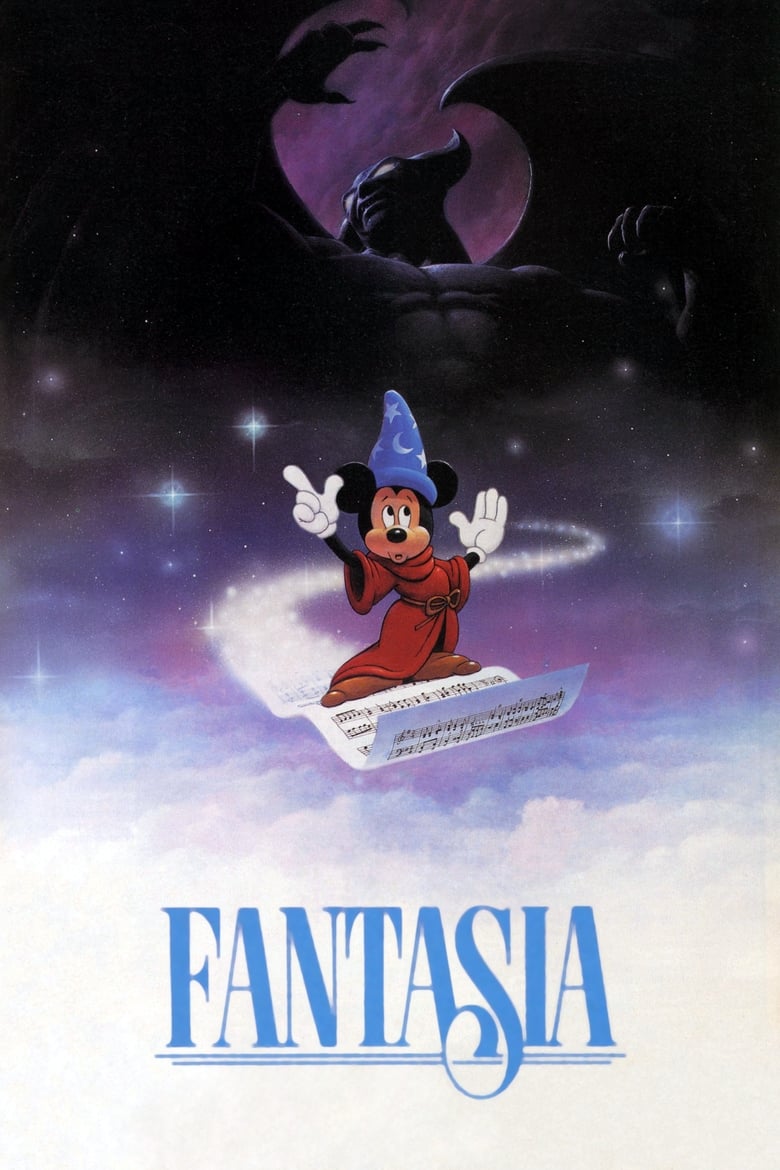
There are films that reshape what cinema thinks it can do, and Fantasia (1940) is one of them. Released at a moment when animation was still widely regarded as a novelty medium, a thing for children and Saturday mornings, Walt Disney's production arrived as a deliberate provocation: a feature-length film with no conventional narrative, no characters to root for beyond a walking broomstick and a handful of dancing hippos, and a soundtrack drawn entirely from the classical repertoire. The concept grew out of a simpler project, an animated short built around Paul Dukas's "The Sorcerer's Apprentice", intended to revive Mickey Mouse's flagging popularity. When conductor Leopold Stokowski expressed enthusiasm for the idea, Disney expanded it into something far more ambitious, a kind of animated concert programme in eight movements, running to over two hours. It was a significant financial gamble. The original roadshow release, in a specially configured "Fantasound" system that is widely considered a precursor to modern surround sound, required theatres to be specially wired for the experience, which limited its initial distribution considerably.
The film was directed not by a single hand but by a committee of twelve, among them James Algar, Samuel Armstrong, and Norman Ferguson, each assigned to a separate musical segment. The screenplay credit, such as it is for a film with almost no dialogue, goes to Dick Huemer and Joe Grant, who worked with Disney to match each piece of music to its animated world. The selections range from Bach's Toccata and Fugue in D Minor, rendered as pure abstraction, to Ludwig van Beethoven's Pastoral Symphony, populated with centaurs and mythological creatures, to Amilcare Ponchielli's "Dance of the Hours", performed here by a troupe of ostriches, hippos, elephants and alligators that remains one of the more genuinely funny sequences Disney ever produced. The score is performed throughout by Stokowski and the Philadelphia Orchestra, and the film's classical ambitions are anchored by Deems Taylor, a respected music critic of the period, who appears on screen in live-action passages to introduce each segment, providing the closest thing the film has to a human anchor. Walt Disney himself also appears briefly.
Cinematographer James Wong Howe, one of Hollywood's most respected names, worked on the live-action sequences and the atmospheric bridging passages, lending the on-screen performances a warmth and texture that sits in interesting contrast to the drawn imagery surrounding them. The animation itself was shot by the studio's own technical crew in Technicolor, and the result is extraordinarily rich in colour and movement, particularly in the "Night on Bald Mountain" segment, which manages a genuinely unsettling atmosphere even now. Editor Stephen Csillag faced the considerable challenge of cutting between live action and animation, and between wildly different tonal registers, from gothic nightmare to pastoral comedy, across the course of a very long evening. The film earned honorary Academy Awards at the 1942 ceremony, recognising both Stokowski's contribution and the studio's work in developing the Fantasound process. For context on how Disney was operating around this same period, I also reviewed Pinocchio, released the same year, and Dumbo, which arrived just a year later on a fraction of the budget. The contrast in approaches is striking. It is also worth looking back at Snow White and the Seven Dwarfs, the feature that first demonstrated Disney could sustain a feature-length animated story, to understand just how rapidly the studio was pushing at its own boundaries in this period.
Fantasia gets called timeless, and having now watched it twice, the best part of forty years apart, I am going to have to disagree.
The first time was as a boy at my grandma's, on a worn VHS, and I remember being thoroughly baffled and more than a bit bored, sitting there waiting for someone to say something, for a story to start, for anything much to happen. None of it came. I went back to it as an adult half-expecting the years to have closed that gap. They had not.
In fairness, I understand it far better now. Fantasia is not a film in the ordinary sense, and was never meant to be. It is an experiment: eight pieces of classical music, from Bach to Stravinsky, each handed its own animated accompaniment, with no plot and barely a word of dialogue beyond a genial host introducing the next movement. Taken on those terms, as a concert you watch rather than a story you follow, it makes a good deal more sense than it did to my confused younger self.
And I will give it its due, because it earns it. For 1940 this is astonishing, arguably the finest animation anyone had put on a screen to that point, and you can feel the ambition and the sheer graft in every frame. The Sorcerer's Apprentice still holds up, and there are images here that were decades ahead of anything else around. As a landmark, its place is not in any doubt.
The trouble is that a landmark and a film you actually want to sit through in 2026 are two different things. Eighty-odd years on it looks dated, it struggles to hold the attention, and at over two hours it is simply too long for what it is.
I can see everything it achieved, and it still did nothing much for me, no more as an adult than it did back at my grandma's. Two and a half stars, and, for all the reverence it gets, not the timeless classic I keep being told it is.
Fantasia occupies a strange position in cinema history: revered in the textbooks, cited in every survey of animation, and yet genuinely divisive when you actually sit down with it. Its reputation was rebuilt slowly over decades, having initially struggled at the box office and divided critics who weren't quite sure what to make of something that fit no existing category. A re-release in 1969, picked up enthusiastically by a generation predisposed to psychedelic visual experience, did much to cement its later canonical status. Whether that status holds when measured against the actual experience of watching it is, of course, the real question, and one that reasonable people have been arguing about for eighty years. Some landmarks are best admired from a distance.
Rating: ★★½ | Year: 1940 | Watched: 2026-09-17
Trailer
▶ Watch the official trailer for Fantasia (1940) on YouTube
Where to watch
Watch in the UK
Stream: Disney Plus
Rent: Apple TV Store · Amazon Video · Sky Store
Buy: Apple TV Store · Amazon Video · Google Play Movies · Sky Store
Physical: Amazon UK · Zavvi
Watch in the US
Stream: Disney Plus
Rent: Apple TV Store
Buy: Amazon Video · Apple TV Store · Google Play Movies · YouTube
Physical: Amazon US
Affiliate disclosure: Movies With Macca may earn a small commission on purchases or subscriptions started via these links. It costs you nothing extra.



