In Conversation: Joscha Bongard on Babystar

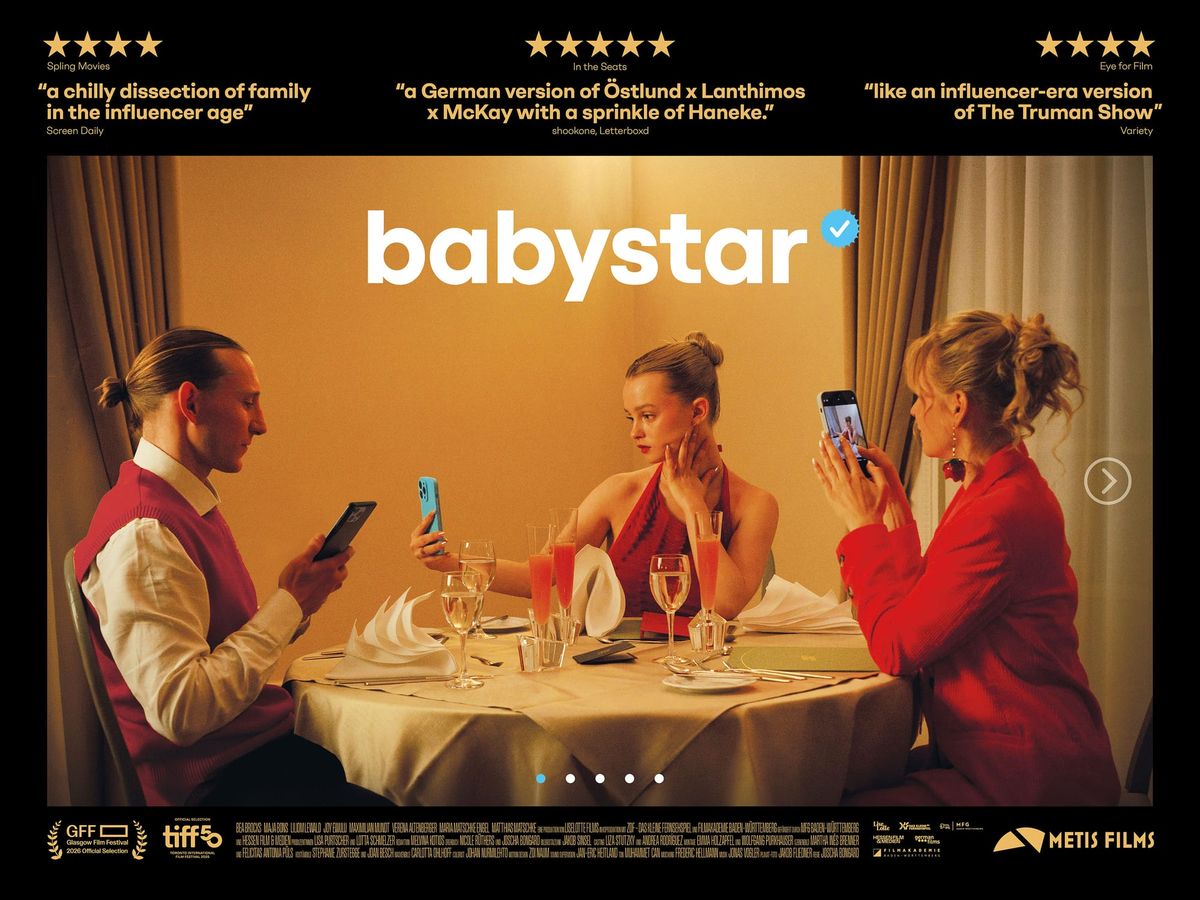
Babystar was one of the sharpest, most unsettling debuts I saw all year. It imagines a family of influencers whose teenage daughter, Luca, has had her entire life turned into content since before she was even born, and it uses that premise to say something genuinely bracing about the first generation raised as an audience metric. I gave it three and a half stars, and you can read my full review here.
It is the feature debut of Joscha Bongard, who wrote it with Nicole Rüthers and who spent time inside the YouTube industry himself, and that lived-in knowledge shows in every frame. He was kind enough to answer some questions for me, and we got into the first-hand access that shaped the story, the daring twenty-five minute prologue, the brilliant AI-avatar idea, casting Maja Bons as Luca, the deliberate refusal of a tidy ending, and what he hopes people take from the film as the UK moves to ban under-sixteens from social media. His answers were as clear-eyed and thoughtful as the film, so I have kept them in full below.
You've spoken about your own time in the YouTube world, and the film has an unnervingly authentic feel for how these families operate. How much of Babystar came from things you saw first-hand, and how did that access shape the story?
When I worked in the YouTube industry ten years ago, family influencing was a very niche phenomenon but I worked with a lot of young adults who became millionaires out of their childhood homes. We took a lot of inspiration from them for the backstories of the parents. My co-author Nicole Rüthers and I did some interviews with actual families in the business and of course completely destroyed our algorithms by watching endless hours of family content. We found so many things we implemented in the storyline, such as the iconic "get ready with me to give birth".
The film's real subject is the "Influencer Child", the first generation raised as content from birth. What was it about that specific figure that you needed to explore, and did making the film change how you think about it?
We are all shaped and influenced by our families and especially by our parents. I wanted to explore how families change in our age of digitalization. I'm really interested in how the obvious and the untold dreams and wishes of parents live on in their children. Also there is the capitalistic aspect of it: should we really commodify every intimate relationship of our life?
My stance is quite clear, but I also don't want to become cynical: I think we need to change our use of social media and I deeply believe in real human interaction and that this interaction will bloom again as a counterpart also to AI.
You run the world of the film for a full twenty-five minutes before the title card even appears. That's a bold choice. What were you after by holding the "prologue" for so long before the story proper kicks in?
To be honest: it still feels very bold and it was kind of an experiment because I love late title cards that divide the film. Our title comes in when Luca develops her first ever doubts on the system her parents built. I like to compare her upbringing with cults: if you're born into a cult and only know this hermetic life, it takes a lot to go against everything you learned and love. This is why we need to watch Luca for quite a time before she begins to act.
The AI-avatar strand is the film's sharpest idea, using the very technology that isolates people while claiming to reconnect them. Where did that come from, and how consciously were you building that irony?
We struggled a lot while writing with the right companion for Luca. Every friend we imagined didn't feel fitting and as we had the idea of Luca befriending herself, it was quite clear that this elevates the story, and we've had a lot of fun with it. The idea came from a podcast I listened to about how people fell in love with their Avatars on the app REPLIKA.
Maja Bons carries an enormous amount as Luca, a role that lives in small, guarded reactions. What were you looking for in casting her, and how did you work with her on a character this exposed?
Casting is so much about gut-feeling. We saw so many different versions of Luca, but when we cast Maja it just felt right. She has a background in modeling and is just such a precise actress with an enormous understanding of human emotions and their relationships. In our first chat about the role she was quite clear that she is only interested in playing Luca if she can portray her not as hyper, but rather as depressed. Luckily this was exactly what I was looking for.
The film deliberately withholds a lot of the catharsis an audience might expect, the head-on confrontation, the neat resolution. Was refusing that release a conscious decision, and what did you feel a tidier ending would have cost the film?
We didn't want to give the audience this relief as children growing up in these kind of families will also never be completely free. Their upbringing is documented, they will be affected by their parents' decisions for their whole lives. Of course we can't see what will happen with them because the first influencer babies are coming of age just now. But if you compare them to child actors it's likely some of the influencer kids will face serious problems.
But to be honest: maybe I would now be more confident to give Babystar an even bolder or tidier ending. But I'm still very happy with the ending we found.
Babystar arrives just as the UK moves to ban under-sixteens from social media. Given how directly the film speaks to that moment, what do you most hope audiences walk out thinking, or doing, differently?
I usually don't like bans but I think it is really necessary to protect children. I think this ban will also give schools the possibility to have more focused students. And I think two very important things of childhood are being able to play and understand the world through it and the feeling of boredom. Boredom is essential to get creative and to get to know your own inner voice. Social media and also AI are the death of boredom, even if we feel bored while watching it.
But I also want to address that it's not only our younger generation having a problematic relationship with social media, but also all the people who didn't grow up with it. We all have to learn a new way of using all these platforms.
My thanks to Joscha Bongard for his time, and to Keir at Strike Media. Babystar is in UK and Irish cinemas from 25 September. You can read my review of Babystar here.