
O Brother, Where Art Thou? (2000)

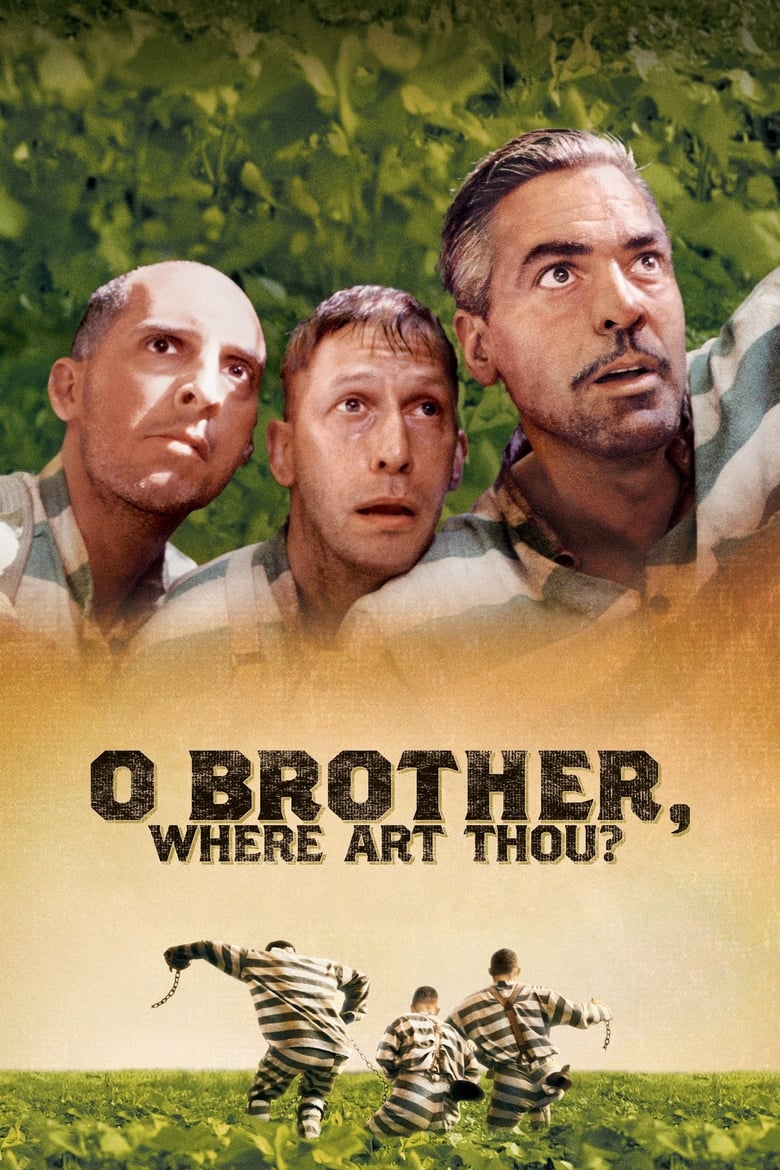
There is a version of O Brother, Where Art Thou? that exists purely as a genre exercise: three bumbling convicts on the run through Depression-era Mississippi, chased by a lawman who seems to belong to a different and more unforgiving film entirely. That version would have been perfectly watchable. What Joel and Ethan Coen actually made in 2000 is something stranger and more ambitious, a loose, freewheeling riff on Homer's Odyssey transplanted to the American South of the 1930s, complete with Sirens, a Cyclops and a blind prophet who turns out to be riding a handcar on a railway track. The classical source material sits lightly on the film, more a structural skeleton than a point-by-point retelling, and most viewers can enjoy it perfectly well without spotting a single allusion. That lightness of touch is rather the point.
By 2000 the Coens were operating from a position of considerable, if unconventional, prestige. They had arrived with the lean, sun-baked noir of Blood Simple back in 1984, and the decade and a half between that debut and O Brother had produced a body of work that swung between cult oddities and genuine awards-season heavyweights. Fargo had won them the Palme d'Or at Cannes in 1996 and brought widespread mainstream recognition, which made O Brother's deliberately shaggy, picaresque register feel like a deliberate step sideways. Touchstone Pictures and Universal backed the production alongside StudioCanal and Working Title, with the Coens writing and directing as their usual joint operation (Ethan taking an editing credit here alongside Tricia Cooke, as he often does). The budget was not especially newsworthy, but the ambition of the period reconstruction was, and the film was shot almost entirely on location in Mississippi.
The casting assembled a characteristically Coen-ish ensemble of reliable collaborators and happy surprises. George Clooney, at the height of his post-ER Hollywood currency, leads as Ulysses Everett McGill, a man whose vanity about his hair is established in the film's first minute and never quite abandoned. John Turturro, a Coen regular going back to Barton Fink, brings his customary intensity, here deployed entirely in the service of comedy. Tim Blake Nelson rounds out the central trio as the good-natured, not-especially-sharp Delmar, and John Goodman arrives for a memorably physical single-scene turn as the one-eyed Bible salesman Big Dan Teague. Holly Hunter, sharp and funny in a small but well-placed role, completes the principal cast.
Cinematographer Roger Deakins, shooting his sixth feature with the Coens, made a decision here that has been widely discussed ever since: the entire film was given a digital colour grade in post-production to drain the Mississippi landscape of its greens and give it the dusty, sepia-toned quality of an old photograph. It was one of the earliest uses of digital colour grading at that scale in a major studio release, and the effect is unmistakable, giving the film a quality that sits somewhere between a woodcut illustration and a bleached-out period postcard. The images feel simultaneously sun-scorched and slightly otherworldly. The musical programme was supervised by T Bone Burnett, who assembled a soundtrack drawing on period blues, gospel, bluegrass and folk traditions. The music, performed and recorded by the likes of Alison Krauss, Gillian Welch and Norman Blake, became a cultural phenomenon in its own right, winning the Grammy for Album of the Year in 2002. Burnett's work here was less a composed film score than an act of careful curation and historical reconstruction, and the sound of the film is as distinctive as its look.
There is a particular difficulty in judging a Coen Brothers film, which is that you inevitably end up measuring it against their own best work.
By that standard O Brother, Where Art Thou? falls short, and it is nowhere near the heights of Fargo or No Country for Old Men. Judged as its own thing, though, it is a hugely entertaining watch, dry and funny and unmistakably Coen from the first frame, a loose Depression-era retelling of the Odyssey with three chain-gang escapees stumbling across the Deep South.
The performances are what carry it. John Turturro is the standout, wonderful as ever in the Coens' hands, and Tim Blake Nelson is a likeable, gormless delight alongside him. George Clooney is fine without ever quite disappearing into the role, all matinee-idol charm where a touch more shabbiness might have served the film better, but the trio bounce off one another nicely and the comic timing across the board is sharp.
If I have one reservation, it is the music (and not the quality, but the "filler style" of it). The soundtrack is justly famous and it suits the world beautifully, but a few of the musical stretches run on longer than they need to, and the pace sags whenever the film pauses to let a song play out in full.
When it gets moving, though, it is a joy: the set pieces and the bigger comic action scenes are among its best moments, staged with flair and confidence. Three and a half stars, then, minor Coens by their own impossibly high standard, and better than most of what you could put beside it.
O Brother, Where Art Thou? sits comfortably in the middle tier of the Coen catalogue, which is still a better place to be than the top of most other directors'. It is the kind of film that rewards a second viewing less for hidden depths than for the pleasure of the performances, the look of the thing and the accumulated goodwill of a world the Coens clearly enjoyed building. For a companion piece that shows a harder, more merciless side of the same brother act, see also No Country for Old Men, and for an earlier road-comedy from the same partnership, I also covered Raising Arizona, which shares rather more DNA with this one than it might first appear. Minor Coens, as noted, but minor Coens is still a pretty good night out.
Rating: ★★★½ | Year: 2000 | Watched: 2026-09-29
Trailer
▶ Watch the official trailer for O Brother, Where Art Thou? (2000) on YouTube
Where to watch
Watch in the UK
Rent: Apple TV Store
Buy: Apple TV Store · Sky Store
Physical: Amazon UK · Zavvi
Watch in the US
Rent: Amazon Video · Apple TV Store · Google Play Movies · YouTube
Buy: Amazon Video · Apple TV Store · Google Play Movies · YouTube
Physical: Amazon US
Affiliate disclosure: Movies With Macca may earn a small commission on purchases or subscriptions started via these links. It costs you nothing extra.



