
John Carter (2012)

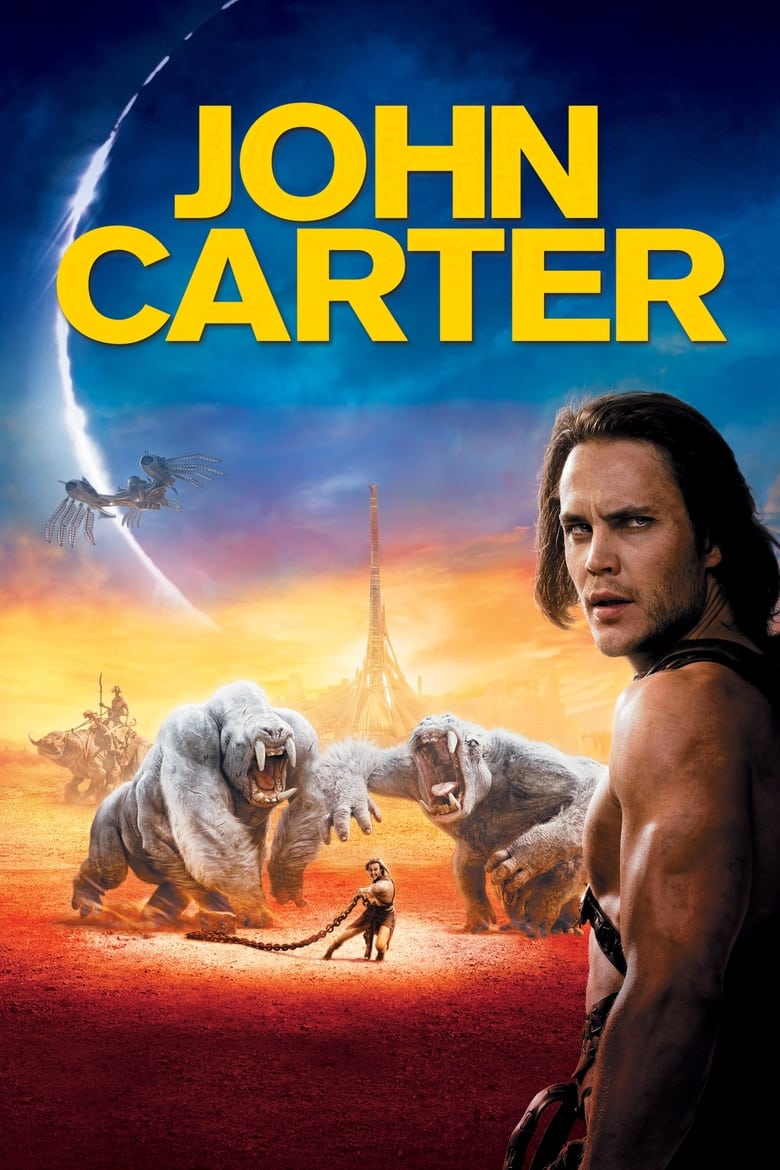
Before there was Flash Gordon, before there was Star Wars, before science fiction had even settled on its own name, there was Edgar Rice Burroughs and his Barsoom. The series of novels Burroughs began in 1912 with A Princess of Mars essentially invented the template for planetary romance: a soldier from Earth transplanted to a dying red world, swept up in wars between alien civilisations, falling for a princess who can handle herself perfectly well. The irony that the source material predates almost every franchise it later inspired is not a small one. Hollywood had been circling these books for decades, various adaptations collapsing in development, before Walt Disney Pictures finally committed to a full theatrical release in 2012 with a reported production budget well north of two hundred million dollars. The sheer scale of the undertaking was a statement of intent, and the studio clearly hoped it had the next great science-fiction property on its hands.
The choice of director was, on paper, the shrewdest move of all. Andrew Stanton had built his reputation entirely at Pixar, where he directed Finding Nemo and WALL·E, two films that demonstrated an almost uncanny gift for wringing genuine feeling from animated characters with limited dialogue and no obvious reason to make you cry. John Carter was his first live-action feature, and he co-wrote the script alongside Mark Andrews and the Pulitzer Prize-winning novelist Michael Chabon, a combination that ought to have produced something with both pulp momentum and literary texture. The screenplay draws primarily from Burroughs's first Barsoom novel, following one John Carter, a Civil War veteran who finds himself inexplicably transported to Mars (here called Barsoom), where the lower gravity grants him extraordinary physical abilities and the dying civilisations around him increasingly demand that he pick a side.
Taylor Kitsch takes the lead, a polished but unremarkable choice who brings a reasonable amount of laconic physicality to the role. Lynn Collins plays Dejah Thoris with considerably more energy than the script perhaps deserves, and the supporting cast fills out with real weight: Samantha Morton, Mark Strong and Ciarán Hinds all bring their particular varieties of authority to the Martian political landscape. Hinds, in particular, brings the kind of grizzled believability that tends to steady a film around him. The Barsoom that cinematographer Dan Mindel constructs is genuinely striking, all amber dust and angular alien architecture, captured with the kind of wide, sun-soaked framing that recalls classic epic cinema. Mindel, who would later shoot Stanton's Finding Dory (see also my thoughts on that one), has a talent for making vast spaces feel tactile rather than purely digital, which is no small achievement given the scale of the visual effects work here. Michael Giacchino provides the score, leaning into grand orchestral sweeps with occasional percussive Martian colour. His work is rarely less than functional and often genuinely rousing, editor Eric Zumbrunnen cutting the action sequences with reasonable propulsion, though the film's mid-section tends to slow in ways that perhaps reveal how much work the cutting room was asked to do. For a sense of how a war narrative can be structured with far greater economy, Paths of Glory remains the quiet benchmark.
John Carter had every ingredient it needed to launch a big new science-fiction franchise, and somehow launched precisely nothing.
The visuals are fantastic, all sweeping red-Martian vistas and lavish design; Taylor Kitsch makes a perfectly decent lead; and when you surround him with the likes of Willem Dafoe and Bryan Cranston, you are most of the way to a winner before you have started. It was even directed by Andrew Stanton, the Pixar man behind WALL·E and Finding Nemo, so you would think making an audience feel something might be the one thing all but guaranteed.
Which makes what went wrong all the more baffling, because the one thing this handsome, hugely expensive film has no idea how to do is make you care. There is no emotional hook to speak of, nobody you fall for, nothing tugging you along beyond the spectacle. For all the money and craft up on screen, there is a hole where the heart should be, and from a storyteller schooled at Pixar of all places, that is a strange thing to get so wrong. It looks every inch a blockbuster. It simply forgot to give you a reason to want one.
The upshot is a film that is not actually bad, and yet feels like a waste of everyone's time, its own very much included. It arrived dead in the water, flopped on a spectacular scale, and snuffed out any hope of the sequel it was so plainly built to set up, which leaves a faint pointlessness hanging over the whole thing even while you are watching it.
There is a decent adventure buried somewhere in all this Martian grandeur, but it never once gives you a reason to care whether it digs itself out. Two and a half stars, all the pieces of a franchise and none of the soul to hold them together.
John Carter sits in a curious category of big-budget films that are not quite disasters in any craft sense but became disasters in every commercial one. It lost Disney somewhere in the region of two hundred million dollars when all was accounted for, a figure that turned it into an industry cautionary tale almost overnight, the kind of flop that gets referenced for years in conversations about studio hubris. That fate is not entirely undeserved, but it is not entirely fair either. The Barsoom novels deserve their place in the history of the genre, and someone will likely try again with them one day. Whether any future attempt learns the right lessons from this one is another matter. A film this expensive and this handsome probably should not be most memorable for what it failed to feel.
Rating: ★★½ | Year: 2012 | Watched: 2026-09-25
Trailer
▶ Watch the official trailer for John Carter (2012) on YouTube
Where to watch
Watch in the UK
Stream: Disney Plus
Rent: Rakuten TV · Sky Store
Buy: Apple TV Store · Rakuten TV · Amazon Video · Google Play Movies
Physical: Amazon UK · Zavvi
Watch in the US
Stream: Disney Plus
Rent: Amazon Video · Apple TV Store · Google Play Movies · YouTube
Buy: Amazon Video · Apple TV Store · Google Play Movies · YouTube
Physical: Amazon US
Affiliate disclosure: Movies With Macca may earn a small commission on purchases or subscriptions started via these links. It costs you nothing extra.



