Dawn of the Dead (1978)

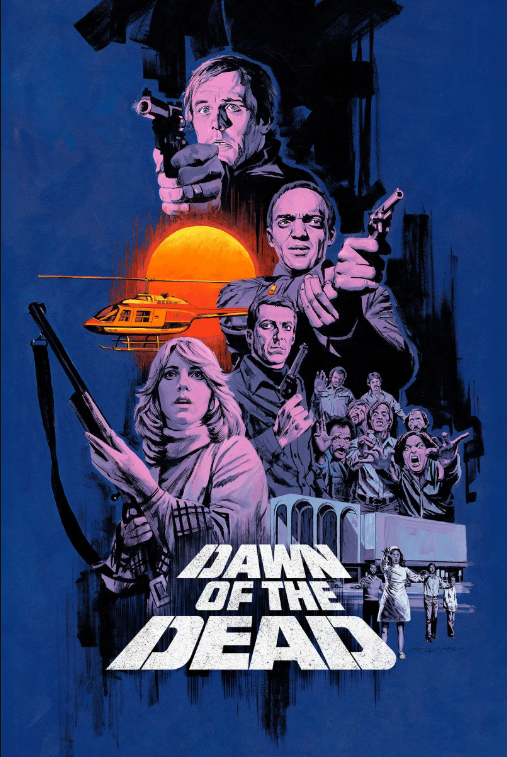
The American Dream isn't dead. It just reanimated, shuffled through the automatic doors, and made itself at home in the nearest shopping mall. That image, a horde of the undead mindlessly drifting between shop fronts, escalators, and fountain displays, is so perfectly, savagely funny that it almost hurts. George Romero didn't need a thesis statement. He built one out of fibreglass storefronts and blue-tinted corpses, and it's been haunting us ever since.
Yes, the zombies are blue. Yes, the blood is a shade of neon red that looks closer to paint than anything you'd find in a human body. Yes, the acting tips into hammy territory more than once. And honestly? None of it matters. Not even slightly. Because what Romero is doing here operates on a frequency where surface-level polish is almost beside the point. The rough edges aren't bugs, they're features. They give the whole thing a tactile, handmade quality that no amount of CGI polish could replicate. This is a real world, built by real people, with fake guts and genuine ideas.
What strikes me every time I come back to this film is the sheer physical scale of it. No AI-enhanced crowds, no digital apocalypse stretching to the horizon. Just an actual shopping mall, actual stuntmen, and Tom Savini running riot with latex and red syrup. Savini's practical effects work here helped define what screen horror could look like, and the lineage runs directly forward: no Savini, no Greg Nicotero. No Nicotero, no Walking Dead. You can draw a straight line from this film to virtually every piece of zombie media that followed, and that line doesn't bend or blur. It's direct.
Because here's the thing about Dawn of the Dead's cultural footprint: it's almost impossible to overstate. Romero's shambling, flesh-hungry, slow-moving dead didn't just influence horror. They colonised television, video games, literature, theme parks, Halloween costumes, and the entire vocabulary of apocalyptic storytelling. Night of the Living Dead lit the match, but Dawn of the Dead burned the house down. We're still standing in the ashes fifty years later, and we're still calling it Romero's genre because it is.
The mall setting is the masterstroke, obviously. Survivors holed up in a consumer paradise, fighting over a space that was already designed to keep people docile and spending. The zombies aren't the punchline, they're the mirror. They wander the concourses doing what the living used to do: circling, consuming, going nowhere with great commitment. It's blunt satire, and Romero knew exactly how blunt he was being. That's what makes it land. There's no winking at the camera, no nudging you in the ribs. He just sets it up and lets you sit with it.
The soundtrack, that queasy mix of library muzak and Goblin's propulsive score, does more atmospheric work than most horror films manage with their entire bag of tricks. The muzak playing over zombie carnage shouldn't work as well as it does, but it's pitch perfect, that collision of the mundane and the monstrous is exactly what the film is about.
We're never going to see a film made quite like this again. Not because the talent isn't there, but because the conditions that produced it, the freedom, the low-fi ambition, the willingness to make a serious argument inside a splatter film without apologising for either half of that equation, those conditions are genuinely rare now. Studios want one thing or the other. Romero wanted both, and he got them.
Four and a half stars. One of the most important horror films ever made, and still one of the most fun. Get yourself a big screen, dim the lights, and let the mall take you.
Rating: ★★★★½ (4.5/5)
Originally logged on Letterboxd.