Annie Hall (1977)

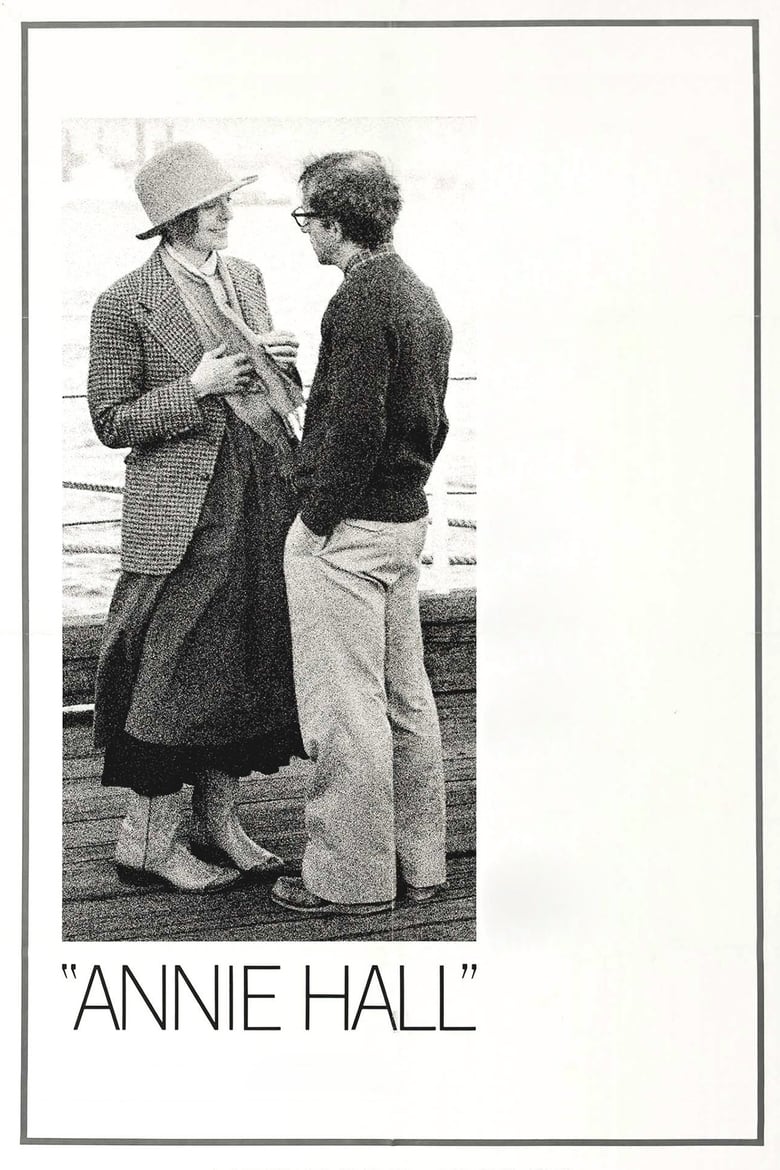
There are films that arrive carrying the full weight of critical consensus behind them, and Annie Hall is one of the heaviest. Released in 1977 by United Artists, through the production banner of Jack Rollins and Charles H. Joffe, it took the Best Picture Oscar that year and remains the film most readily cited when people want to draw a line between early, broadly farcical Woody Allen and the more personal, reflective work that would define the rest of his career. Whether that reputation holds up on fresh viewing is, of course, another question entirely.
Allen wrote the screenplay with Marshall Brickman, a longtime collaborator who had worked with him on television before the two moved into features together. The film follows New York stand-up comedian Alvy Singer as he picks over the wreckage of a relationship with the free-spirited Annie Hall, the narrative lurching back and forth in time, breaking rules as casually as it breaks the fourth wall. It is less a conventional romantic comedy than a kind of comic autopsy, dissecting what goes wrong between two people who are plainly fond of each other but probably not all that good for each other. The 93-minute runtime keeps things moving at a pace that suits the material, which is restless and associative by design.
Diane Keaton, who had already made her mark in the Godfather pictures (I covered the third instalment in my review of The Godfather Part III, and the second in my review of The Godfather Part II), won the Academy Award for Best Actress for her performance here, and the role became so associated with her personal style that it shifted fashion in a measurable, documented way. Her Annie is warm, slightly chaotic, and genuinely funny in a way that does not feel constructed. Tony Roberts plays Alvy's reliably sardonic best friend, Carol Kane appears as an early girlfriend, and Paul Simon turns up in a supporting role that is, to put it charitably, an interesting piece of casting.
Behind the camera, the film is the product of a particularly fruitful set of collaborations. Gordon Willis, the cinematographer known in the industry as "the Prince of Darkness" for his predilection for shadow and underexposure, gives Annie Hall a look that is naturalistic but never flat, with location work across New York and Los Angeles that feels lived-in rather than dressed. The cutting, handled by Wendy Greene Bricmont and Ralph Rosenblum, is where the film's formal playfulness really registers: the editing keeps pace with the non-linear structure without ever losing the audience, a trickier job than it might appear given how freely the timeline fragments. Artie Butler provides the score, which sits lightly under the action, allowing the dialogue and the performances the room they need.
For a companion piece on Allen working in a very different register, see also Manhattan (1979), which shares a great deal of DNA with this film, and I also reviewed Vicky Cristina Barcelona, which sits at quite a different point in his filmography.
I have worked through a fair few Woody Allen films now, and I have arrived at a firm conclusion: the best of them tend to be the ones he keeps himself out of.
My favourite so far is Vicky Cristina Barcelona, where he is nowhere near the screen, and the one that sorely tested my patience was Manhattan, where he is front and centre throughout. So I went into Annie Hall braced for more of the same, Woody Allen gently massaging his own ego for a couple of hours.
To be fair to it, there is a lot here that works. The writing is sharp, as it usually is with him, and I liked the playfulness of it, the way it breaks the fourth wall and talks directly to you. There is a wonderful scene where two characters make polite conversation while subtitles reveal what they are actually thinking, which is exactly the kind of clever, lightly experimental touch I enjoy. On the page, this is a good film.
The trouble, as ever, is the man at the centre of it. Diane Keaton is terrific, and to my mind she deserved a far better leading man than the one she got, someone with a bit more warmth and a bit less self-regard.
Allen's screen presence pulls me out of the thing every time, and it keeps Annie Hall, for me, in the good-not-great bracket rather than the classic everyone else seems to see. Three stars, well written and inventive in places, but held back by the very person who made it.
Annie Hall sits in an unusual position in the canon, a film so frequently described as a masterpiece that engaging with it honestly, on your own terms, requires a certain effort of will. What is not in dispute is that it changed what a romantic comedy was allowed to look like, and that its more formally adventurous moments still feel genuinely playful rather than merely clever. Whether those virtues outweigh its frustrations is precisely the sort of question that makes film worth arguing about over a pint. Canonical or not, some films are better loved from a slight distance.
Rating: ★★★ | Year: 1977 | Watched: 2026-10-02
Trailer
▶ Watch the official trailer for Annie Hall (1977) on YouTube
Where to watch
Watch in the UK
Stream: MGM Plus Amazon Channel
Rent: Apple TV Store · Amazon Video · Sky Store
Buy: Apple TV Store · Amazon Video · Google Play Movies · Sky Store
Physical: Amazon UK · Zavvi
Watch in the US
Rent: Amazon Video · Apple TV Store · Google Play Movies · YouTube
Buy: Amazon Video · Apple TV Store · Google Play Movies · YouTube
Physical: Amazon US
Affiliate disclosure: Movies With Macca may earn a small commission on purchases or subscriptions started via these links. It costs you nothing extra.