Tarzan (1999)
★★½ — Tarzan (1999)

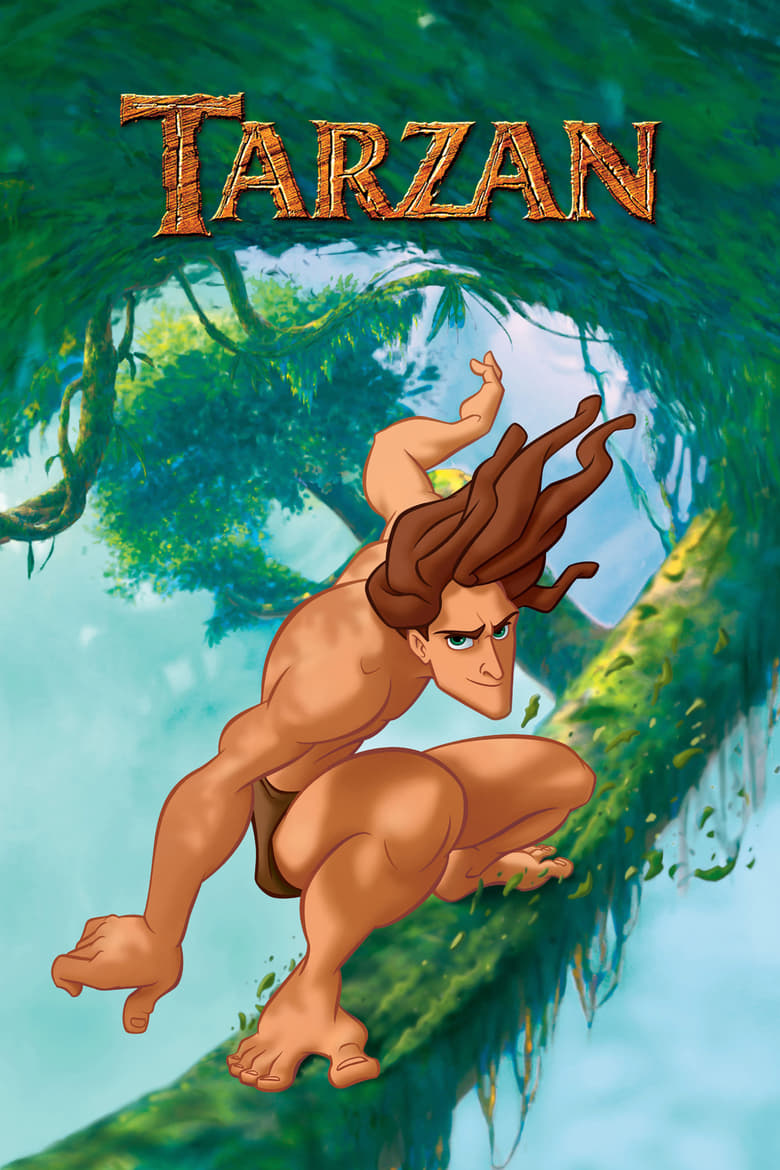
There's a moment in Disney's Tarzan where the man raised by apes surfs through a jungle canopy at full tilt, branches bending and snapping underfoot, the camera swooping and diving with him like it's on a rollercoaster. It's genuinely thrilling. And then it's over, and you realise the film's spent most of its energy on sequences like that one rather than on the people inside them. That's Tarzan in a nutshell: all swing, not enough soul.
The animation is properly impressive, I'll give it that. The jungle feels dense and alive, the movement of the gorillas is weighty and convincing, and the action sequences have a kinetic momentum that holds up well. The character designs are expressive too, especially among the ape troupe. On a purely visual level, it's a handsome piece of work. Disney's technical ambition here is hard to argue with.
But the story? We've been here before. Orphan raised by animals, grows up caught between two worlds, must figure out where he belongs. It's a solid bones idea, no question, only Tarzan doesn't push it anywhere particularly new or uncomfortable. The themes of colonialism and belonging and what it means to be part of a family are all there, hovering at the edges, but the film never quite commits to pulling them into the light. It keeps choosing the safer path when a braver version of this story was within reach.
What saves the whole thing, and I mean genuinely saves it, is Phil Collins. His soundtrack is the emotional engine the script can't fully provide on its own. "You'll Be in My Heart," "Two Worlds," "Son of Man," these are anthemic, warm, properly felt songs, and Collins uses his voice like a narrator who actually cares about the character's journey. There's something unusual and rather wonderful about a pop star functioning as a one-man Greek chorus, and it works far better than it has any right to. Without that soundtrack, I think this film would feel significantly emptier.
The characters, though, are where it really lets itself down. Tarzan is more physique than personality. He's compelling to watch in motion but there's not a great deal going on beneath the surface. Jane is charming in flashes but underwritten, and the villain, a cartoonishly greedy hunter with no real menace to him, feels like a placeholder rather than a genuine threat. Even the supporting apes, for all the talent involved in voicing them, lean heavily into broad comedy when the film could have used a bit more emotional complexity from that corner.
Compare it to something like The Hunchback of Notre Dame, a Disney film from the same era that took genuine risks with its themes, gave its villain real menace, and earned its emotional moments properly. Tarzan doesn't have that courage. It's polished to a high shine, it's entertaining enough, and it's got one of the best soundtracks in the whole Disney catalogue. But it skims across the surface of its own ideas rather than going deep.
There's a decent film here, and I didn't have a bad time watching it. The music alone is worth your while. But when I stack it up against the films from Disney's genuine golden run, the ones that had both the visual craft and the emotional weight to match, Tarzan comes up short. It swings with real confidence through some spectacular jungle scenery. It just never quite gets off the ground.
Two and a half stars.
Rating: ★★½ | Year: 1999 | Watched: 2026-04-16
Where to watch
Watch in the UK
Stream: Disney Plus
Rent: Rakuten TV · Sky Store
Buy: Apple TV Store · Rakuten TV · Amazon Video · Google Play Movies
Physical: Amazon UK · Zavvi
Watch in the US
Stream: Disney Plus
Rent: Amazon Video · Google Play Movies · YouTube · Fandango At Home
Buy: Amazon Video · Apple TV Store · Google Play Movies · YouTube
Physical: Amazon US
Affiliate disclosure: Movies With Macca may earn a small commission on purchases or subscriptions started via these links. It costs you nothing extra.
Related on Movies With Macca
More from Chris Buck: Surf's Up (2007) · Frozen II (2019) · Frozen (2013)
More from the 1990s: Lessons of Darkness (1992) · Shinjuku Boys (1995) · Blue (1993) · Cemetery Man (1994)
More animation: Fantastic Planet (1973) · Alice in Wonderland (1951) · Mononoke the Movie: The Phantom in the Rain (2024) · Mononoke the Movie: Chapter II - The Ashes of Rage (2025)
More family: Alice in Wonderland (1951) · Wonder (2017) · Kirikou and the Wild Beasts (2005) · Anastasia (1997)