One Hundred and One Dalmatians (1961)
★★½ — One Hundred and One Dalmatians (1961)

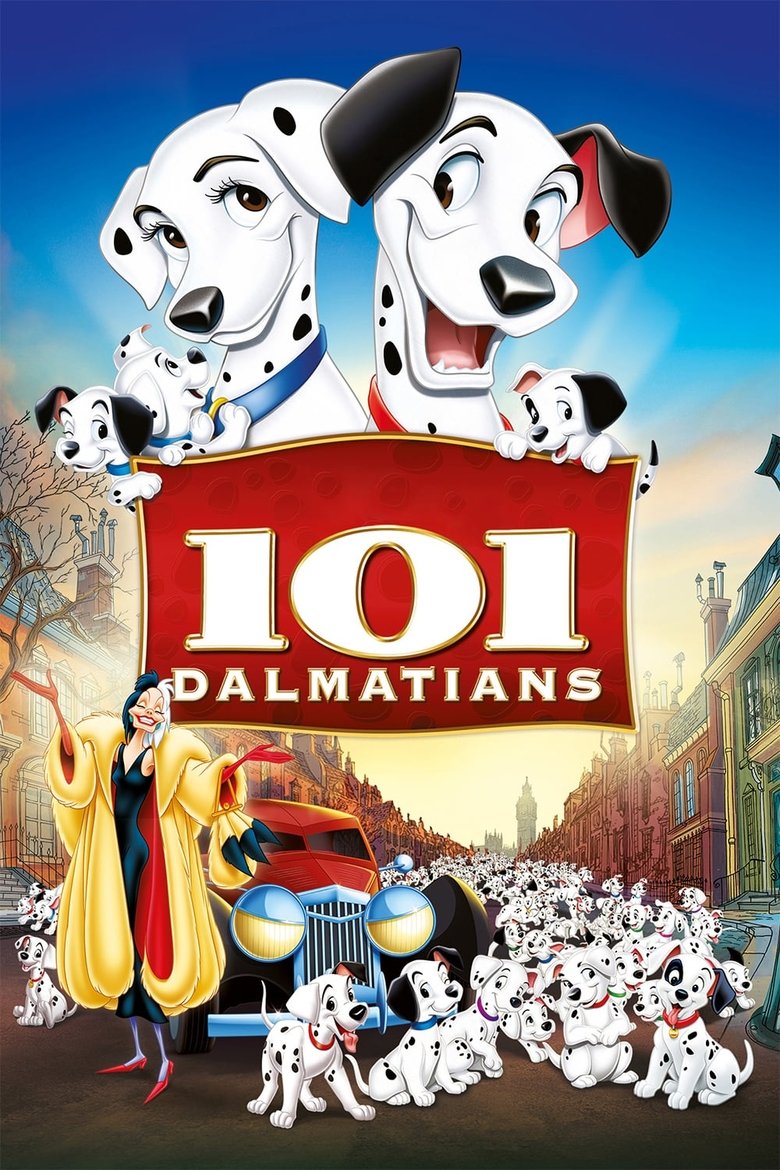
Let me get this out of the way early: Cruella de Vil is one of the great screen villains. Not just in animation, not just in Disney, full stop. She sweeps into every scene in a cloud of cigarette smoke and fur, all angular menace and shrieking self-importance, and the film absolutely crackles whenever she's on screen. The trouble is, she's not on screen nearly enough, and when she's absent you start to notice how thin everything else is.
One Hundred and One Dalmatians is perfectly watchable. I don't want to be unfair to it. There's genuine charm here, and the animation is the most interesting thing the film has going for it beyond its villain. Disney used xerography to transfer animators' drawings directly onto cels, giving the whole film a scratchy, graphic quality that feels unlike anything the studio had done before. London is rendered in stylish, almost spare lines. The sea of spotty puppies produces some genuinely playful visual gags. It looks fresh, even now, and that's no small achievement for a film of this age.
But here's the thing. Once you've admired the technique and gasped at Cruella's entrance, the story doesn't give you a great deal else to hold onto. Pongo and Perdita are pleasant enough leads, but pleasant is about as far as it goes. They're competent, they're likeable, they love their puppies, and they're almost entirely without the kind of depth that makes you genuinely invest in a character's journey. Compare them to the leads in Pinocchio (1940), a film that wrings real emotional stakes out of a wooden puppet and his conscience, and the flatness becomes harder to ignore.
The plot, too, is as simple as animated films get. Puppies get stolen. Dogs try to get them back. There are montages. More montages. A chase. Credits. It's not that a simple story can't work, it absolutely can, but the middle section here drags in a way that even younger viewers might fidget through. The "find the puppies" sequences start to blur into one another, and without a strong emotional throughline to keep you anchored, the momentum stalls.
The music is sparse, especially by Disney standards of the era. There's no showstopper, no song that lodges itself in your chest the way the great ones do. The human characters, meanwhile, feel like props rather than people. They exist to set up the crisis and to be reunited with their dogs at the end, and not much more than that.
I've seen people make the case that this is an underrated gem in the Disney canon, and I can see where they're coming from. It is genuinely different-looking, and Cruella is a creation worth celebrating. But I can't quite get there myself. Compared to the studio's richer, stranger work, this plays more like an extended cartoon than a fully realised story. It's the kind of film that's enjoyable enough in the moment but doesn't leave much of a mark once you've seen it. I watched it and immediately found my thoughts drifting to the animation craft rather than anything the story made me feel.
That's not a disaster, but it is a limitation. There's a version of this film that uses its wonderful villain and its striking visual style as the scaffolding for something with a bit more weight to it, and I kept wishing I was watching that version instead. What we've got is cute, competent and largely harmless. A solid second division entry in the Disney catalogue rather than a classic. Worth your time if you've never seen it, and there's plenty of nostalgic warmth to be had, but don't be surprised if Cruella is the only thing you're still thinking about the next morning.
Two and a half stars.
Rating: ★★½ | Year: 1961 | Watched: 2026-04-16
Where to watch
Watch in the UK
Stream: Disney Plus
Rent: Apple TV Store · Rakuten TV · Sky Store
Buy: Apple TV Store · Rakuten TV · Amazon Video · Google Play Movies
Physical: Amazon UK · Zavvi
Watch in the US
Stream: Disney Plus
Rent: Apple TV Store · Google Play Movies · YouTube
Buy: Amazon Video · Apple TV Store · Google Play Movies · YouTube
Physical: Amazon US
Affiliate disclosure: Movies With Macca may earn a small commission on purchases or subscriptions started via these links. It costs you nothing extra.
Related on Movies With Macca
More from Hamilton Luske: Alice in Wonderland (1951) · Pinocchio (1940)
More from the 1960s: Viy (1967) · Persona (1966) · Carnival of Souls (1962) · Daisies (1966)
More adventure: Alice in Wonderland (1951) · The Eagle (1925) · Louisiana Story (1948) · The General (1926)
More animation: Fantastic Planet (1973) · Alice in Wonderland (1951) · Mononoke the Movie: The Phantom in the Rain (2024) · Mononoke the Movie: Chapter II - The Ashes of Rage (2025)