Kirikou and the Sorceress (1998)
★★½ — Kirikou and the Sorceress (1998)

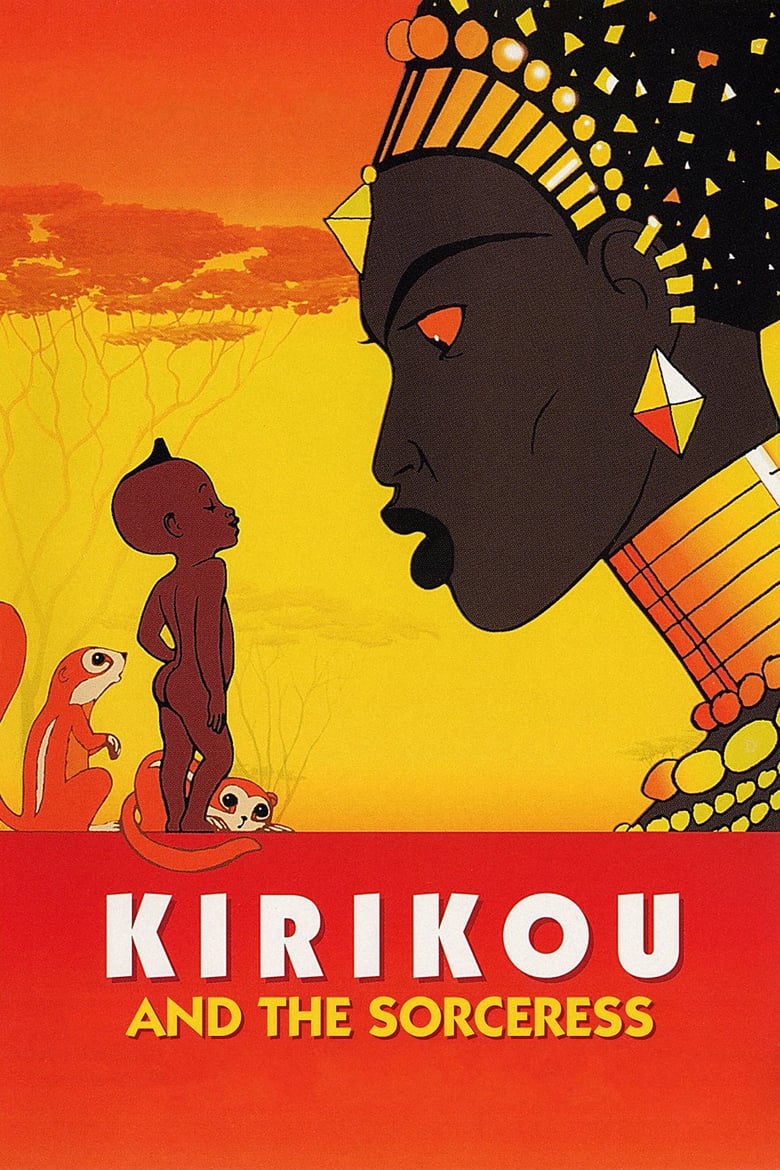
There's a moment early in Kirikou and the Sorceress where the tiny, newborn hero, barely seconds old, announces he can walk and talk and sets off to save his village. It's delightful. Completely absurd in the best possible way, rooted in the logic of a folk tale rather than any attempt at realism, and it immediately signals what kind of film this is: a story told the way stories were meant to be told, around a fire, for children and the child still rattling around inside every adult. I wanted to love it. I genuinely did. And I do love parts of it. But there are frustrations here that keep it from being everything it could be.
The art style is the first thing that grabs you, and it doesn't let go. Bold shapes, vivid colours, stylised landscapes that feel genuinely rooted in West African visual traditions rather than processed through the usual Western animation filter. Kirikou himself, tiny and unashamedly naked, is full of personality in the way he's drawn. The sorceress Karaba, towering and mysterious, has a real visual presence. This is not a film that looks like anything else in mainstream animation, and that specificity deserves proper recognition. It's rare, and it matters.
The music is wonderful too. Traditional rhythms, melodic chants, a warmth and authenticity that makes the world feel lived-in rather than constructed. The soundtrack does as much world-building as the visuals, and together they create something that feels genuinely grounded in its cultural roots. For that alone, I'd recommend seeking it out.
The story moves in the episodic, fable-like way of oral tradition. Kirikou sets out to understand why Karaba has cursed his village, encounters obstacles, shows courage and empathy, and learns that understanding a person's pain is often the first step to resolving it. It's gentle and moral and perfectly suited to young children. As a bedtime story stretched to feature length, it works. As something to hold the attention of an older viewer looking for dramatic momentum, it's a tougher sell. The pacing is slow, and the simplicity that suits its youngest audience can leave everyone else feeling a little restless.
But the thing that genuinely undermined my experience, and I can't ignore it, is the English dub. Flat delivery, awkward line readings, a mismatched energy that drains the warmth right out of scenes that should sing. If you're going to watch this, do yourself a favour and go for the original French track, or subtitles at the very least. The dub isn't just a minor inconvenience. It actively works against the film. Voice performances in animation carry so much of the emotional weight, and when they're this lifeless, you feel it in every scene.
I had a similar experience watching Fantastic Planet (1973), where the visual imagination is so strong that even a patchy dub can't entirely sink it, but it remains a nagging distraction throughout. Kirikou has that same problem, though perhaps even more acutely because the story is simpler and relies more heavily on its performances to carry emotional weight.
There's real charm here, and real cultural value. I'm glad films like this exist, and I'm glad I watched it. If you've got young children who are ready to encounter a story from outside the usual Disney or Dreamworks pipeline, this is exactly the kind of thing worth putting in front of them. I also went on to watch Kirikou and the Wild Beasts (2005), which revisits the character and is worth a look if this one connects with you.
For me, though, Kirikou and the Sorceress sits at two and a half stars. Admirable in its ambition and its artistic identity, hampered by a dub that does it no favours and a pace that tests adult patience. A beautiful bedtime fable, not the sweeping adventure it occasionally reaches for.
Rating: ★★½ | Year: 1998 | Watched: 2026-04-16
Where to watch
Watch in the US
Stream: Amazon Prime Video · Amazon Prime Video with Ads
Rent: Amazon Video
Buy: Amazon Video
Physical: Amazon US
Affiliate disclosure: Movies With Macca may earn a small commission on purchases or subscriptions started via these links. It costs you nothing extra.
Related on Movies With Macca
More from Michel Ocelot: Kirikou and the Wild Beasts (2005) · Princes and Princesses (2000)
More from France: Fantastic Planet (1973) · Letter from Siberia (1957) · Lessons of Darkness (1992) · Here and Elsewhere (1976)
More from the 1990s: Lessons of Darkness (1992) · Shinjuku Boys (1995) · Blue (1993) · Cemetery Man (1994)
More fantasy: Viy (1967) · Alice in Wonderland (1951) · Mononoke the Movie: The Phantom in the Rain (2024) · Mononoke the Movie: Chapter II - The Ashes of Rage (2025)
More adventure: Alice in Wonderland (1951) · The Eagle (1925) · Louisiana Story (1948) · The General (1926)