Island of Lost Souls (1932)
★★½ — Island of Lost Souls (1932)

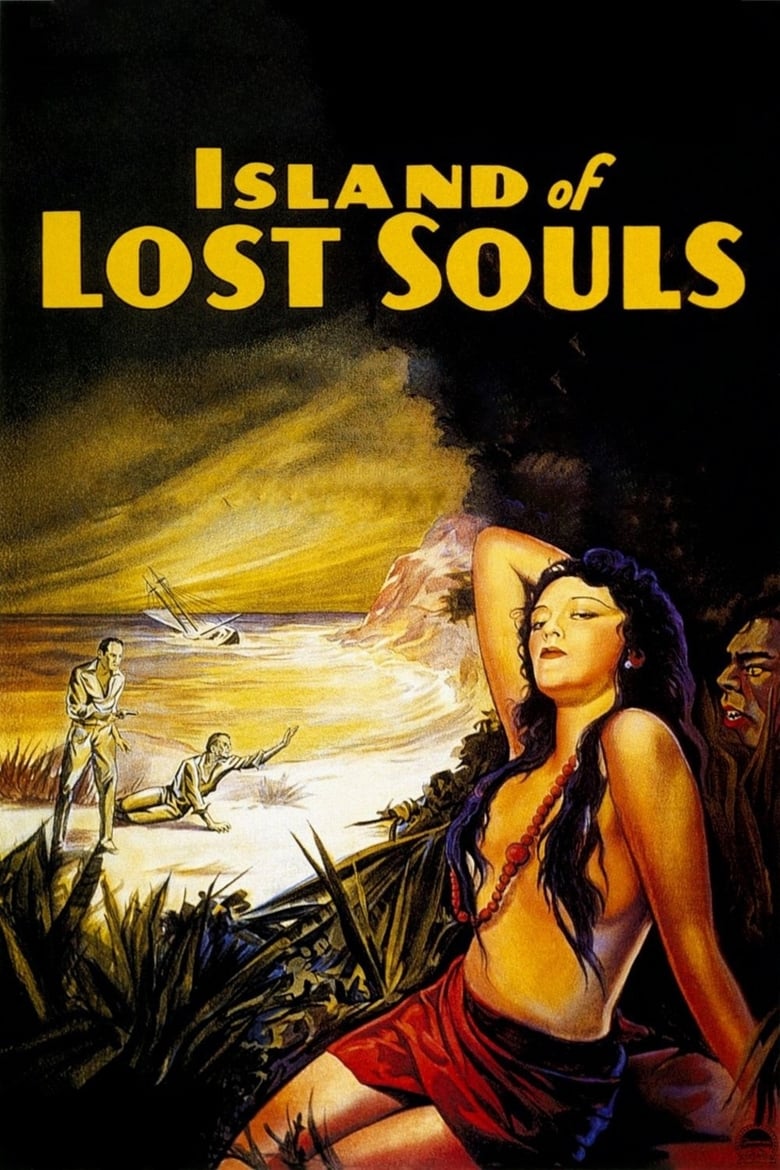
There's a moment in Island of Lost Souls where you realise exactly what you're watching, and it hits like a cold hand on the back of the neck. A man stumbles through dense jungle, torchlight catching faces in the undergrowth. Not human faces exactly, not animal ones either. Something in between, something wrong. And the film just holds on them. It doesn't flinch. For 1932, that's extraordinary, and also a little insane.
This is pre-Code Hollywood at its most unhinged. Based on H.G. Wells' The Island of Doctor Moreau, it follows a shipwrecked man washed ashore on a remote island where Charles Laughton's Dr. Moreau has been playing God with a scalpel, surgically forcing animals into human form, conditioning them with pain and law, and congratulating himself on the results. The story goes to places that studios would soon be legally forbidden to touch. Blasphemy, bodily violation, the suggestion of something between man and beast that the Hays Code censors clearly found appalling. You can see exactly why they banned it. You can also see why it fascinated people.
Laughton is the film's great pleasure. Moreau is theatrical, immaculate, utterly convinced of his own genius, and completely devoid of anything resembling conscience. Laughton plays him with this horrible warmth, like a man who genuinely believes he's doing important work and is mildly irritated that others can't appreciate it. He's magnetic in the way that truly dangerous people can be. I've admired Laughton in other things, not least in Witness for the Prosecution, and here you can already see that quality he had: the ability to make villainy feel reasonable, even charming, right up until it isn't.
Bela Lugosi turns up in a supporting role and, as ever, commands every second he's given. He's barely recognisable under the makeup, but the eyes give him away. That particular stillness he had, that coiled intensity, it cuts straight through the fur and the prosthetics. Two iconic horror presences sharing a jungle set is, on its own, reason enough to seek this one out.
The Beast Men themselves are where things get complicated. There's genuine eeriness in their wide-eyed stares, their guttural chanting of Moreau's laws. As a concept, they're deeply unsettling. But the physical effects are, by any honest measure, pretty rough. Men in heavy makeup and fur suits, moving with the stiffness you'd expect. For 1932 it was groundbreaking work. Watching it now, you have to extend a fair bit of goodwill, because the gap between what the film is reaching for and what it actually achieves on screen is wide enough to trip over. It pulls you out of the dread just when the dread is building nicely.
That tension between ambition and execution runs through the whole film. The ideas here are genuinely bold, the ethics of creation, the arrogance of science, the violence buried in civilisation's foundations. These are questions that still matter, and the film deserves credit for raising them so directly. But as a narrative it's loose, more a series of escalating confrontations than a properly constructed story. Coherence isn't really its strong suit. It gets away with this partly because the pacing is brisk and partly because Laughton refuses to let you look away.
It sits comfortably alongside some of the great Universal-adjacent horrors of the period. If you've enjoyed The Old Dark House or The Invisible Man, both from roughly the same moment in horror history, you'll find familiar pleasures here: that peculiar combination of theatrical excess, genuine menace, and ideas that were genuinely too much for comfortable audiences to sit with. It's a crowded and impressive era.
So where does that leave me? Island of Lost Souls is historically significant, no question. It helped lay the groundwork for body horror and science fiction ethics in ways that still echo. But as a viewing experience in 2024, it's more curio than classic. Something to admire, something to find genuinely unsettling in flashes, but not something that fully coheres into the nightmare it so clearly wants to be. Worth your time if you're interested in where horror came from. Just don't expect it to keep you up at night.
Two and a half stars.
Rating: ★★½ | Year: 1932 | Watched: 2026-04-13
Where to watch
Watch in the US
Rent: Amazon Video · Apple TV Store · Google Play Movies · YouTube
Buy: Amazon Video · Apple TV Store · Google Play Movies · YouTube
Physical: Amazon US
Affiliate disclosure: Movies With Macca may earn a small commission on purchases or subscriptions started via these links. It costs you nothing extra.
Related on Movies With Macca
More with Charles Laughton: The Old Dark House (1932) · Witness for the Prosecution (1957)
More from the 1930s: Earth (1930) · Monkey Business (1931) · Sabotage (1936) · People on Sunday (1930)
More science fiction: Invasion of the Body Snatchers (1956) · Fantastic Planet (1973) · Nightmare City (1980) · The Long Walk (2025)
More horror: Invasion of the Body Snatchers (1956) · Viy (1967) · Nightmare City (1980) · Angst (1983)