Death Line (1972)
★★ — Death Line (1972)

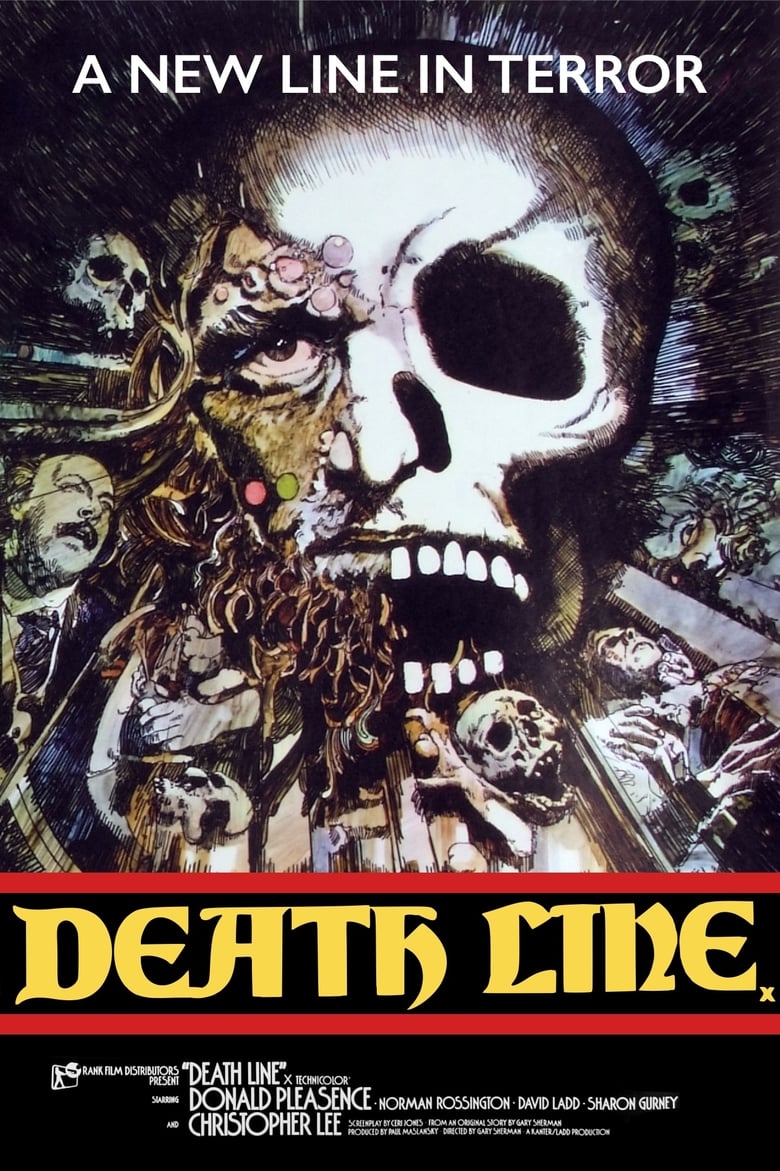
Donald Pleasence is doing everything he can to save this film, and he very nearly pulls it off. That's not nothing. But it's also not quite enough.
Death Line, also released as Raw Meat, is one of those British horror films from the early seventies that wears its ambitions proudly on its sleeve while simultaneously tripping over its own feet. The premise is genuinely unsettling: beneath the London Underground, a family of cannibals descended from Victorian railway workers have survived for generations after being sealed underground by a tunnel collapse. It's crude, it's grim, and it's clearly drawing on the legend of Sawney Bean, that gruesome bit of Scottish folklore about a cannibal clan living in coastal caves. Transplant that into the bowels of the Tube and you've got something with real potential for horror and social commentary in equal measure.
And to be fair, director Gary Sherman is clearly after something more than cheap shocks. There's an argument buried down here about class, urban neglect, and the people society leaves behind, forgotten and rotting beneath the city's feet while everyone above goes about their business. It's a genuinely interesting idea. The problem is that the film keeps getting in its own way before the idea can breathe.
The underground sets are the film's best asset. Claustrophobic, damp, oppressive, they carry a tactile nastiness that a lot of bigger productions couldn't manage. And the practical effects are legitimately impressive for 1972, grisly and unflinching in a way that clearly meant business. The atmosphere down in those tunnels works. I'll give it that.
What doesn't work is sitting above ground. The American lead, David Ladd, is quite simply wrong for this film. Wooden is probably too kind a word. He delivers his lines with all the conviction of someone reading subtitles off a screen just out of frame, and the tonal mismatch between him and the rest of the cast is jarring every single time he opens his mouth. A lot of the dialogue hasn't aged especially well either, full of clunky exposition and period slang that dates things far more than the grainy photography does.
Pleasence, though. He's doing something completely different from everyone else on screen, playing a world-weary, curmudgeonly inspector with such specific, lived-in detail that he almost feels like he's wandered in from a better film. When he's on screen, Death Line has a pulse. When he's not, it flatlines. I use "strongest performance" loosely given the overall standard, but he's the only reason I'd actively recommend tracking this down. Fans of his work in Halloween will recognise that same gift for making eccentric authority figures feel utterly real, even when everything around him is going a bit daft.
The bleak tone does stick around after the credits, I'll admit. Sherman's instinct to play it all deadpan rather than winking at the camera is the right one, even if the result is that some of the more absurd moments land as unintentional comedy. There were points where I genuinely wasn't sure if I was supposed to be laughing or not. The social horror message, the neglect, the class abandonment, gets swallowed up by the melodrama and shock value before it can really land with any force.
For fans of British horror of the period, like The Curse of Frankenstein and its ilk, there's a certain fascination to Death Line as a curio. It sits at an odd crossroads between serious-minded genre filmmaking and grindhouse exploitation, and that tension never really resolves itself. It's often laughable, occasionally genuinely effective, and never quite boring, which counts for something. But its ambition significantly outweighs its execution, and two stars feels about right.
Watch it for Pleasence, watch it for its odd little place in the history of British horror, and keep your expectations low enough that the tunnel sets and the practical nastiness can pleasantly surprise you. Just don't go in expecting coherence or subtlety, because you'll be waiting a long time.
Rating: ★★ | Year: 1972 | Watched: 2026-05-05
Where to watch
Watch in the UK
Physical: Amazon UK · Zavvi
Watch in the US
Stream: Amazon Prime Video · fuboTV · Night Flight Plus · FlixFling
Rent: Amazon Video · Apple TV Store · Google Play Movies · YouTube
Buy: Amazon Video · Apple TV Store · Google Play Movies · YouTube
Physical: Amazon US
Affiliate disclosure: Movies With Macca may earn a small commission on purchases or subscriptions started via these links. It costs you nothing extra.
Related on Movies With Macca
More with Donald Pleasence: Halloween II (1981) · Halloween (1978)
More from United Kingdom: Lessons of Darkness (1992) · Shinjuku Boys (1995) · The Curse of Frankenstein (1957) · Blue (1993)
More from the 1970s: Fantastic Planet (1973) · Here and Elsewhere (1976) · Italianamerican (1974) · Punishment Park (1971)
More horror: Invasion of the Body Snatchers (1956) · Viy (1967) · Nightmare City (1980) · Angst (1983)